



DBt-10
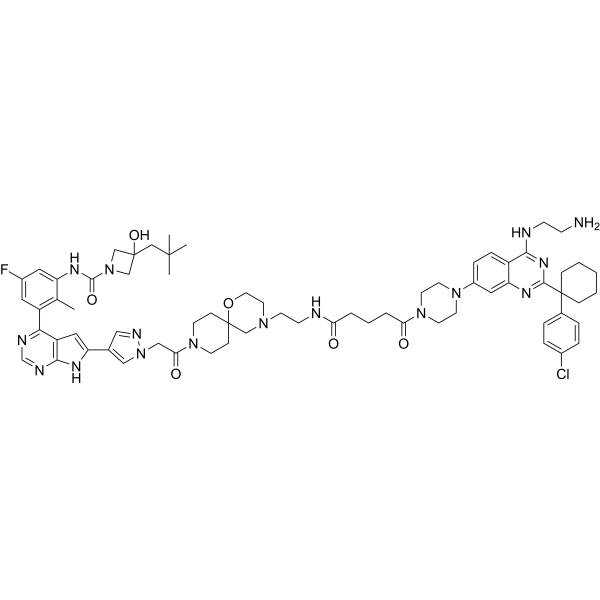
DBt-10 is a PROTAC degrader that targets and degrades BTK by recruiting DCAF1. It degrades BTK in TMD8 BTK-GFP/mCherry cells with a DC50 of 137 nM. DBt-10 induces CRL4DCAF1-dependent ubiquitination and proteasomal degradation of BTK, and retains BTK-degrading and antiproliferative activities in TMD8 cells that are resistant to CRBN-BTK PROTACs due to loss of CRBN expression. DBt-10 has a high survival window and exhibits extremely weak apoptosis-inducing effects on lymphoma cells. DBt-10 can be used for research on diffuse large B-cell lymphoma.
(Pink: Target protein ligand; Blue: Cereblon ligand (HY-149934); Black: linker).
商品は「研究用試薬」です。人や動物の医療用・臨床診断用・食品用の製品ではありません。
研究用途以外に使用した場合、当社は一切の責任を負いかねます。
- 分子式: C68H86ClFN16O6
- 分子量:1277.97
-
保管条件:
Please store the product under the recommended conditions in the Certificate of Analysis.

To place orders, for customer services and technical support, please contact: MedChemExpress USA
Tel: 609-228-6898 E-mail: [email protected] [email protected]


-
 生物活性
生物活性
-
化学情報
- プロトコル
- 純度とドキュメンテーション
- 参考文献
-
 Help & FAQs


PROTACs アイソフォーム固有の製品をすべて表示
More

生物活性
製品説明
IC50 & Target
[1]|
BTK 137 nM (DC50) |
DCAF1 136 nM (IC50) |
DCAF1 147 nM (Kd) |
体外実験
DBt-10 (1 μM; 1-24 h) reduces endogenous BTK protein in TMD8 cells, with obvious degradation occurring at approximately 6 h[1].
DBt-10 (5 µM; 6 h) selectively degrades BTK in TMD8 cells, and global proteomic analysis detects that it only causes extremely mild off-target downregulation of LIMK1[1].
The TR-FRET IC50 of DBt-10 binding to DCAF1 is 0.136 μM, and the IC50 decreases to 0.082 μM after the addition of BTK[1].
The SPR KD of the DBt-10/DCAF1 binary complex is 0.147 μM with a complex half-life of 175 s, whereas the apparent KD of the DCAF1/DBt-10/BTK ternary complex is 0.033 μM with a half-life of 429 s[1].
DBt-10 (24 h) degrades BTK-GFP in TMD8 BTK-GFP/mCherry cells, with a DC50 of 0.137 μM and a maximum BTK reduction level of 94%. Its cell viability GI50 is >25 μM, and the GI50/DC50 ratio is >182.6[1].
MedChemExpress (MCE) has not independently confirmed the accuracy of these methods. They are for reference only.
-
Cell Line:TMD8 cells
-
Concentration:1 µM
-
Incubation Time:1, 3, 6, 24 h
-
Result:Reduced endogenous BTK, with efficient degradation observed at approximately 6 h.
-
Cell Line:TMD8 cells
-
Concentration:0.625, 1.25, 2.5, 5 and 10 μM
-
Incubation Time:6 h
-
Result:Reduced endogenous BTK in a concentration-dependent manner, with significant degradation at 2.5 μM.
-
Cell Line:TMD8 cells
-
Concentration:Inhibitors: 1 μM for 30 min; DBt-10: 2.5 μM
-
Incubation Time:6 h after DBt-10 addition
-
Result:Rescued BTK degradation with Bortezomib (HY-10227).


化学情報
-
分子量 1277.97
-
分子式 C68H86ClFN16O6
-
SMILES
ClC(C=C1)=CC=C1C2(CCCCC2)C3=NC4=CC(N5CCN(C(CCCC(NCCN6CC7(CCN(C(CN8C=C(C9=CC(C(C%10=C(C)C(NC(N%11CC(CC(C)(C)C)(O)C%11)=O)=CC(F)=C%10)=NC=N%12)=C%12N9)C=N8)=O)CC7)OCC6)=O)=O)CC5)=CC=C4C(NCCN)=N3
-
輸送条件
Room temperature in continental US; may vary elsewhere.
-
保管条件
Please store the product under the recommended conditions in the Certificate of Analysis.


純度とドキュメンテーション
参考文献

Calculators
濃度 (開始) × 体積 (開始) = 濃度 (終了) × 体積 (終了)


DBt-10 関連分類
HY-156746 関連分類
 Powered by Bioz