



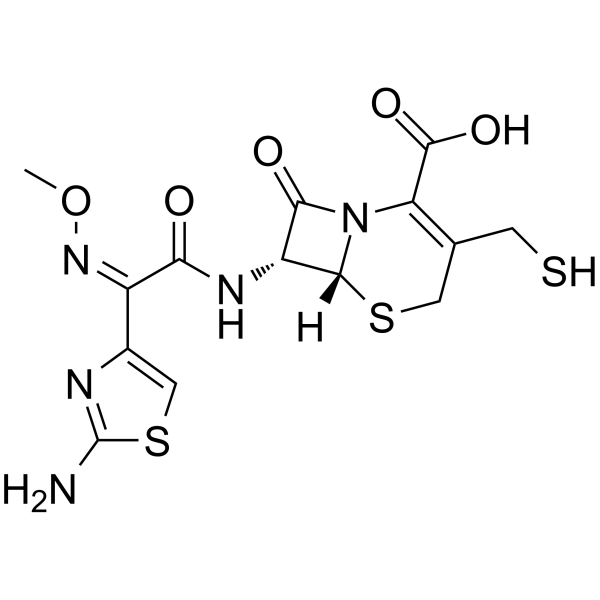
Desfuroylceftiofur

Based on 1 Customer Validation
Desfuroylceftiofur is an antibacterial agent and the active metabolite of Ceftiofur sodium (HY-B0898) with an intact β-lactam ring. Desfuroylceftiofur exhibits inhibitory activity against Gram-negative and Gram-positive pathogenic bacteria of veterinary interest in vitro. Desfuroylceftiofur can be used in the research of bovine respiratory disease, porcine respiratory disease, equine lymphadenitis, bovine mastitis, turkey colibacillosis, suppurative arthritis and respiratory infections.
For research use only. We do not sell to patients.
- Purity : 85.0%
- CAS No.: 120882-22-6
- Formula: C14H15N5O5S3
- Molecular Weight:429.49
-
Storage:
-20°C, sealed storage, away from moisture
* In solvent : -80°C, 6 months; -20°C, 1 month (sealed storage, away from moisture)

To place orders, for customer services and technical support, please contact: MedChemExpress USA
Tel: 609-228-6898 E-mail: [email protected] [email protected]


-
 Biological Activity
-
Chemical Information
-
Solvent & Solubility
- Protocols
- Purity & Documentation
- References
-
 Help & FAQs




Biological Activity
Description
In Vitro
Desfuroylceftiofur (≤0.0019-4.0 μg/mL; 24 h) exhibits high in vitro activity against Haemophilus somnus (MIC ≤0.0019 μg/mL) and equine streptococcal isolates (MIC90 = 0.03 μg/mL) in an agar dilution assay[3].
Desfuroylceftiofur (≤0.0039-4.0 μg/mL; 24 h) exhibits high in vitro activity against veterinary gram-negative bacterial isolates (MIC90 ≤2.0 μg/mL) and variable activity against gram-positive isolates, with highest potency against streptococci (MIC90 ≤0.5 μg/mL) and lowest potency against staphylococci (MIC90 = 4.0-8.0 μg/mL) in a microdilution assay[3].
MedChemExpress (MCE) has not independently confirmed the accuracy of these methods. They are for reference only.
In Vivo
MedChemExpress (MCE) has not independently confirmed the accuracy of these methods. They are for reference only.
-
Animal Model:Horses (3.2 years; 436.5 kg)[2]
-
Dosage:2 g per animal (regional intravenous perfusion); 2 g per animal (systemic intravenous injection)
-
Administration:regional intravenous perfusion (infused over 90-120 seconds); systemic intravenous injection (jugular vein)
-
Result:Reached a peak mean synovial fluid concentration of 397.7 μg/mL and remained above 1 μg/mL (MIC90) for more than 24 hours after regional intravenous perfusion.
Reached a peak mean synovial fluid concentration of 2.72 μg/mL and fell below 1 μg/mL between 8 and 12 hours post-injection after systemic intravenous injection.
Showed significantly lower plasma concentrations during tourniquet inflation period after regional perfusion compared to systemic injection; after tourniquet deflation, plasma concentrations followed a similar elimination pattern between the two routes.


Chemical Information
-
CAS No. 120882-22-6
-
Appearance Solid
-
Molecular Weight 429.49
-
Formula C14H15N5O5S3
-
Color Off-white to light yellow
-
SMILES
O=C(C(N12)=C(CS)CS[C@]2([H])[C@H](NC(/C(C3=CSC(N)=N3)=N\OC)=O)C1=O)O
-
Shipping
Room temperature in continental US; may vary elsewhere.
-
Storage
-20°C, sealed storage, away from moisture
* In solvent : -80°C, 6 months; -20°C, 1 month (sealed storage, away from moisture)


Solvent & Solubility
In Vitro:
Ethanol : 10 mg/mL (23.28 mM; Need ultrasonic and warming)
Please refer to the solubility information to select the appropriate solvent. Once prepared, please aliquot and store the solution to prevent product inactivation from repeated freeze-thaw cycles.
Storage method and period of stock solution: -80°C, 6 months; -20°C, 1 month (sealed storage, away from moisture). When stored at -80°C, please use it within 6 months. When stored at -20°C, please use it within 1 month.
Please refer to the solubility information to select the appropriate solvent. Once prepared, please aliquot and store the solution to prevent product inactivation from repeated freeze-thaw cycles.
Storage method and period of stock solution: -80°C, 6 months; -20°C, 1 month (sealed storage, away from moisture). When stored at -80°C, please use it within 6 months. When stored at -20°C, please use it within 1 month.
Concentration (start) × Volume (start) = Concentration (final) × Volume (final)


Purity & Documentation
-
Data Sheet (279 KB)
-
SDS (393 KB)
- English - EN (393 KB)
- Français - FR (393 KB)
- Deutsch - DE (393 KB)
- Norwegian - NO (393 KB)
- Español - ES (393 KB)
- Swedish - SV (393 KB)
- Italian - IT (393 KB)
- Korean - KR (393 KB)
- Portuguese - PT (393 KB)
-
Handling Instructions (2659 KB)
References


Complete Stock Solution Preparation Table
Please refer to the solubility information to select the appropriate solvent. Once prepared, please aliquot and store the solution to prevent product inactivation from repeated freeze-thaw cycles.
Storage method and period of stock solution: -80°C, 6 months; -20°C, 1 month (sealed storage, away from moisture). When stored at -80°C, please use it within 6 months. When stored at -20°C, please use it within 1 month.
| Optional Solvent | Concentration Solvent Mass | 1 mg | 5 mg | 10 mg | 25 mg |
|---|---|---|---|---|---|
| Ethanol | 1 mM | 2.3283 mL | 11.6417 mL | 23.2834 mL | 58.2086 mL |
| 5 mM | 0.4657 mL | 2.3283 mL | 4.6567 mL | 11.6417 mL | |
| 10 mM | 0.2328 mL | 1.1642 mL | 2.3283 mL | 5.8209 mL | |
| 15 mM | 0.1552 mL | 0.7761 mL | 1.5522 mL | 3.8806 mL | |
| 20 mM | 0.1164 mL | 0.5821 mL | 1.1642 mL | 2.9104 mL |


Desfuroylceftiofur Related Classifications
HY-126818 Related Classifications
 Powered by Bioz
Keywords
- Desfuroylceftiofur
- 120882-22-6
- Bacterial
- Drug Metabolite
- Streptococcus equi ssp. zooepidemicus
- equine lymphadenitis
- gram-positive bacterial pathogens
- bovine mastitis
- swine respiratory disease
- gram-negative bacterial pathogens
- Streptococcus equi ssp. equi
- turkey colibacillosis
- Haemophilus somnus
- bovine respiratory disease
- Inhibitor
- inhibitor
- inhibit