



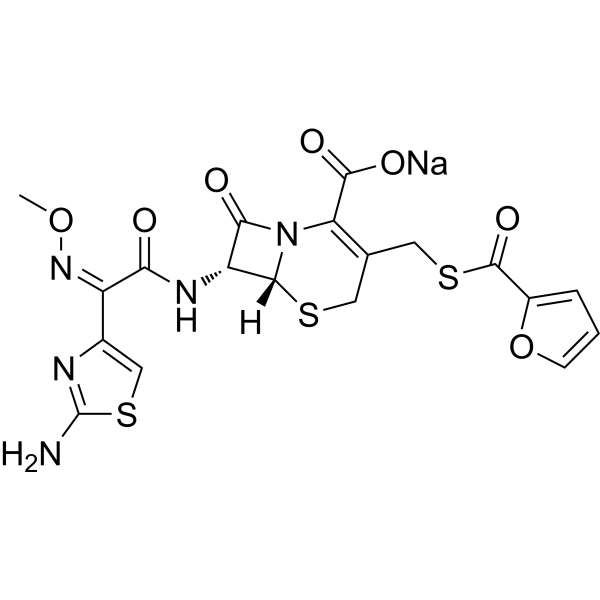
Ceftiofur sodium
Based on 6 publication(s) in Google Scholar
Ceftiofur sodium is a cell wall synthesis inhibitor that targets bacterial penicillin-binding proteins (PBPs) and has anti-inflammatory effects in endotoxemia. Ceftiofur sodium exerts bactericidal effects by inhibiting the synthesis of bacterial cell wall peptidoglycan, leading to bacterial cell lysis. Ceftiofur sodium also inhibits the activation of NF-κB and MAPKs, thereby reducing the secretion of pro-inflammatory cytokines such as TNF-α, IL-1β, and IL-6.
For research use only. We do not sell to patients.
- Purity : 98.02%
- CAS No.: 104010-37-9
- Formula: C19H16N5NaO7S3
- Molecular Weight:545.54
-
Storage:
4°C, sealed storage, away from moisture
* In solvent : -80°C, 6 months; -20°C, 1 month (sealed storage, away from moisture)

To place orders, for customer services and technical support, please contact: MedChemExpress USA
Tel: 609-228-6898 E-mail: [email protected] [email protected]


-
 Biological Activity
-
Chemical Information
-
Solvent & Solubility
- Protocols
- Purity & Documentation
- References
-
 Help & FAQs





Publications Citing Use of MedChemExpress (MCE) Ceftiofur sodium
MoreAll Antibiotic Isoforms
More

Biological Activity
Description
IC50 & Target
|
β-lactam |
In Vitro
Ceftiofur (1, 5, 10 mg/L; pretreatment for 1 h+LPS stimulation for 12 h) sodium can significantly inhibit the secretion of TNF-α, IL-1β, and IL-6 in RAW 264.7 cells, but has no significant effect on the secretion of IL-10[2].
Ceftiofur sodium (1, 5, 10 mg/L; pretreatment for 1 h+LPS stimulation for 30 min) can significantly inhibit the phosphorylation of ERK, JNK, and p38 and the nuclear translocation of NF-κB p65 in RAW 264.7 cells[2].
MedChemExpress (MCE) has not independently confirmed the accuracy of these methods. They are for reference only.
-
Cell Line:RAW 264.7 cells
-
Concentration:1, 5, 10 mg/L
-
Incubation Time:1 h pretreatment with Ceftiofur followed by 30 min LPS stimulation
-
Result:Dramatically decreased the phosphorylation levels of ERK, JNK, and p38 in Ceftiofur-treated cells compared to the LPS-treated control cells, while the total protein levels of MAPKs showed no change.
-
Cell Line:RAW 264.7 cells
-
Concentration:1, 5, 10 mg/L
-
Incubation Time:1 h pretreatment with Ceftiofur followed by 1 h LPS stimulation
-
Result:Strongly inhibited nuclear translocation of NF-κB p65 induced by LPS in a dose-dependent manner in Ceftiofur-pretreated cells.
In Vivo
MedChemExpress (MCE) has not independently confirmed the accuracy of these methods. They are for reference only.
-
Animal Model:Female C57BL/6 mice (18-20 g, 6-8 weeks old) with LPS-induced endotoxemia model[3]
-
Dosage:20 mg/kg Ceftiofur (dissolved in saline)
-
Administration:Subcutaneous injection, single dose, administered 1 h before or 0, 1, 4, 12 h after intraperitoneal injection of 30 mg/kg LPS.
-
Result:Pretreatment with 20 mg/kg Ceftiofur 1 h before LPS challenge significantly increased the survival rate of mice (70% survival at 144 h vs. 0% in LPS control group).
When administered 0 or 1 h after LPS injection, Ceftiofur still provided significant protection, but protection decreased when delayed to 4 h and was absent at 12 h.
Plasma levels of TNF-α, IL-1β, and IL-6 in Ceftiofur-pretreated mice were significantly lower than those in the LPS control group at specific time points (1 h for TNF-α, 3 h for IL-6, 12 h for IL-1β), while IL-10 levels were significantly higher at 1 h after LPS challenge.


Chemical Information
-
CAS No. 104010-37-9
-
Appearance Solid
-
Molecular Weight 545.54
-
Formula C19H16N5NaO7S3
-
Color White to light yellow
-
SMILES
O=C(O[Na])C(N12)=C(CSC(C3=CC=CO3)=O)CS[C@]2([H])[C@H](NC(/C(C4=CSC(N)=N4)=N\OC)=O)C1=O
-
Synonyms
sodium ceftiofur
-
Shipping
Room temperature in continental US; may vary elsewhere.
-
Storage
4°C, sealed storage, away from moisture
* In solvent : -80°C, 6 months; -20°C, 1 month (sealed storage, away from moisture)


Publications (6)
-
Journal Impact Factor
-
Most Recent
-
Nat Commun
Selective inhibition of cancer cell self-renewal through a Quisinostat-histone H1.0 axis. [Abstract]2020 Apr 14;11(1):1792. PMID: 32286289 -
Mol Syst Biol
2022 Sep;18(9):e11081. PMID: 36065847 -
-
Microorganisms
Isolation, Antimicrobial Susceptibility, and Genotypes of Three Pasteurellaeae Species Prevalent on Pig Farms in China Between 2021 and 2023. [Abstract]2025 Apr 18;13(4):938. PMID: 40284774 -
Vet Microbiol
Discovery of the tigecycline resistance gene cluster tmexCD3-toprJ1 in Pasteurella multocida strains isolated from pigs in China. [Abstract]2024 May:292:110046. PMID: 38471428 -


Solvent & Solubility
In Vitro:
DMSO : 50 mg/mL (91.65 mM; Need ultrasonic; Hygroscopic DMSO has a significant impact on the solubility of product, please use newly opened DMSO)
Please refer to the solubility information to select the appropriate solvent. Once prepared, please aliquot and store the solution to prevent product inactivation from repeated freeze-thaw cycles.
Storage method and period of stock solution: -80°C, 6 months; -20°C, 1 month (sealed storage, away from moisture). When stored at -80°C, please use it within 6 months. When stored at -20°C, please use it within 1 month.
Please refer to the solubility information to select the appropriate solvent. Once prepared, please aliquot and store the solution to prevent product inactivation from repeated freeze-thaw cycles.
Storage method and period of stock solution: -80°C, 6 months; -20°C, 1 month (sealed storage, away from moisture). When stored at -80°C, please use it within 6 months. When stored at -20°C, please use it within 1 month.
Concentration (start) × Volume (start) = Concentration (final) × Volume (final)
In Vivo:
Select the appropriate dissolution method based on your experimental animal and administration route.
- For the following dissolution methods, please ensure to first prepare a clear stock solution using an In Vitro approach and then sequentially add co-solvents:
- To ensure reliable experimental results, the clarified stock solution can be appropriately stored based on storage conditions. As for the working solution for In Vivo experiments, it is recommended to prepare freshly and use it on the same day.
- The percentages shown for the solvents indicate their volumetric ratio in the final prepared solution. If precipitation or phase separation occurs during preparation, heat and/or sonication can be used to aid dissolution.
Add each solvent one by one: 10% DMSO 40% PEG300 5% Tween-80 45% Saline
Solubility: 1.67 mg/mL (3.06 mM); Clear solution; Need ultrasonic
This protocol yields a clear solution of 1.67 mg/mL.
Taking 1 mL working solution as an example, add 100 μL DMSO stock solution (16.7 mg/mL) to 400 μL PEG300, and mix evenly; then add 50 μL Tween-80 and mix evenly; then add 450 μL Saline to adjust the volume to 1 mL.
Preparation of Saline: Dissolve 0.9 g sodium chloride in ddH₂O and dilute to 100 mL to obtain a clear Saline solution.
Add each solvent one by one: 10% DMSO 90% (20% SBE-β-CD in Saline)
Solubility: 1.67 mg/mL (3.06 mM); Clear solution; Need ultrasonic
This protocol yields a clear solution of 1.67 mg/mL.
Taking 1 mL working solution as an example, add 100 μL DMSO stock solution (16.7 mg/mL) to 900 μL 20% SBE-β-CD in Saline, and mix evenly.
Preparation of 20% SBE-β-CD in Saline (4°C, storage for one week): 2 g SBE-β-CD powder is dissolved in 10 mL Saline, completely dissolve until clear.
In Vivo Dissolution Calculator
Please enter the basic information of animal experiments:
-
-
-
-
Recommended: Prepare an additional quantity of animals to account for potential losses during experiments.
Please enter your animal formula composition:
-
%DMSO +
Recommended: Keep the proportion of DMSO in working solution below 2% if your animal is weak.
-
%+
-
+%Tween-80 + +
-
%Saline +
The co-solvents required include: DMSO, . All of co-solvents are available by MedChemExpress (MCE). , Tween 80. All of co-solvents are available by MedChemExpress (MCE).
Working solution concentration: 0.22 mg/mL
Method for preparing stock solution: mg drug dissolved in μL DMSO. Stock solution concentration: mg/mL. * In solvent : -80°C, 6 months; -20°C, 1 month (sealed storage, away from moisture)
1. Take μL DMSO stock solution;
2. Add μL .
μL , mix evenly;
3. Then add μL Tween 80, mix evenly;
4. Then add μL
Please ensure that the stock solution in the first step is dissolved to a clear state, and add co-solvents in sequence. You can use ultrasonic heating (ultrasonic cleaner, recommended frequency 20-40 kHz), vortexing, etc. to assist dissolution.


Purity & Documentation
-
Data Sheet (282 KB)
-
SDS (419 KB)
- English - EN (419 KB)
- Français - FR (419 KB)
- Deutsch - DE (419 KB)
- Norwegian - NO (419 KB)
- Español - ES (419 KB)
- Swedish - SV (419 KB)
- Italian - IT (419 KB)
- Korean - KR (419 KB)
- Portuguese - PT (419 KB)
-
Handling Instructions (2659 KB)
References
[1]. Salmon SA, et al. In vitro activity of Ceftiofur and its primary metabolite, desfuroylCeftiofur, against organisms of veterinary importance. J Vet Diagn Invest. 1996 Jul;8(3):332-6. [Content Brief]
[2]. Ci X, et al. Ceftiofur impairs pro-inflammatory cytokine secretion through the inhibition of the activation of NF-kappaB and MAPK. Biochem Biophys Res Commun. 2008 Jul 18;372(1):73-7. [Content Brief]
[3]. Ci X, et al. Ceftiofur regulates LPS-induced production of cytokines and improves LPS-induced survival rate in mice. Inflammation. 2008 Dec;31(6):422-7. [Content Brief]


Complete Stock Solution Preparation Table
Please refer to the solubility information to select the appropriate solvent. Once prepared, please aliquot and store the solution to prevent product inactivation from repeated freeze-thaw cycles.
Storage method and period of stock solution: -80°C, 6 months; -20°C, 1 month (sealed storage, away from moisture). When stored at -80°C, please use it within 6 months. When stored at -20°C, please use it within 1 month.
| Optional Solvent | Concentration Solvent Mass | 1 mg | 5 mg | 10 mg | 25 mg |
|---|---|---|---|---|---|
| DMSO | 1 mM | 1.8330 mL | 9.1652 mL | 18.3305 mL | 45.8262 mL |
| 5 mM | 0.3666 mL | 1.8330 mL | 3.6661 mL | 9.1652 mL | |
| 10 mM | 0.1833 mL | 0.9165 mL | 1.8330 mL | 4.5826 mL | |
| 15 mM | 0.1222 mL | 0.6110 mL | 1.2220 mL | 3.0551 mL | |
| 20 mM | 0.0917 mL | 0.4583 mL | 0.9165 mL | 2.2913 mL | |
| 25 mM | 0.0733 mL | 0.3666 mL | 0.7332 mL | 1.8330 mL | |
| 30 mM | 0.0611 mL | 0.3055 mL | 0.6110 mL | 1.5275 mL | |
| 40 mM | 0.0458 mL | 0.2291 mL | 0.4583 mL | 1.1457 mL | |
| 50 mM | 0.0367 mL | 0.1833 mL | 0.3666 mL | 0.9165 mL | |
| 60 mM | 0.0306 mL | 0.1528 mL | 0.3055 mL | 0.7638 mL | |
| 80 mM | 0.0229 mL | 0.1146 mL | 0.2291 mL | 0.5728 mL |


Ceftiofur sodium Related Classifications
HY-B0898 Related Classifications
 Powered by Bioz