



Diquafosol
Based on 5 publication(s) in Google Scholar
Diquafosol (INS365 free base) is a potent P2Y2 agonist. Diquafosol nhibits apoptosis and decreases ROS generation. Diquafosol has the potential for the research of dry eye.
For research use only. We do not sell to patients.
- CAS No.: 59985-21-6
- Formula: C18H26N4O23P4
- Molecular Weight:790.31
-
Storage:
Please store the product under the recommended conditions in the Certificate of Analysis.


To place orders, for customer services and technical support, please contact: MedChemExpress USA
Tel: 609-228-6898 E-mail: [email protected] [email protected]


-
 Biological Activity
-
Chemical Information
- Protocols
- Purity & Documentation
- References
-
 Help & FAQs


Publications Citing Use of MedChemExpress (MCE) Diquafosol
MoreAll P2Y Receptor Isoforms
More

Biological Activity
Description
IC50 & Target
[1]|
P2Y2 Receptor |
In Vitro
Diquafosol (3%; 24 h) inhibits apoptosis and decreases ROS generation in dry-conditioned hCECs[1].
Diquafosol (3%; 24 h) increases the protein expression of phospho-Erk1/2, phospho-Akt, and phospho-p90RSK in hCECs[1].
MedChemExpress (MCE) has not independently confirmed the accuracy of these methods. They are for reference only.
-
Cell Line:human corneal epithelial cells (hCECs)
-
Concentration:3% (diluted at 1:100)
-
Incubation Time:24 h
-
Result:Increased the protein expression of phospho-Erk1/2, phospho-Akt, and phospho-p90RSK.
In Vivo
MedChemExpress (MCE) has not independently confirmed the accuracy of these methods. They are for reference only.
-
Animal Model:6 weeks, 160-180 g Wistar female rats (dry eye model)[1]
-
Dosage:ophthalmic solution 3%
-
Administration:eyedrop, four times daily (8, 12 AM; 4, 8 PM) for 28 days
-
Result:Increased the expression of phospho-Erk1/2, phospho-Akt, and phospho-p90RSK, inhibits apoptosis, decreased the IL-1β, TNF-α expression.


Chemical Information
-
CAS No. 59985-21-6
-
Molecular Weight 790.31
-
Formula C18H26N4O23P4
-
SMILES
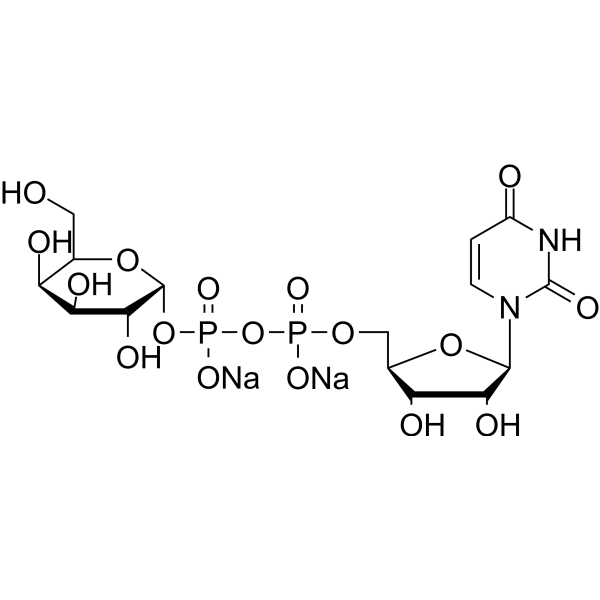
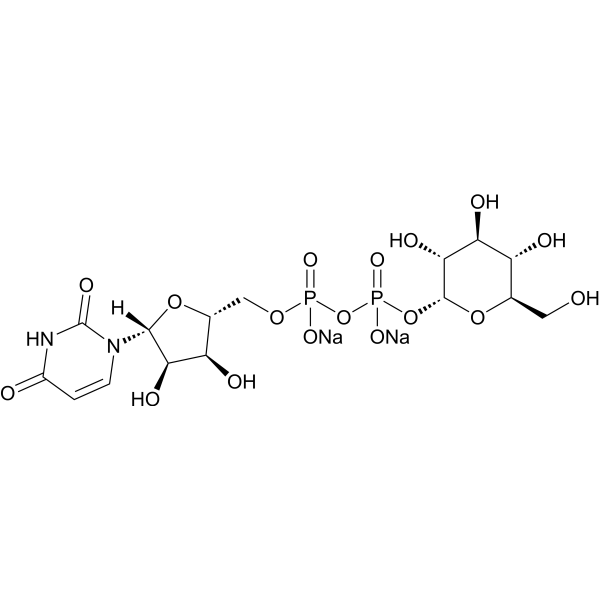
O[C@H]1[C@@H](O)[C@H](N(C(N2)=O)C=CC2=O)O[C@@H]1COP(O)(OP(OP(OP(OC[C@@H]3[C@@H](O)[C@@H](O)[C@H](N4C(NC(C=C4)=O)=O)O3)(O)=O)(O)=O)(O)=O)=O
-
Synonyms
INS365 free base
-
Shipping
Room temperature in continental US; may vary elsewhere.
-
Storage
Please store the product under the recommended conditions in the Certificate of Analysis.


Publications (5)
-
Journal Impact Factor
-
Most Recent
-
Cell Prolif
Establishment of human corneal epithelial organoids for ex vivo modelling dry eye disease. [Abstract]2024 Nov;57(11):e13704. PMID: 38961590 -
Commun Biol
2023 Aug 29;6(1):889. PMID: 37644178 -
Int J Mol Sci
2022 Jul 17;23(14):7870. PMID: 35887219 -
-


Purity & Documentation
References

Calculators
Concentration (start) × Volume (start) = Concentration (final) × Volume (final)


Diquafosol Related Classifications
HY-B0606A Related Classifications
 Powered by Bioz