



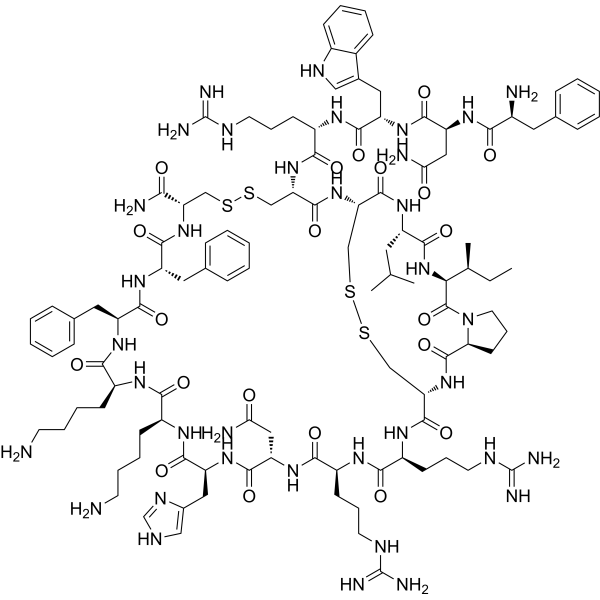
NMB-1
NMB-1 is a cone peptide analog and a mechanosensitive current inhibitor. NMB-1 selectively inhibits sustained mechanically activated currents in sensory neurons, with an IC50 of 1 μM. NMB-1 inhibits mechanical pain. NMB-1 selectively raises high-threshold pressure nociceptive thresholds in rats. NMB-1 can be used in research on mechanically evoked pain and auditory dysfunction.
For research use only. We do not sell to patients.
- CAS No.: 2843557-76-4
- Formula: C111H164N36O21S4
- Molecular Weight:2466.98
-
Storage:
Please store the product under the recommended conditions in the Certificate of Analysis.

To place orders, for customer services and technical support, please contact: MedChemExpress USA
Tel: 609-228-6898 E-mail: [email protected] [email protected]


-
 Biological Activity
-
Chemical Information
- Purity & Documentation
- References
-
 Help & FAQs




Biological Activity
Description
In Vitro
NMB-1 (5 µM; 3.5 min) is analyzed by pull-down combined with LC-MS/MS, and annexin A6 is the most abundant candidate among the binding proteins shared by DRG neurons and ND-C cells, with a cumulative peptide match of 36[1].
NMB-1 (2 µM; overnight) binds to WT mouse DRG tissue sections, whereas binding to Anxa6 KO DRG tissue is significantly reduced, with residual binding to other membrane proteins[1].
NMB-1 (0.15-15 μM) selectively blocks slowly adapting mechanically activated currents in cultured rat DRG neurons, with an apparent IC50 of 1.0 μM[2].
NMB-1 (2 μM; 2 min) selectively binds peripherin-positive small-diameter cultured adult rat DRG neurons[2].
NMB-1 (5 μM) inhibits mechanotransduction-dependent rapid FM1-43 loading in rat cochlear inner and outer hair cells[2].
NMB-1 (2 μM) does not inhibit mustard oil-induced TRPA1 currents in transfected CHO-K1 cells[2].
NMB-1 (0.1-10 μM; 600 ms) inhibits TTN3-mediated slowly adapting MA currents in HEK293T cells with an IC50 of 0.92 μM[3].
NMB-1 (10 μM; 600 ms) does not inhibit Piezo1- or Piezo2-mediated MA currents in HEK293T cells, supporting selectivity for TTN3[3].
NMB-1 (10 μM; 600 ms) inhibition of TTN3 depends on the negative charge of Glu126[3].
MedChemExpress (MCE) has not independently confirmed the accuracy of these methods. They are for reference only.
In Vivo
MedChemExpress (MCE) has not independently confirmed the accuracy of these methods. They are for reference only.
-
Animal Model:Sprague-Dawley (male, 4-5 weeks, 120-150 g)[2]
-
Dosage:20 nMoles; 2 × 20 nMoles
-
Administration:intradermal injection into the plantar surface of the paw (von Frey); intradermal injection on the plantar and dorsal surfaces of the paw (Randall-Selitto)
-
Result:In the von Frey test, no significant effect was observed on paw withdrawal thresholds.
In the Randall-Selitto test, the pain threshold increased by 41.1%.
In the Hargreaves test, no activity was observed.


Chemical Information
-
CAS No. 2843557-76-4
-
Molecular Weight 2466.98
-
Formula C111H164N36O21S4
-
Sequence
Phe-Asn-Trp-Arg-Cys-Cys-Leu-Ile-Pro-Cys-Arg-Arg-Asn-His-Lys-Lys-Phe-Phe-Cys-NH2 (Disulfide bridge: Cys5-Cys19, Cys6-Cys10)
-
Sequence Shortening
FNWRCCLIPCRRNHKKFFC-NH2 (Disulfide bridge: Cys5-Cys19, Cys6-Cys10)
-
Shipping
Room temperature in continental US; may vary elsewhere.
-
Storage
Please store the product under the recommended conditions in the Certificate of Analysis.


Purity & Documentation
-
Data Sheet (314 KB)
-
SDS (252 KB)
- Français - FR (252 KB)
- Deutsch - DE (252 KB)
- Norwegian - NO (252 KB)
- Español - ES (252 KB)
- Swedish - SV (252 KB)
- Italian - IT (252 KB)
- Korean - KR (252 KB)
- Portuguese - PT (252 KB)
-
Handling Instructions (2659 KB)
References
[1]. Raouf R, et al. Inhibition of somatosensory mechanotransduction by annexin A6. Science signaling. 2018 Jun 19;11(535):eaao2060. [Content Brief]
[2]. Drew LJ, et al. High-threshold mechanosensitive ion channels blocked by a novel conopeptide mediate pressure-evoked pain. PloS one. 2007 Jun 13;2(6):e515. [Content Brief]

Calculators
Concentration (start) × Volume (start) = Concentration (final) × Volume (final)


NMB-1 Related Classifications
HY-P5163 Related Classifications
 Powered by Bioz
Keywords
- NMB-1
- 2843557-76-4
- NMB1
- NMB 1
- Biochemical Assay Reagents
- DRG mechanically activated currents
- TTN3
- annexin-A6
- cochlear mechanotransduction
- hair-cell rapid styryl dye loading
- mechanically evoked pain
- mechanosensitive-current inhibitor
- noxious mechanical behavior
- peripherin-positive sensory neurons
- sensory-neuron currents
- Inhibitor
- inhibitor
- inhibit