



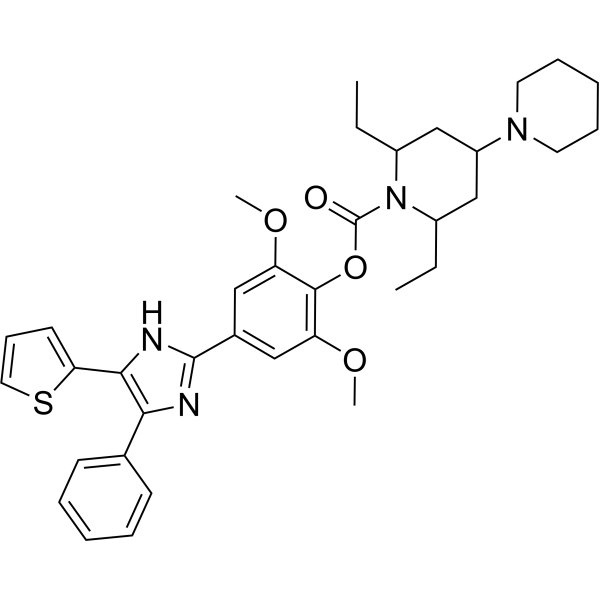
DPTIP-prodrug 18
DPTIP-proagent 18 (P18) is a orally active and brain-penetrable proagent of DPTIP (HY-131002). DPTIP-proagent 18 is a potent nSMase2 inhibitor. DPTIP-proagent 18 significantly inhibits IL-1β-induced EV (extracellular vesicle) release by inhibition of nSMase2 (neutral sphingomyelinase-2) activity. DPTIP-proagent 18 can be used for brain injury research.
For research use only. We do not sell to patients.
- CAS No.: 2881068-33-1
- Formula: C36H44N4O4S
- Molecular Weight:628.82
-
Storage:
Please store the product under the recommended conditions in the Certificate of Analysis.

To place orders, for customer services and technical support, please contact: MedChemExpress USA
Tel: 609-228-6898 E-mail: [email protected] [email protected]


-
 Biological Activity
-
Chemical Information
- Protocols
- Purity & Documentation
- References
-
 Help & FAQs


All Phospholipase Isoforms
More

Biological Activity
Description
IC50 & Target
nSMase2[1]
In Vitro
DPTIP-prodrug 18 is metabolically stable with >75% intact prodrug remaining after 1 h of incubation at 37 °C[1].
MedChemExpress (MCE) has not independently confirmed the accuracy of these methods. They are for reference only. Further protocols information, click here.
In Vivo
DPTIP-prodrug 18 shows significant inhibition of nSMase2 activity and IL-1β-induced EV release in mice[1].
MedChemExpress (MCE) has not independently confirmed the accuracy of these methods. They are for reference only.
-
Animal Model:CES1–/– mice[1]
-
Dosage:10 mg/kg DPTIP equivalent
-
Administration:Orally, once (Pharmacokinetic Analysis)
-
Result:Exhibited >fourfold higher plasma (AUC0-t=1047 pmol·h/mL) and brain exposures (AUC0-t=247 pmol·h/g) versus DPTIP and a significant enhancement of DPTIP half-life (2 h vs ~0.5 h).
-
Animal Model:Interleukin-1β-injected mice (a mouse model of brain injury)[1]
-
Dosage:0, 3 and 10 mg/kg (DPTIP equivalent)
-
Administration:Orally, once
-
Result:Significantly inhibited the release of brain-derived GFP+ EVs into the blood at both 3 and 10 mg/kg (DPTIP equivalent dose).
Clinical Trial
| NCT Number | Sponsor | Condition | Start Date |
Phase

|
|---|---|---|---|---|
| NCT01329991 | Plexxikon| | 2011-05 | PHASE1 |


Chemical Information
-
CAS No. 2881068-33-1
-
Molecular Weight 628.82
-
Formula C36H44N4O4S
-
SMILES
COC1=CC(C2=NC(C3=CC=CC=C3)=C(C4=CC=CS4)N2)=CC(OC)=C1OC(N5C(CC)CC(CC5CC)N6CCCCC6)=O
-
Synonyms
P18
-
Shipping
Room temperature in continental US; may vary elsewhere.
-
Storage
Please store the product under the recommended conditions in the Certificate of Analysis.

Protocols
-
Pyroptosis Solutions
Pyroptosis is a lytic inflammatory cell-death pathway executed by gasdermin pores, most classically through inflammasome-mediated activation of caspase-1, cleavage of gasdermin D, membrane pore formation, LDH release, and secretion of IL-1β and IL-18. The canonical pathway is commonly modeled by priming cells with an inflammatory signal such as LPS to induce pro-IL-1β and inflammasome components, followed by an activation signal such as ATP or nigericin to activate NLRP3, ASC speck formation, caspase-1 cleavage, GSDMD cleavage, cytokine release, and pyroptotic membrane rupture. The non-canonical pathway is triggered when cytosolic LPS activates mouse caspase-11 or human caspase-4/5, leading to GSDMD cleavage and pyroptosis, and this can secondarily activate NLRP3-dependent IL-1β release. Pyroptosis is linked to inflammatory injury, infection, cancer, liver disease, ocular disease, placental inflammation, and other disease phenotypes, but unresolved questions include which gasdermin fam


Purity & Documentation
References

Calculators
Concentration (start) × Volume (start) = Concentration (final) × Volume (final)


DPTIP-prodrug 18 Related Classifications
HY-149025 Related Classifications
 Powered by Bioz