



EA-230

Based on 1 Customer Validation
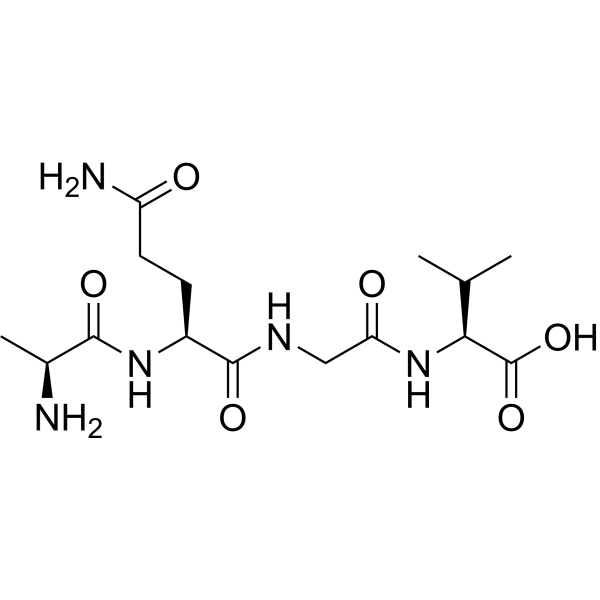
EA-230 is a synthetic oligopeptide originally derived from beta-human chorionic gonadotropin (beta-hCG) lysates. EA-230 has anti-inflammatory effects and can be used for the research of sepsis.
For research use only. We do not sell to patients.
- Purity : 99.27%
- CAS No.: 503844-09-5
- Formula: C15H27N5O6
- Molecular Weight:373.40
-
Storage:
Sealed storage, away from moisture.
Powder -80°C, 2 years , -20°C, 1 year* In solvent : -80°C, 6 months; -20°C, 1 month (sealed storage, away from moisture)

To place orders, for customer services and technical support, please contact: MedChemExpress USA
Tel: 609-228-6898 E-mail: [email protected] [email protected]


-
 Biological Activity
-
Chemical Information
-
Solvent & Solubility
- Protocols
- Purity & Documentation
- References
-
 Help & FAQs




Biological Activity
Description
In Vivo
MedChemExpress (MCE) has not independently confirmed the accuracy of these methods. They are for reference only.
-
Animal Model:Male C57Bl/6 mice, ischemia reperfusion injury model[1]
-
Dosage:20, 30, 40 or 50 mg/kg
-
Administration:Intraperitoneal injection, twice daily for four consecutive days
-
Result:Improved survival markedly. With doses between 30–50 mg/kg survival reached 56–62%, the low dose treatment with 20 mg/kg did not have a beneficial effect. Significantly increased renal blood flow (RBF), attenuated CTGF up-regulation, enhanced tubular epithelial cell regeneration and attenuated TGF-beta activation.
Clinical Trial
| NCT Number | Sponsor | Condition | Start Date |
Phase

|
|---|---|---|---|---|
| NCT01329991 | 2011-05 | PHASE1 |


Chemical Information
-
CAS No. 503844-09-5
-
Appearance Solid
-
Molecular Weight 373.40
-
Formula C15H27N5O6
-
Color White to off-white
-
Sequence Shortening
AQGV
-
Shipping
Room temperature in continental US; may vary elsewhere.
-
Storage
Sealed storage, away from moisture
Powder -80°C 2 years -20°C 1 year * In solvent : -80°C, 6 months; -20°C, 1 month (sealed storage, away from moisture)


Solvent & Solubility
In Vitro:
DMSO : 125 mg/mL (334.76 mM; Need ultrasonic; Hygroscopic DMSO has a significant impact on the solubility of product, please use newly opened DMSO)
Please refer to the solubility information to select the appropriate solvent. Once prepared, please aliquot and store the solution to prevent product inactivation from repeated freeze-thaw cycles.
Storage method and period of stock solution: -80°C, 6 months; -20°C, 1 month (sealed storage, away from moisture). When stored at -80°C, please use it within 6 months. When stored at -20°C, please use it within 1 month.
Please refer to the solubility information to select the appropriate solvent. Once prepared, please aliquot and store the solution to prevent product inactivation from repeated freeze-thaw cycles.
Storage method and period of stock solution: -80°C, 6 months; -20°C, 1 month (sealed storage, away from moisture). When stored at -80°C, please use it within 6 months. When stored at -20°C, please use it within 1 month.
Concentration (start) × Volume (start) = Concentration (final) × Volume (final)


Purity & Documentation
-
Data Sheet (273 KB)
-
SDS (252 KB)
- English - EN (252 KB)
- Français - FR (252 KB)
- Deutsch - DE (252 KB)
- Norwegian - NO (252 KB)
- Español - ES (252 KB)
- Swedish - SV (252 KB)
- Italian - IT (252 KB)
- Korean - KR (252 KB)
- Portuguese - PT (252 KB)
-
Handling Instructions (2659 KB)
References


Complete Stock Solution Preparation Table
Please refer to the solubility information to select the appropriate solvent. Once prepared, please aliquot and store the solution to prevent product inactivation from repeated freeze-thaw cycles.
Storage method and period of stock solution: -80°C, 6 months; -20°C, 1 month (sealed storage, away from moisture). When stored at -80°C, please use it within 6 months. When stored at -20°C, please use it within 1 month.
| Optional Solvent | Concentration Solvent Mass | 1 mg | 5 mg | 10 mg | 25 mg |
|---|---|---|---|---|---|
| DMSO | 1 mM | 2.6781 mL | 13.3905 mL | 26.7809 mL | 66.9523 mL |
| 5 mM | 0.5356 mL | 2.6781 mL | 5.3562 mL | 13.3905 mL | |
| 10 mM | 0.2678 mL | 1.3390 mL | 2.6781 mL | 6.6952 mL | |
| 15 mM | 0.1785 mL | 0.8927 mL | 1.7854 mL | 4.4635 mL | |
| 20 mM | 0.1339 mL | 0.6695 mL | 1.3390 mL | 3.3476 mL | |
| 25 mM | 0.1071 mL | 0.5356 mL | 1.0712 mL | 2.6781 mL | |
| 30 mM | 0.0893 mL | 0.4463 mL | 0.8927 mL | 2.2317 mL | |
| 40 mM | 0.0670 mL | 0.3348 mL | 0.6695 mL | 1.6738 mL | |
| 50 mM | 0.0536 mL | 0.2678 mL | 0.5356 mL | 1.3390 mL | |
| 60 mM | 0.0446 mL | 0.2232 mL | 0.4463 mL | 1.1159 mL | |
| 80 mM | 0.0335 mL | 0.1674 mL | 0.3348 mL | 0.8369 mL | |
| 100 mM | 0.0268 mL | 0.1339 mL | 0.2678 mL | 0.6695 mL |


EA-230 Related Classifications
HY-106279 Related Classifications
 Powered by Bioz