



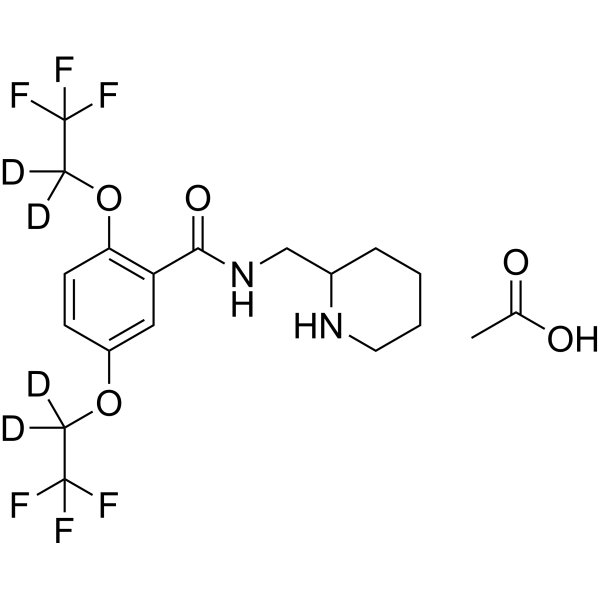
Flecainide-d4 acetate

Based on 1 Customer Validation
Flecainide-d4 (acetate) is the deuterium labeled Flecainide acetate. Flecainide acetate (R-818) is a class 1C antiarrhythmic agent especially used for the management of supraventricular arrhythmia; works by blocking the Nav1.5 sodium channel in the heart, causing prolongation of the cardiac action potential.
For research use only. We do not sell to patients.
- Purity : 99.72%
- CAS No.: 1276197-21-7
- Formula: C19H20D4F6N2O5
- Molecular Weight:478.42
-
Storage:
4°C, sealed storage, away from moisture
* In solvent : -80°C, 6 months; -20°C, 1 month (sealed storage, away from moisture)

To place orders, for customer services and technical support, please contact: MedChemExpress USA
Tel: 609-228-6898 E-mail: [email protected] [email protected]


-
 Biological Activity
-
Chemical Information
-
Solvent & Solubility
- Protocols
- Purity & Documentation
- References
-
 Help & FAQs




Biological Activity
Description
In Vitro
Stable heavy isotopes of hydrogen, carbon, and other elements have been incorporated into drug molecules, largely as tracers for quantitation during the drug development process. Deuteration has gained attention because of its potential to affect the pharmacokinetic and metabolic profiles of drugs[1].
MedChemExpress (MCE) has not independently confirmed the accuracy of these methods. They are for reference only.
Application
1. This compound can be used as a tracer
2. This compound can be used as an internal standard for quantitative analysis by NMR, GC-MS, or LC-MS.


Chemical Information
-
CAS No. 1276197-21-7
-
Unlabeled CAS 54143-56-5
-
Appearance Solid
-
Molecular Weight 478.42
-
Formula C19H20D4F6N2O5
-
Color White to off-white
-
SMILES
CC(O)=O.O=C(C1=C(C=CC(OC([2H])([2H])C(F)(F)F)=C1)OC([2H])([2H])C(F)(F)F)NCC2CCCCN2
-
Synonyms
R-818-d4
-
Shipping
Room temperature in continental US; may vary elsewhere.
-
Storage
4°C, sealed storage, away from moisture
* In solvent : -80°C, 6 months; -20°C, 1 month (sealed storage, away from moisture)


Solvent & Solubility
In Vitro:
DMSO : 50 mg/mL (104.51 mM; Need ultrasonic; Hygroscopic DMSO has a significant impact on the solubility of product, please use newly opened DMSO)
H2O : 20 mg/mL (41.80 mM; Need ultrasonic)
Please refer to the solubility information to select the appropriate solvent. Once prepared, please aliquot and store the solution to prevent product inactivation from repeated freeze-thaw cycles.
Storage method and period of stock solution: -80°C, 6 months; -20°C, 1 month (sealed storage, away from moisture). When stored at -80°C, please use it within 6 months. When stored at -20°C, please use it within 1 month.
* Note: If you choose water as the stock solution, please dilute it to the working solution, then filter and sterilize it with a 0.22 μm filter before use.
Please refer to the solubility information to select the appropriate solvent. Once prepared, please aliquot and store the solution to prevent product inactivation from repeated freeze-thaw cycles.
Storage method and period of stock solution: -80°C, 6 months; -20°C, 1 month (sealed storage, away from moisture). When stored at -80°C, please use it within 6 months. When stored at -20°C, please use it within 1 month.
* Note: If you choose water as the stock solution, please dilute it to the working solution, then filter and sterilize it with a 0.22 μm filter before use.
Concentration (start) × Volume (start) = Concentration (final) × Volume (final)


Purity & Documentation
-
Data Sheet (273 KB)
-
SDS (252 KB)
- English - EN (252 KB)
- Français - FR (252 KB)
- Deutsch - DE (252 KB)
- Norwegian - NO (252 KB)
- Español - ES (252 KB)
- Swedish - SV (252 KB)
- Italian - IT (252 KB)
- Korean - KR (252 KB)
- Portuguese - PT (252 KB)
-
Handling Instructions (2659 KB)
References
[1]. Russak EM, et al. Impact of Deuterium Substitution on the Pharmacokinetics of Pharmaceuticals. Ann Pharmacother. 2019;53(2):211-216. [Content Brief]
[2]. Yamashita T, Nakajima T, Hamada E, Flecainide inhibits the transient outward current in atrial myocytes isolated from the rabbit heart. J Pharmacol Exp Ther. 1995 Jul;274(1):315-21. [Content Brief]
[3]. Desaphy JF, De Luca A, Didonna MP, Different flecainide sensitivity of hNav1.4 channels and myotonic mutants explained by state-dependent block. J Physiol. 2004 Jan 15;554(Pt 2):321-34. [Content Brief]
[4]. Kohli V. Oral flecainide is effective in management of refractory tachycardia in infants. Indian Heart J. 2013 Mar-Apr;65(2):168-71. [Content Brief]


Complete Stock Solution Preparation Table
Please refer to the solubility information to select the appropriate solvent. Once prepared, please aliquot and store the solution to prevent product inactivation from repeated freeze-thaw cycles.
Storage method and period of stock solution: -80°C, 6 months; -20°C, 1 month (sealed storage, away from moisture). When stored at -80°C, please use it within 6 months. When stored at -20°C, please use it within 1 month.
| Optional Solvent | Concentration Solvent Mass | 1 mg | 5 mg | 10 mg | 25 mg |
|---|---|---|---|---|---|
| H2O / DMSO | 1 mM | 2.0902 mL | 10.4511 mL | 20.9021 mL | 52.2553 mL |
| 5 mM | 0.4180 mL | 2.0902 mL | 4.1804 mL | 10.4511 mL | |
| 10 mM | 0.2090 mL | 1.0451 mL | 2.0902 mL | 5.2255 mL | |
| 15 mM | 0.1393 mL | 0.6967 mL | 1.3935 mL | 3.4837 mL | |
| 20 mM | 0.1045 mL | 0.5226 mL | 1.0451 mL | 2.6128 mL | |
| 25 mM | 0.0836 mL | 0.4180 mL | 0.8361 mL | 2.0902 mL | |
| 30 mM | 0.0697 mL | 0.3484 mL | 0.6967 mL | 1.7418 mL | |
| 40 mM | 0.0523 mL | 0.2613 mL | 0.5226 mL | 1.3064 mL | |
| DMSO | 50 mM | 0.0418 mL | 0.2090 mL | 0.4180 mL | 1.0451 mL |
| 60 mM | 0.0348 mL | 0.1742 mL | 0.3484 mL | 0.8709 mL | |
| 80 mM | 0.0261 mL | 0.1306 mL | 0.2613 mL | 0.6532 mL | |
| 100 mM | 0.0209 mL | 0.1045 mL | 0.2090 mL | 0.5226 mL |
* Note: If you choose water as the stock solution, please dilute it to the working solution, then filter and sterilize it with a 0.22 μm filter before use.


Flecainide-d4 acetate Related Classifications
HY-17429S Related Classifications
 Powered by Bioz