



Ganglioside GM1

Based on 1 Customer Validation
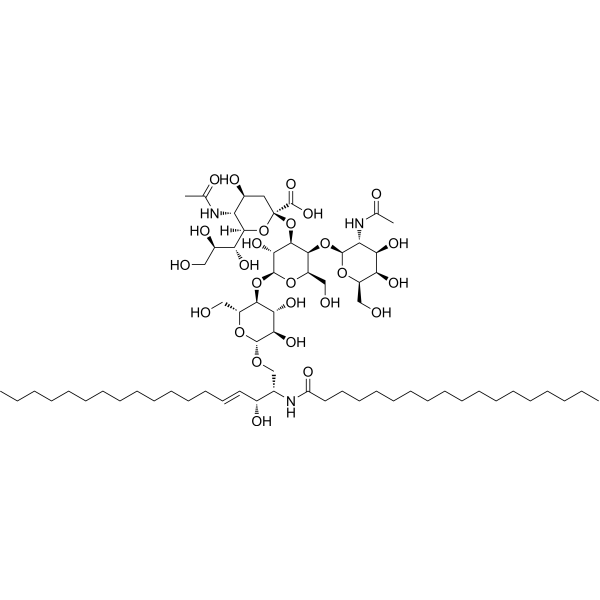
Ganglioside GM1 is a type of glycosphingolipid, mainly found on the cell membranes of the central nervous system of vertebrates. Ganglioside GM1 exerts neuroprotective effects by reducing excessive activation of NMDAR, activating TrkA and ERK1/2, and inhibiting oxidative stress and cell apoptosis and autophagy. Ganglioside GM1 can be used in the research of diseases such as traumatic brain injury, Parkinson's disease, Alzheimer's disease, and Huntington's disease.
For research use only. We do not sell to patients.
- Purity : 99%
- CAS No.: 37758-47-7
-
Storage:Powder -20°C, 3 years ; In solvent -80°C, 6 months , -20°C, 1 month


To place orders, for customer services and technical support, please contact: MedChemExpress USA
Tel: 609-228-6898 E-mail: [email protected] [email protected]


-
 Biological Activity
-
Chemical Information
-
Solvent & Solubility
- Purity & Documentation
- References
-
 Help & FAQs


-

HY-W747597
Ganglioside GD1b Disodium Salt (Bovine Brain) -

HY-141569
Ganglioside GD1aAnti-inflammatory Agent -

HY-165740
Ganglioside GD2Tumor-associated Antigen -

HY-131686
Ganglioside GT1b (bovine) ammoniumGanglioside -
HY-148385
Ganglioside GM2Tumor Antigen -
HY-101047
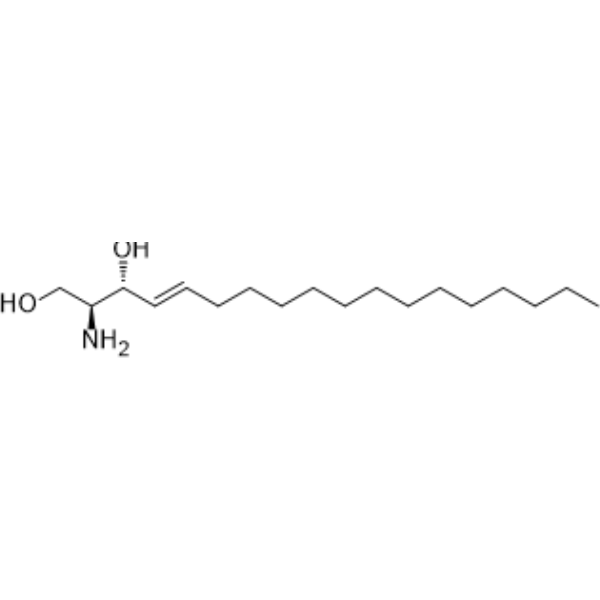
D-erythro-SphingosinePKC Inhibitor -

HY-W714151
Ganglioside ga1Ester Product -

HY-131686A
Ganglioside GT1b (porcine) ammoniumGanglioside -

HY-101047R
D-erythro-Sphingosine (Standard)PKC Inhibitor -

HY-W342441
Monosialoganglioside GM3 (bovine)Akt Inhibitor
All iGluR Isoforms
More

Biological Activity
Description
|
TrkA |
ERK1 |
ERK2 |
In Vitro
Ganglioside GM1 significantly enhances the activation effect of nerve growth factor (NGF) on TrkA in PC12 cells. The GM1 oligosaccharide chain (OligoGM1) can directly interact with TrkA, activate the ERK1/2 pathway, promote differentiation, and exert neuroprotective effects[2][3].
MedChemExpress (MCE) has not independently confirmed the accuracy of these methods. They are for reference only.
In Vivo
Ganglioside GM1 (i.p.) reduces the infarct area in the mouse ischemic injury model, inhibits the expression of NMDAR1, and lowers calcium overload; in the rat cerebral ischemia model, it reduces the ratio of LC3-II/LC3-I, the expression of P62 and Beclin-1, inhibits autophagy, and improves the neurological behavior score[1].
Ganglioside GM1 (15 mg/kg, i.p.) inhibits endoplasmic reticulum stress and reduces brain injury in diabetic rat models by up-regulating GRP78 and down-regulating CHOP/caspial-12[1].
MedChemExpress (MCE) has not independently confirmed the accuracy of these methods. They are for reference only.


Chemical Information
-
CAS No. 37758-47-7
-
Appearance Solid
-
Color White to off-white
-
SMILES
[Ganglioside GM1]
-
Structure Classification
-
Initial Source
hog epididymis
-
Shipping
Room temperature in continental US; may vary elsewhere.
-
Storage
Powder -20°C 3 years In solvent -80°C 6 months -20°C 1 month


Solvent & Solubility
In Vitro:
0.01 M NaOH : 50 mg/mL (Need ultrasonic)
DMSO : 50 mg/mL (Need ultrasonic; Hygroscopic DMSO has a significant impact on the solubility of product, please use newly opened DMSO)
In Vivo:
Select the appropriate dissolution method based on your experimental animal and administration route.
- For the following dissolution methods, please ensure to first prepare a clear stock solution using an In Vitro approach and then sequentially add co-solvents:
- To ensure reliable experimental results, the clarified stock solution can be appropriately stored based on storage conditions. As for the working solution for In Vivo experiments, it is recommended to prepare freshly and use it on the same day.
- The percentages shown for the solvents indicate their volumetric ratio in the final prepared solution. If precipitation or phase separation occurs during preparation, heat and/or sonication can be used to aid dissolution.
Add each solvent one by one: 10% DMSO 40% PEG300 5% Tween-80 45% Saline
Solubility: ≥ 1.25 mg/mL; Clear solution
This protocol yields a clear solution of ≥ 1.25 mg/mL (saturation unknown).
Taking 1 mL working solution as an example, add 100 μL DMSO stock solution (12.5 mg/mL) to 400 μL PEG300, and mix evenly; then add 50 μL Tween-80 and mix evenly; then add 450 μL Saline to adjust the volume to 1 mL.
Preparation of Saline: Dissolve 0.9 g sodium chloride in ddH₂O and dilute to 100 mL to obtain a clear Saline solution.
Add each solvent one by one: 10% DMSO 90% (20% SBE-β-CD in Saline)
Solubility: ≥ 1.25 mg/mL; Clear solution
This protocol yields a clear solution of ≥ 1.25 mg/mL (saturation unknown).
Taking 1 mL working solution as an example, add 100 μL DMSO stock solution (12.5 mg/mL) to 900 μL 20% SBE-β-CD in Saline, and mix evenly.
Preparation of 20% SBE-β-CD in Saline (4°C, storage for one week): 2 g SBE-β-CD powder is dissolved in 10 mL Saline, completely dissolve until clear.
In Vivo Dissolution Calculator
Please enter the basic information of animal experiments:
-
-
-
-
Recommended: Prepare an additional quantity of animals to account for potential losses during experiments.
Please enter your animal formula composition:
-
%DMSO +
Recommended: Keep the proportion of DMSO in working solution below 2% if your animal is weak.
-
%+
-
+%Tween-80 + +
-
%Saline +
The co-solvents required include: DMSO, . All of co-solvents are available by MedChemExpress (MCE). , Tween 80. All of co-solvents are available by MedChemExpress (MCE).
Working solution concentration: 0.22 mg/mL
Method for preparing stock solution: mg drug dissolved in μL DMSO. Stock solution concentration: mg/mL.
1. Take μL DMSO stock solution;
2. Add μL .
μL , mix evenly;
3. Then add μL Tween 80, mix evenly;
4. Then add μL
Please ensure that the stock solution in the first step is dissolved to a clear state, and add co-solvents in sequence. You can use ultrasonic heating (ultrasonic cleaner, recommended frequency 20-40 kHz), vortexing, etc. to assist dissolution.


Purity & Documentation
-
Data Sheet (271 KB)
-
SDS (251 KB)
- English - EN (251 KB)
- Français - FR (251 KB)
- Deutsch - DE (251 KB)
- Norwegian - NO (251 KB)
- Español - ES (251 KB)
- Swedish - SV (251 KB)
- Italian - IT (251 KB)
- Korean - KR (251 KB)
- Portuguese - PT (251 KB)
-
Handling Instructions (2659 KB)
References
[1]. Wenchao Zhang, et al. Pathophysiology of Ganglioside GM1 in Ischemic Stroke: Ganglioside GM1: A Critical Review. Cell Transplant. 2019 Jun;28(6):657-661. [Content Brief]
[2]. Chiricozzi E, et al. GM1 Ganglioside Is A Key Factor in Maintaining the Mammalian Neuronal Functions Avoiding Neurodegeneration. Int J Mol Sci. 2020 Jan 29;21(3):868. [Content Brief]
[3]. Guo Z. Ganglioside GM1 and the Central Nervous System. Int J Mol Sci. 2023 May 31;24(11):9558. [Content Brief]

Calculators
Concentration (start) × Volume (start) = Concentration (final) × Volume (final)


Ganglioside GM1 Related Classifications
HY-N10546 Related Classifications
 Powered by Bioz