



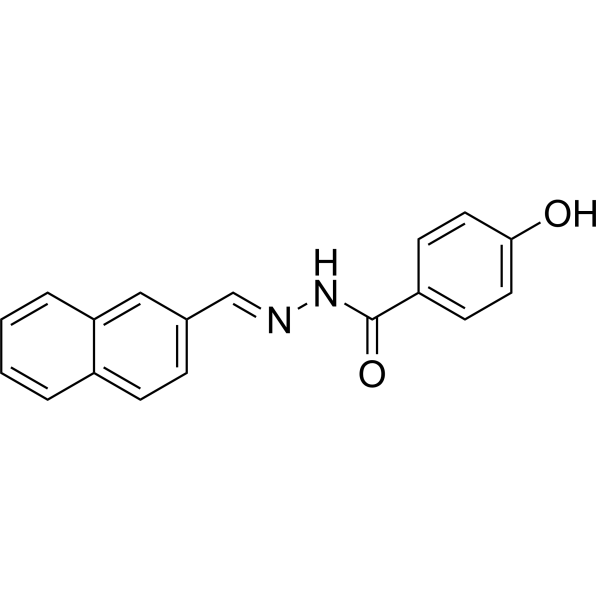
SLU-PP-332
Based on 1 publication(s) in Google Scholar
SLU-PP-332 is a pan-Estrogen Receptor/ERR agonist with EC50 values of 98, 230 and 430 nM for ERRα, ERRβ and ERRγ, respectively. SLUPP-332 enhances mitochondrial function and cellular respiration in skeletal muscle cell lines. SLU-PP-332 has the potential to study metabolic diseases as well as improve muscle function.
For research use only. We do not sell to patients.
- Purity: 98.98%
- CAS No.: 303760-60-3
- Formula: C18H14N2O2
- Molecular Weight:290.32
-
Storage:Powder -20°C, 3 years ; In solvent -80°C, 6 months , -20°C, 1 month


-
 Biological Activity
-
Chemical Information
-
Solvent & Solubility
- Purity & Documentation
- References
-
 Help & FAQs
-

Nuclear Receptor Compound Library
HY-L126
-
Cuproptosis Compound Library
HY-L133
-
Cancer Stem Cells Compound Library
HY-L135
-
Membrane Receptor-targeted Compound Library
HY-L150
-
Multi-Target Compound Library
HY-L176
-
Bioactive Compound Library Max
HY-L181
-
MCE Bioactive Compound Library
HY-L001V
-
Bioactive Compound Library
HY-L001
-
High-Throughput Bioactive Compound Library
HY-L205


Publications Citing Use of MedChemExpress (MCE) SLU-PP-332
More

Biological Activity
|
ERRα 98 nM (EC50) |
ERRβ 230 nM (EC50) |
ERRγ 430 nM (EC50) |
SLU-PP-332 (0-5 μM, 24 h) increases the expression of an ERR target gene and enhances mitochondrial respiration in C2C12 myocytes[1].
MedChemExpress (MCE) has not independently confirmed the accuracy of these methods. They are for reference only.
-
Cell Line:C2C12 cells
-
Concentration:0-5 μM
-
Incubation Time:24 h
-
Result:Increased the levels of pyruvate dehydrogenase kinase 4 (Pdk4) expression and induced mitochondrial biogenesis in proliferating C2C12 cells.
SLU-PP-332 (50 mg/kg, i.p., twice per day for 28 days or 12 days) induces fatty acid metabolism, reduces fat mass and improves glucose metabolism in diet-induced obesity mouse models[3].
MedChemExpress (MCE) has not independently confirmed the accuracy of these methods. They are for reference only.
-
Animal Model:8-10 male C57BL/6J mice[1]
-
Dosage:50 mg/kg
-
Administration:i.p., a single dose for 28 or 12 days
-
Result:Displayed a more oxidative muscle phenotype, increased the complex I (NDUFB8) and complex V (ATP5A) protein expression in the gastrocnemius muscle and cytochrome C, mitochondria content and oxidative type IIa muscle fibers lavels in mice.
-
Animal Model:High fat diet-induced obesity mouse model[3]
-
Dosage:50 mg/kg
-
Administration:i.p., twice per day for 28 days or 12 days
-
Result:Did not alter brown adipose tissue mass, daily food intake and glucose metabolism, increased fatty acid oxidation (FAO) in normal in C57Bl/6 mice, but induced a progressive weight loss and decreased adipocytes size in high fat diet-induced obesity mouse models.


Chemical Information
-
CAS No. 303760-60-3
-
Appearance Solid
-
Molecular Weight 290.32
-
Formula C18H14N2O2
-
Color White to off-white
-
SMILES
O=C(N/N=C/C1=CC=C2C=CC=CC2=C1)C3=CC=C(O)C=C3
-
Shipping
Room temperature in continental US; may vary elsewhere.
-
Storage
Powder -20°C 3 years In solvent -80°C 6 months -20°C 1 month


Publications (1)
-
Journal Impact Factor
-
Most Recent


Solvent & Solubility
DMSO : 100 mg/mL (344.45 mM; Need ultrasonic; Hygroscopic DMSO has a significant impact on the solubility of product, please use newly opened DMSO)
Please refer to the solubility information to select the appropriate solvent. Once prepared, please aliquot and store the solution to prevent product inactivation from repeated freeze-thaw cycles.
Storage method and period of stock solution: -80°C, 6 months; -20°C, 1 month. When stored at -80°C, please use it within 6 months. When stored at -20°C, please use it within 1 month.
Please refer to the solubility information to select the appropriate solvent. Once prepared, please aliquot and store the solution to prevent product inactivation from repeated freeze-thaw cycles.
Storage method and period of stock solution: -80°C, 6 months; -20°C, 1 month. When stored at -80°C, please use it within 6 months. When stored at -20°C, please use it within 1 month.
Concentration (start) × Volume (start) = Concentration (final) × Volume (final)
Select the appropriate dissolution method based on your experimental animal and administration route.
- For the following dissolution methods, please ensure to first prepare a clear stock solution using an In Vitro approach and then sequentially add co-solvents:
- To ensure reliable experimental results, the clarified stock solution can be appropriately stored based on storage conditions. As for the working solution for In Vivo experiments, it is recommended to prepare freshly and use it on the same day.
- The percentages shown for the solvents indicate their volumetric ratio in the final prepared solution. If precipitation or phase separation occurs during preparation, heat and/or sonication can be used to aid dissolution.
Add each solvent one by one: 10% DMSO 40% PEG300 5% Tween-80 45% Saline
Solubility: ≥ 2.5 mg/mL (8.61 mM); Clear solution
This protocol yields a clear solution of ≥ 2.5 mg/mL (saturation unknown).
Taking 1 mL working solution as an example, add 100 μL DMSO stock solution (25.0 mg/mL) to 400 μL PEG300, and mix evenly; then add 50 μL Tween-80 and mix evenly; then add 450 μL Saline to adjust the volume to 1 mL.
Preparation of Saline: Dissolve 0.9 g sodium chloride in ddH₂O and dilute to 100 mL to obtain a clear Saline solution.
Add each solvent one by one: 10% DMSO 90% (20% SBE-β-CD in Saline)
Solubility: ≥ 2.5 mg/mL (8.61 mM); Clear solution
This protocol yields a clear solution of ≥ 2.5 mg/mL (saturation unknown).
Taking 1 mL working solution as an example, add 100 μL DMSO stock solution (25.0 mg/mL) to 900 μL 20% SBE-β-CD in Saline, and mix evenly.
Preparation of 20% SBE-β-CD in Saline (4°C, storage for one week): 2 g SBE-β-CD powder is dissolved in 10 mL Saline, completely dissolve until clear.
Please enter the basic information of animal experiments:
-
-
-
-
Recommended: Prepare an additional quantity of animals to account for potential losses during experiments.
Please enter your animal formula composition:
-
%DMSO +
Recommended: Keep the proportion of DMSO in working solution below 2% if your animal is weak.
-
%+
-
+%Tween-80 + +
-
%Saline +
The co-solvents required include: DMSO, . All of co-solvents are available by MedChemExpress (MCE). , Tween 80. All of co-solvents are available by MedChemExpress (MCE).
Working solution concentration: 0.22 mg/mL
Method for preparing stock solution: mg drug dissolved in μL DMSO. Stock solution concentration: mg/mL.
1. Take μL DMSO stock solution;
2. Add μL .
μL , mix evenly;
3. Then add μL Tween 80, mix evenly;
4. Then add μL
Please ensure that the stock solution in the first step is dissolved to a clear state, and add co-solvents in sequence. You can use ultrasonic heating (ultrasonic cleaner, recommended frequency 20-40 kHz), vortexing, etc. to assist dissolution.


Purity & Documentation
-
Data Sheet (276 KB)
-
SDS (393 KB)
- English - EN (393 KB)
- Français - FR (393 KB)
- Deutsch - DE (393 KB)
- Norwegian - NO (393 KB)
- Español - ES (393 KB)
- Swedish - SV (393 KB)
- Italian - IT (393 KB)
- Portuguese - PT (393 KB)
-
Handling Instructions (2659 KB)
References
[1]. Billon C, et al. Synthetic ERRα/β/γ Agonist Induces an ERRα-Dependent Acute Aerobic Exercise Response and Enhances Exercise Capacity. ACS Chem Biol. 2023 Apr 21;18(4):756-771. [Content Brief]
[3]. Billon C, et al. A Synthetic ERR Agonist Alleviates Metabolic Syndrome. J Pharmacol Exp Ther. 2024 Jan 17;388(2):232-240. [Content Brief]


Complete Stock Solution Preparation Table
Please refer to the solubility information to select the appropriate solvent. Once prepared, please aliquot and store the solution to prevent product inactivation from repeated freeze-thaw cycles.
Storage method and period of stock solution: -80°C, 6 months; -20°C, 1 month. When stored at -80°C, please use it within 6 months. When stored at -20°C, please use it within 1 month.
| Optional Solvent | Concentration Solvent Mass | 1 mg | 5 mg | 10 mg | 25 mg |
|---|---|---|---|---|---|
| DMSO | 1 mM | 3.4445 mL | 17.2224 mL | 34.4447 mL | 86.1119 mL |
| 5 mM | 0.6889 mL | 3.4445 mL | 6.8889 mL | 17.2224 mL | |
| 10 mM | 0.3444 mL | 1.7222 mL | 3.4445 mL | 8.6112 mL | |
| 15 mM | 0.2296 mL | 1.1482 mL | 2.2963 mL | 5.7408 mL | |
| 20 mM | 0.1722 mL | 0.8611 mL | 1.7222 mL | 4.3056 mL | |
| 25 mM | 0.1378 mL | 0.6889 mL | 1.3778 mL | 3.4445 mL | |
| 30 mM | 0.1148 mL | 0.5741 mL | 1.1482 mL | 2.8704 mL | |
| 40 mM | 0.0861 mL | 0.4306 mL | 0.8611 mL | 2.1528 mL | |
| 50 mM | 0.0689 mL | 0.3444 mL | 0.6889 mL | 1.7222 mL | |
| 60 mM | 0.0574 mL | 0.2870 mL | 0.5741 mL | 1.4352 mL | |
| 80 mM | 0.0431 mL | 0.2153 mL | 0.4306 mL | 1.0764 mL | |
| 100 mM | 0.0344 mL | 0.1722 mL | 0.3444 mL | 0.8611 mL |


 Powered by Bioz