



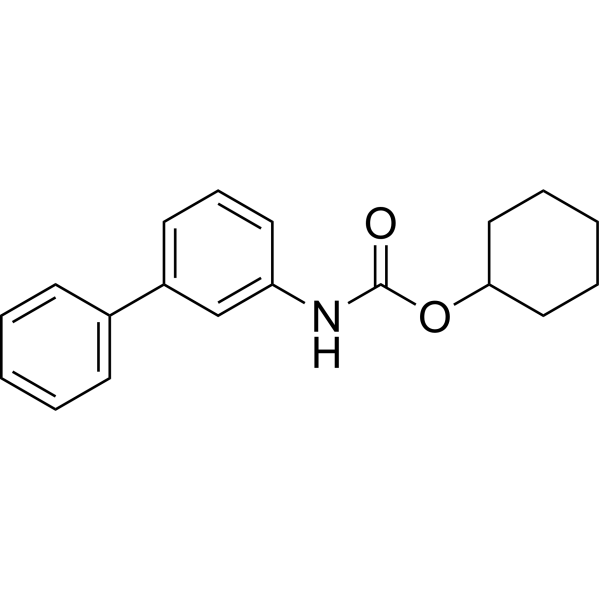
URB602

Based on 1 Customer Validation
URB602 is a selective monoacylglycerol lipase (MGL) inhibitor, which inhibits rat brain MGL with IC50 of 28±4 μM through a noncompetitive mechanism.
Para uso exclusivo en investigación. No vendemos a pacientes.
- Pureza: 99.74%
- No. CAS: 565460-15-3
- Fòrmula: C19H21NO2
- Peso molecular:295.38
-
Almacenamiento:Powder -20°C, 3 years , 4°C, 2 years ; In solvent -80°C, 2 years , -20°C, 1 year

To place orders, for customer services and technical support, please contact: MedChemExpress USA
Tel: 609-228-6898 E-mail: [email protected] [email protected]


-
 Actividad biológica
-
Chemical Information
-
Solvente y solubilidad
- Protocolo
- Pureza y Documentación
- Referencias
-
 Help & FAQs


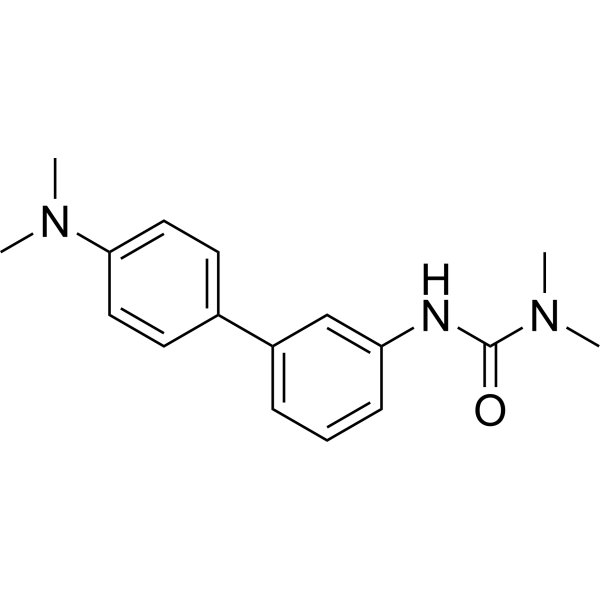
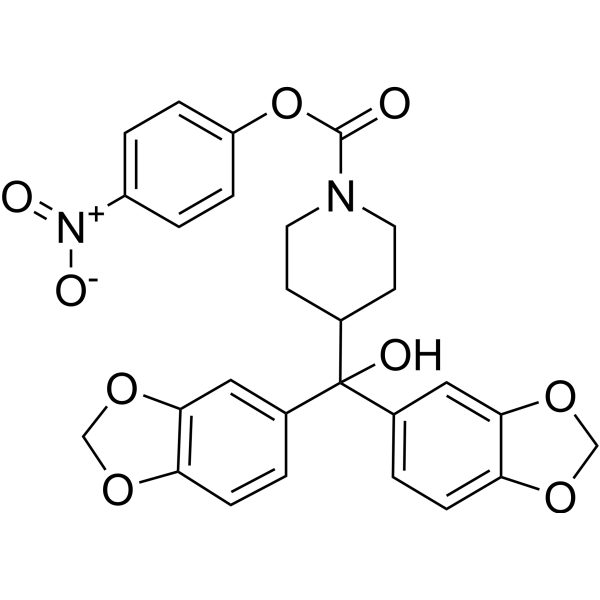
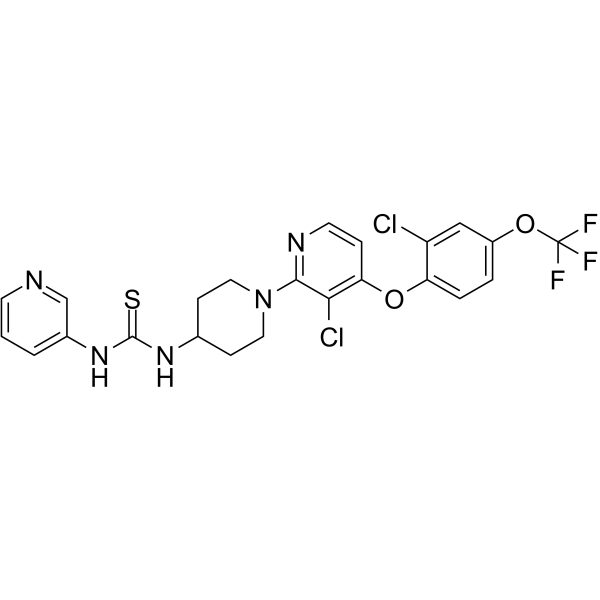



Actividad biológica
Descripciòn
IC50 & Target
IC50: 28±4 μM (rat brain MGL)[1]
In Vitro
Without URB602, the apparent Michaelis constant (Km) of MGL for 2-AG is 24±1.7 μM and the maximum velocity (Vmax) is 1814±51 nmol min per mg protein; with URB602, the Km is 20±0.4 μM and the Vmax is 541±20 nmol min per mg protein (n=4). When organotypic slice cultures of rat forebrain are incubated with URB602 (100 μM), both baseline and Ca2+-ionophore-stimulated 2-arachidonoylglycerol (2-AG) concentrations are increased[1]. URB602 is an inhibitor of monoacylglycerol lipase (MGL), a serine hydrolase involved in the biological deactivation of the endocannabinoid 2-arachidonoyl-sn-glycerol (2-AG). URB602 weakly inhibits recombinant MGL (IC50=223±63 μM) through a rapid and noncompetitive mechanism[2].
MedChemExpress (MCE) has not independently confirmed the accuracy of these methods. They are for reference only.
In Vivo
MedChemExpress (MCE) has not independently confirmed the accuracy of these methods. They are for reference only.


Chemical Information
-
No. CAS 565460-15-3
-
Appearance Solid
-
Peso molecular 295.38
-
Fòrmula C19H21NO2
-
Color White to off-white
-
SMILES
O=C(OC1CCCCC1)NC2=CC(C3=CC=CC=C3)=CC=C2
-
Envío
Room temperature in continental US; may vary elsewhere.
-
Almacenamiento
Powder -20°C 3 years 4°C 2 years In solvent -80°C 2 years -20°C 1 year


Solvente y solubilidad
In Vitro:
DMSO : 100 mg/mL (338.55 mM; Need ultrasonic; Hygroscopic DMSO has a significant impact on the solubility of product, please use newly opened DMSO)
Please refer to the solubility information to select the appropriate solvent. Once prepared, please aliquot and store the solution to prevent product inactivation from repeated freeze-thaw cycles.
Storage method and period of stock solution: -80°C, 2 years; -20°C, 1 year. When stored at -80°C, please use it within 2 years. When stored at -20°C, please use it within 1 year.
Please refer to the solubility information to select the appropriate solvent. Once prepared, please aliquot and store the solution to prevent product inactivation from repeated freeze-thaw cycles.
Storage method and period of stock solution: -80°C, 2 years; -20°C, 1 year. When stored at -80°C, please use it within 2 years. When stored at -20°C, please use it within 1 year.
Concentration (start) × Volume (start) = Concentration (final) × Volume (final)
In Vivo:
Select the appropriate dissolution method based on your experimental animal and administration route.
- For the following dissolution methods, please ensure to first prepare a clear stock solution using an In Vitro approach and then sequentially add co-solvents:
- To ensure reliable experimental results, the clarified stock solution can be appropriately stored based on storage conditions. As for the working solution for In Vivo experiments, it is recommended to prepare freshly and use it on the same day.
- The percentages shown for the solvents indicate their volumetric ratio in the final prepared solution. If precipitation or phase separation occurs during preparation, heat and/or sonication can be used to aid dissolution.
Add each solvent one by one: 10% DMSO 40% PEG300 5% Tween-80 45% Saline
Solubility: 2.5 mg/mL (8.46 mM); Suspended solution; Need ultrasonic
This protocol yields a suspended solution of 2.5 mg/mL. Suspended solution can be used for oral and intraperitoneal injection.
Taking 1 mL working solution as an example, add 100 μL DMSO stock solution (25.0 mg/mL) to 400 μL PEG300, and mix evenly; then add 50 μL Tween-80 and mix evenly; then add 450 μL Saline to adjust the volume to 1 mL.
Preparation of Saline: Dissolve 0.9 g sodium chloride in ddH₂O and dilute to 100 mL to obtain a clear Saline solution.
In Vivo Dissolution Calculator
Please enter the basic information of animal experiments:
-
-
-
-
Recommended: Prepare an additional quantity of animals to account for potential losses during experiments.
Please enter your animal formula composition:
-
%DMSO +
Recommended: Keep the proportion of DMSO in working solution below 2% if your animal is weak.
-
%+
-
+%Tween-80 + +
-
%Saline +
The co-solvents required include: DMSO, . All of co-solvents are available by MedChemExpress (MCE). , Tween 80. All of co-solvents are available by MedChemExpress (MCE).
Working solution concentration: 0.22 mg/mL
Method for preparing stock solution: mg drug dissolved in μL DMSO. Stock solution concentration: mg/mL.
1. Take μL DMSO stock solution;
2. Add μL .
μL , mix evenly;
3. Then add μL Tween 80, mix evenly;
4. Then add μL
Please ensure that the stock solution in the first step is dissolved to a clear state, and add co-solvents in sequence. You can use ultrasonic heating (ultrasonic cleaner, recommended frequency 20-40 kHz), vortexing, etc. to assist dissolution.

Protocolo
Kinase Assay[2]
Samples containing either URB602 (300 μM), MGL (1.4 pM), or both URB602 and MGL are incubated at 37°C for 30 min in assay buffer. At various time points, the reaction is stopped with an equal volume of ice-cold methanol and directly analyzed in positive ionization mode by LC/MS. A SB-CN column (150×2.1 mm i.d., 5 μm) eluted is used with a linear gradient of methanol in water containing 0.25% acetic acid and 5 mM ammonium acetate (from 60% to 100% of methanol in 8 min) at a flow rate of 0.5 mL/min with column temperature at 50°C. Capillary voltage is set at 4 kV and fragmentor voltage is 100V. Nebulizer pressure is set at 60 psi. N2 is used as drying gas at a flow rate of 13 liters/min and a temperature of 350°C. ESI is in the positive mode and a full scan spectrum is acquired from m/z 100 to 600. Extracted ion chromatograms are used to quantify URB602 ([M+H]+, m/z 296)[2].
MedChemExpress (MCE) has not independently confirmed the accuracy of these methods. They are for reference only.
Mice[3]
Male C57BL/6 mice (5-6 wk; 20-26 g) or female CB1-/- mice (8 wk; 18-22 g) on a C57BL/6 background are used. After an overnight fasting period (water ad libitum), a marker is administered orally to assess upper GI transit, as described in detail by others. At 30 min after intraperitoneal (ip) administration of URB602 (20 or 40 mg/kg) or vehicle (10% DMSO/Tween 80 in saline), an oral gavage of 200 μL of an Evans blue marker (5% Evans blue, 5% gum arabic) is administered. After 15 min animals are killed by cervical dislocation and the intestine from the region of the pyloric sphincter to the ileocecal junction is immediately removed. The distance traveled by the marker is measured in centimeters and expressed as a percentage of the total length of the small intestine.
Rats[4]
Three hundred and seven adult male Sprague-Dawley rats weighing 275-350 g, at the time of testing, are used. In a first study, the dose-response curves for JZL184 and URB602 are determined using the AUC of Phase 1 or Phase 2 pain behaviour. In a second study, the antinociceptive effects of JZL184 (300 μg) and URB602 (600 μg) are evaluated following injection in the paw, ipsilateral or contralateral to formalin, to exclude the possibility that systemic leakage contributed to the pattern of results obtained. In a third study, antinociceptive effects of ED50 doses of JZL184 (0.03 μg i.paw) or URB602 (66 μg i.paw), in combination with 2-AG (ED50 dose of 1 μg i.paw), are quantified to evaluate the presence of additive or synergic effects of these drugs. In a fourth study, antinociceptive effects of JZL184 (at 10 μg i.paw, an analgesic dose) are studied in the presence or absence of either AM251 or AM630 to determine whether these effects are mediated through CB1 and/or CB2 receptors. The CB1 receptor antagonist AM251 exhibits 306-fold selectivity for CB1 over CB2 receptors, whereas the CB2 receptor antagonist AM630 exhibits 70-165-fold selectivity for CB2 over CB1 receptors. The doses employed (AM251 at 80 μg i.paw and AM630 at 25 μg i.paw) are those which block peripheral antinociceptive effects of URB602 in Wistar rats. For the first study (n=4-6 per group for URB602 and n=6-8 per group for JZL184) and for all the other behavioural studies (n=6 per group), drugs, administered either alone or in combination, are dissolved in the same total volume (50 μL) and injected into the right hind paw. Preliminary experiments (n=8 per group; data not shown) confirmed that formalin-induced pain behaviour did not change following intra-paw administration of either vehicle (PEG 300: Tween 80 in a 4:1 ratio or DMSO: ethanol: cremophor: 0.9% saline in a 1:1:1:17 ratio].
MedChemExpress (MCE) has not independently confirmed the accuracy of these methods. They are for reference only.


Pureza y Documentación
-
Ficha de datos (279 KB)
-
SDS (251 KB)
- English - EN (251 KB)
- Français - FR (251 KB)
- Deutsch - DE (251 KB)
- Norwegian - NO (251 KB)
- Español - ES (251 KB)
- Swedish - SV (251 KB)
- Italian - IT (251 KB)
- Korean - KR (251 KB)
- Portuguese - PT (251 KB)
-
Instrucciones de manejo (2659 KB)
Referencias
[1]. Hohmann AG, et al. An endocannabinoid mechanism for stress-induced analgesia. Nature. 2005 Jun 23;435(7045):1108-12. [Content Brief]
[2]. King AR, et al. URB602 inhibits monoacylglycerol lipase and selectively blocks 2-arachidonoylglycerol degradation in intact brain slices. Chem Biol. 2007 Dec;14(12):1357-65. [Content Brief]
[3]. Duncan M, et al. Distribution and function of monoacylglycerol lipase in the gastrointestinal tract. Am J Physiol Gastrointest Liver Physiol. 2008 Dec;295(6):G1255-65. [Content Brief]
[4]. Guindon J, et al. Peripheral antinociceptive effects of inhibitors of monoacylglycerol lipase in a rat model of inflammatory pain. Br J Pharmacol. 2011 Aug;163(7):1464-78. [Content Brief]


Complete Stock Solution Preparation Table
Please refer to the solubility information to select the appropriate solvent. Once prepared, please aliquot and store the solution to prevent product inactivation from repeated freeze-thaw cycles.
Storage method and period of stock solution: -80°C, 2 years; -20°C, 1 year. When stored at -80°C, please use it within 2 years. When stored at -20°C, please use it within 1 year.
| Optional Solvent | Concentration Solvent Mass | 1 mg | 5 mg | 10 mg | 25 mg |
|---|---|---|---|---|---|
| DMSO | 1 mM | 3.3855 mL | 16.9273 mL | 33.8547 mL | 84.6367 mL |
| 5 mM | 0.6771 mL | 3.3855 mL | 6.7709 mL | 16.9273 mL | |
| 10 mM | 0.3385 mL | 1.6927 mL | 3.3855 mL | 8.4637 mL | |
| 15 mM | 0.2257 mL | 1.1285 mL | 2.2570 mL | 5.6424 mL | |
| 20 mM | 0.1693 mL | 0.8464 mL | 1.6927 mL | 4.2318 mL | |
| 25 mM | 0.1354 mL | 0.6771 mL | 1.3542 mL | 3.3855 mL | |
| 30 mM | 0.1128 mL | 0.5642 mL | 1.1285 mL | 2.8212 mL | |
| 40 mM | 0.0846 mL | 0.4232 mL | 0.8464 mL | 2.1159 mL | |
| 50 mM | 0.0677 mL | 0.3385 mL | 0.6771 mL | 1.6927 mL | |
| 60 mM | 0.0564 mL | 0.2821 mL | 0.5642 mL | 1.4106 mL | |
| 80 mM | 0.0423 mL | 0.2116 mL | 0.4232 mL | 1.0580 mL | |
| 100 mM | 0.0339 mL | 0.1693 mL | 0.3385 mL | 0.8464 mL |


URB602 Related Classifications
HY-100792 Related Classifications
 Powered by Bioz