



Alizarin complexone

Based on 1 Customer Validation
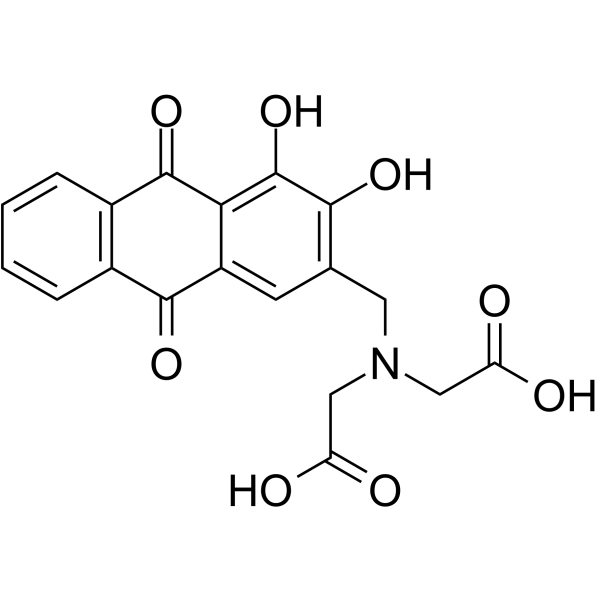
Alizarin complexone is a calcium-binding fluorescent dye. Alizarin complexone stains mineralized areas of bone by binding to calcium crystals. Alizarin complexone inhibits the reverse transcriptase activity of RAV-2, HIV-1, and RSV with IC50 values of 3.8 μg/mL, 45 μg/mL, and 100 μg/mL, respectively. Alizarin complexone exhibits antiviral activity against HIV-1 and RSV. Alizarin complexone delays RSV-induced tumor induction in chickens.
Para uso exclusivo en investigación. No vendemos a pacientes.
- Pureza: 98.0%
- No. CAS: 3952-78-1
- Fòrmula: C19H15NO8
- Peso molecular:385.32
-
Almacenamiento:
4°C, protect from light, stored under nitrogen
* In solvent : -80°C, 6 months; -20°C, 1 month (protect from light, stored under nitrogen)

To place orders, for customer services and technical support, please contact: MedChemExpress USA
Tel: 609-228-6898 E-mail: [email protected] [email protected]


-
 Actividad biológica
-
Chemical Information
-
Solvente y solubilidad
- Pureza y Documentación
- Referencias
-
 Help & FAQs







Actividad biológica
Descripciòn
IC50 & Target
[1]|
HIV-1 |
In Vitro
Alizarin complexone inhibits reverse transcriptase activity of RAV-2 , HIV-1, and RSV, with IC50 values of 3.8 μg/mL, 45 μg/mL and 100 μg/mL, respectively[1].
Alizarin complexone (0.1%; 1.5-2.5 h) stains mineralized bone matrix in medaka larvae, enabling visualization of vertebral body mineralization and assessment of Bisphosphonate-induced inhibition of osteoclast-mediated bone resorption in vitro[3].
MedChemExpress (MCE) has not independently confirmed the accuracy of these methods. They are for reference only.
In Vivo
Alizarin complexone (0.75 mg/mL, 10 μL; intra-articular injection) detects increased permeability from articular cartilage to subchondral bone and enhanced periosteal penetration in 11-12-week-old male C57BL/6J mice with DMM-induced early osteoarthritis[4].
MedChemExpress (MCE) has not independently confirmed the accuracy of these methods. They are for reference only.


Chemical Information
-
No. CAS 3952-78-1
-
Appearance Solid
-
Peso molecular 385.32
-
Fòrmula C19H15NO8
-
Color Yellow to brown
-
SMILES
O=C(C1=C(C(O)=C(C=C1C2=O)CN(CC(O)=O)CC(O)=O)O)C3=C2C=CC=C3
-
Envío
Room temperature in continental US; may vary elsewhere.
-
Almacenamiento
4°C, protect from light, stored under nitrogen
* In solvent : -80°C, 6 months; -20°C, 1 month (protect from light, stored under nitrogen)


Solvente y solubilidad
In Vitro:
DMSO : ≥ 100 mg/mL (259.52 mM; Hygroscopic DMSO has a significant impact on the solubility of product, please use newly opened DMSO)
* "≥" means soluble, but saturation unknown.
Please refer to the solubility information to select the appropriate solvent. Once prepared, please aliquot and store the solution to prevent product inactivation from repeated freeze-thaw cycles.
Storage method and period of stock solution: -80°C, 6 months; -20°C, 1 month (protect from light, stored under nitrogen). When stored at -80°C, please use it within 6 months. When stored at -20°C, please use it within 1 month.
Please refer to the solubility information to select the appropriate solvent. Once prepared, please aliquot and store the solution to prevent product inactivation from repeated freeze-thaw cycles.
Storage method and period of stock solution: -80°C, 6 months; -20°C, 1 month (protect from light, stored under nitrogen). When stored at -80°C, please use it within 6 months. When stored at -20°C, please use it within 1 month.
Concentration (start) × Volume (start) = Concentration (final) × Volume (final)
In Vivo:
Select the appropriate dissolution method based on your experimental animal and administration route.
- For the following dissolution methods, please ensure to first prepare a clear stock solution using an In Vitro approach and then sequentially add co-solvents:
- To ensure reliable experimental results, the clarified stock solution can be appropriately stored based on storage conditions. As for the working solution for In Vivo experiments, it is recommended to prepare freshly and use it on the same day.
- The percentages shown for the solvents indicate their volumetric ratio in the final prepared solution. If precipitation or phase separation occurs during preparation, heat and/or sonication can be used to aid dissolution.
Add each solvent one by one: 10% DMSO 40% PEG300 5% Tween-80 45% Saline
Solubility: ≥ 2.5 mg/mL (6.49 mM); Clear solution
This protocol yields a clear solution of ≥ 2.5 mg/mL (saturation unknown).
Taking 1 mL working solution as an example, add 100 μL DMSO stock solution (25.0 mg/mL) to 400 μL PEG300, and mix evenly; then add 50 μL Tween-80 and mix evenly; then add 450 μL Saline to adjust the volume to 1 mL.
Preparation of Saline: Dissolve 0.9 g sodium chloride in ddH₂O and dilute to 100 mL to obtain a clear Saline solution.
In Vivo Dissolution Calculator
Please enter the basic information of animal experiments:
-
-
-
-
Recommended: Prepare an additional quantity of animals to account for potential losses during experiments.
Please enter your animal formula composition:
-
%DMSO +
Recommended: Keep the proportion of DMSO in working solution below 2% if your animal is weak.
-
%+
-
+%Tween-80 + +
-
%Saline +
The co-solvents required include: DMSO, . All of co-solvents are available by MedChemExpress (MCE). , Tween 80. All of co-solvents are available by MedChemExpress (MCE).
Working solution concentration: 0.22 mg/mL
Method for preparing stock solution: mg drug dissolved in μL DMSO. Stock solution concentration: mg/mL. * In solvent : -80°C, 6 months; -20°C, 1 month (protect from light, stored under nitrogen)
1. Take μL DMSO stock solution;
2. Add μL .
μL , mix evenly;
3. Then add μL Tween 80, mix evenly;
4. Then add μL
Please ensure that the stock solution in the first step is dissolved to a clear state, and add co-solvents in sequence. You can use ultrasonic heating (ultrasonic cleaner, recommended frequency 20-40 kHz), vortexing, etc. to assist dissolution.


Pureza y Documentación
-
Ficha de datos (277 KB)
-
SDS (394 KB)
- English - EN (394 KB)
- Français - FR (394 KB)
- Deutsch - DE (394 KB)
- Norwegian - NO (394 KB)
- Español - ES (394 KB)
- Swedish - SV (394 KB)
- Italian - IT (394 KB)
- Korean - KR (394 KB)
- Portuguese - PT (394 KB)
-
Instrucciones de manejo (2659 KB)
Referencias
[1]. Higuchi H, et al. Antiretroviral activities of anthraquinones and their inhibitory effects on reverse transcriptase. Antiviral Res. 1991;15(3):205-216. [Content Brief]
[2]. Oshima T, et al. Selective extraction of histidine derivatives by metal affinity with a copper(II)-chelating ligand complex in an aqueous two-phase system. J Chromatogr B Analyt Technol Biomed Life Sci. 2015;990:73-79. [Content Brief]
[3]. Yu T, et al. Live imaging of osteoclast inhibition by bisphosphonates in a medaka osteoporosis model. Dis Model Mech. 2016 Feb;9(2):155-63. [Content Brief]
[4]. Cui M, et al. New role of calcium-binding fluorescent dye alizarin complexone in detecting permeability from articular cartilage to subchondral bone. FASEB Bioadv. 2024 Oct 7;6(11):539-554. [Content Brief]


Complete Stock Solution Preparation Table
Please refer to the solubility information to select the appropriate solvent. Once prepared, please aliquot and store the solution to prevent product inactivation from repeated freeze-thaw cycles.
Storage method and period of stock solution: -80°C, 6 months; -20°C, 1 month (protect from light, stored under nitrogen). When stored at -80°C, please use it within 6 months. When stored at -20°C, please use it within 1 month.
| Optional Solvent | Concentration Solvent Mass | 1 mg | 5 mg | 10 mg | 25 mg |
|---|---|---|---|---|---|
| DMSO | 1 mM | 2.5952 mL | 12.9762 mL | 25.9525 mL | 64.8811 mL |
| 5 mM | 0.5190 mL | 2.5952 mL | 5.1905 mL | 12.9762 mL | |
| 10 mM | 0.2595 mL | 1.2976 mL | 2.5952 mL | 6.4881 mL | |
| 15 mM | 0.1730 mL | 0.8651 mL | 1.7302 mL | 4.3254 mL | |
| 20 mM | 0.1298 mL | 0.6488 mL | 1.2976 mL | 3.2441 mL | |
| 25 mM | 0.1038 mL | 0.5190 mL | 1.0381 mL | 2.5952 mL | |
| 30 mM | 0.0865 mL | 0.4325 mL | 0.8651 mL | 2.1627 mL | |
| 40 mM | 0.0649 mL | 0.3244 mL | 0.6488 mL | 1.6220 mL | |
| 50 mM | 0.0519 mL | 0.2595 mL | 0.5190 mL | 1.2976 mL | |
| 60 mM | 0.0433 mL | 0.2163 mL | 0.4325 mL | 1.0814 mL | |
| 80 mM | 0.0324 mL | 0.1622 mL | 0.3244 mL | 0.8110 mL | |
| 100 mM | 0.0260 mL | 0.1298 mL | 0.2595 mL | 0.6488 mL |


Alizarin complexone Related Classifications
HY-121075 Related Classifications
 Powered by Bioz