



Arzoxifene
Based on 1 publication(s) in Google Scholar
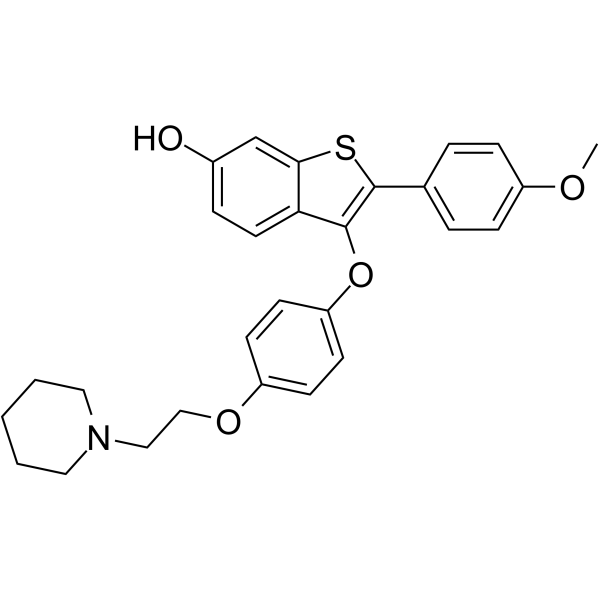
Arzoxifene (LY353381) is an orally active selective estrogen receptor modulator with a fixed ring structure similar to raloxifene. Arzoxifene has minimal side effects with powerful antiestrogenic effects on breast cancer and endometrium, with equally strong favorable estrogenic effects on bone and lipid profile.
Para uso exclusivo en investigación. No vendemos a pacientes.
- No. CAS: 182133-25-1
- Fòrmula: C28H29NO4S
- Peso molecular:475.60
-
Almacenamiento:
Please store the product under the recommended conditions in the Certificate of Analysis.

To place orders, for customer services and technical support, please contact: MedChemExpress USA
Tel: 609-228-6898 E-mail: [email protected] [email protected]


-
 Actividad biológica
-
Chemical Information
- Protocolo
- Pureza y Documentación
- Referencias
-
 Help & FAQs


Publications Citing Use of MedChemExpress (MCE) Arzoxifene
More

Actividad biológica
Descripciòn
IC50 & Target
estrogen[1]
Cellular Effect
|
Cell Line

|
Type | Value | Description | References |
|---|---|---|---|---|
| MCF7 | IC50 |
0.3 nM
Compound: 8
|
Antagonist activity at estrogen receptor in human MCF7 cells assessed as inhibition of 17beta-estradiol-mediated transcriptional activation after 24 hrs by luciferase reporter gene assay
Antagonist activity at estrogen receptor in human MCF7 cells assessed as inhibition of 17beta-estradiol-mediated transcriptional activation after 24 hrs by luciferase reporter gene assay
|
[PMID: 25879485] |
| MCF7 | IC50 |
0.4 μM
Compound: 8
|
Cytotoxicity against human MCF7 cells assessed as cell viability after 5 days by CellTiter-Glo assay
Cytotoxicity against human MCF7 cells assessed as cell viability after 5 days by CellTiter-Glo assay
|
[PMID: 25879485] |
| MCF7 | EC50 |
0.0002 μM
Compound: 8
|
Induction of estrogen receptor-alpha degradation in human MCF7 cells after 4 hrs by in-cell western assay
Induction of estrogen receptor-alpha degradation in human MCF7 cells after 4 hrs by in-cell western assay
|
[PMID: 25879485] |
| MCF7 | EC50 |
0.2 nM
Compound: 8
|
Induction of estrogen receptor-alpha degradation in human MCF7 cells after 4 hrs by in-cell western assay
Induction of estrogen receptor-alpha degradation in human MCF7 cells after 4 hrs by in-cell western assay
|
[PMID: 25879485] |
In Vitro
Arzoxifene reduces estrogen receptor expression in endometrial cancer cell lines (ECC-1)[1].
MedChemExpress (MCE) has not independently confirmed the accuracy of these methods. They are for reference only. Further protocols information, click here.
In Vivo
Ensayo clínico
| NCT Number | Sponsor | Condition | Start Date |
Phase
|
|---|---|---|---|---|
| NCT01329991 | Plexxikon| | 2011-05 | PHASE1 |


Chemical Information
-
No. CAS 182133-25-1
-
Peso molecular 475.60
-
Fòrmula C28H29NO4S
-
SMILES
OC1=CC=C(C(OC2=CC=C(OCCN3CCCCC3)C=C2)=C(C4=CC=C(OC)C=C4)S5)C5=C1
-
Synonyms
LY353381; SERM III
-
Envío
Room temperature in continental US; may vary elsewhere.
-
Almacenamiento
Please store the product under the recommended conditions in the Certificate of Analysis.


Publications (1)
-
Journal Impact Factor
-
Most Recent
-
Viruses
Antiviral Activity of Selective Estrogen Receptor Modulators against Severe Fever with Thrombocytopenia Syndrome Virus In Vitro and In Vivo. [Abstract]2024 Aug 20;16(8):1332. PMID: 39205306

Protocolo
-
Research Protocol for Endocrine Diseases
Endocrine diseases often arise from disrupted hormone production, hormone signaling, or target-tissue responsiveness; for diabetes-focused endocrine disease models, insulin signaling regulates glucose uptake, hepatic glucose output, lipid metabolism, and β-cell compensation. Type 2 diabetes develops through interacting defects in insulin resistance, β-cell dysfunction, adipose inflammation, hepatic glucose overproduction, altered incretin signaling, and ectopic lipid metabolism. A major unresolved question is whether endocrine dysfunction is driven primarily by target-tissue insulin resistance, intrinsic β-cell failure, immune/inflammatory stress, or combined multi-organ failure that differs by disease stage.
-
Breast Cancer Modeling
Breast cancer is a heterogeneous cancer, and it has been distinguished into four subtypes: luminal A, luminal B, HER2-positive and basal-like. Molecular mutations, epigenetic alterations, hormone exposure and immune microenvironment are related to the progression of breast cancer.


Pureza y Documentación
Referencias

Calculators
Concentration (start) × Volume (start) = Concentration (final) × Volume (final)


Arzoxifene Related Classifications
HY-13556 Related Classifications
 Powered by Bioz