



L48H37
Based on 1 publication(s) in Google Scholar
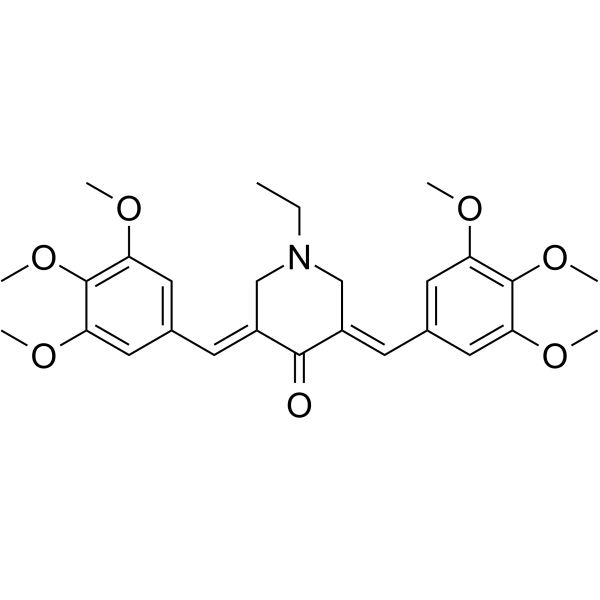
L48H37 is an analog of Curcumin (HY-N0005) with improved chemical stability. L48H37 is a potent and specific myeloid differentiation protein 2 (MD2) inhibitor and inhibits the interaction and signaling transduction of LPS-TLR4/MD2. L48H37 is used for the research of sepsis or lung injury treatment.
Para uso exclusivo en investigación. No vendemos a pacientes.
- Pureza : 97.13%
- No. CAS: 343307-76-6
- Fòrmula: C27H33NO7
- Peso molecular:483.55
-
Almacenamiento:
4°C, protect from light
* In solvent : -80°C, 6 months; -20°C, 1 month (protect from light)

To place orders, for customer services and technical support, please contact: MedChemExpress USA
Tel: 609-228-6898 E-mail: [email protected] [email protected]


-
 Actividad biológica
-
Chemical Information
-
Solvente y solubilidad
- Protocolo
- Pureza y Documentación
- Referencias
-
 Help & FAQs



Publications Citing Use of MedChemExpress (MCE) L48H37
More

Actividad biológica
Descripciòn
IC50 & Target
[1]|
TLR4 |
Cellular Effect
|
Cell Line

|
Type | Value | Description | References |
|---|---|---|---|---|
| A549 | IC50 |
4.2 μM
Compound: 7B
|
Cytotoxicity against human A549 cells assessed as reduction in cell viability after 72 hrs by MTT assay
Cytotoxicity against human A549 cells assessed as reduction in cell viability after 72 hrs by MTT assay
|
[PMID: 29655083] |
| HEp-2 | IC50 |
16.59 μM
Compound: 569; CA15
|
Antiproliferative activity against human HEp-2 cells assessed as cell growth inhibition measured after 72 hrs by MTT assay
Antiproliferative activity against human HEp-2 cells assessed as cell growth inhibition measured after 72 hrs by MTT assay
|
[PMID: 32172081] |
| HEp-2 | IC50 |
16.59 μM
Compound: 179
|
Cytotoxicity against human Hep2 Cells
Cytotoxicity against human Hep2 Cells
|
[PMID: 31129455] |
| L02 | IC50 |
12.8 μM
Compound: 7B
|
Cytotoxicity against human HL7702 cells assessed as reduction in cell viability after 72 hrs by MTT assay
Cytotoxicity against human HL7702 cells assessed as reduction in cell viability after 72 hrs by MTT assay
|
[PMID: 29655083] |
| L02 | IC50 |
46.79 μM
Compound: 569; CA15
|
Antiproliferative activity against human HL7702 cells assessed as cell growth inhibition measured after 72 hrs by MTT assay
Antiproliferative activity against human HL7702 cells assessed as cell growth inhibition measured after 72 hrs by MTT assay
|
[PMID: 32172081] |
| L02 | IC50 |
46.79 μM
Compound: 179
|
Cytotoxicity against human HL-7702 cells
Cytotoxicity against human HL-7702 cells
|
[PMID: 31129455] |
| NCI-H1650 | IC50 |
8.2 μM
Compound: 7B
|
Cytotoxicity against human NCI-H1650 cells assessed as reduction in cell viability after 72 hrs by MTT assay
Cytotoxicity against human NCI-H1650 cells assessed as reduction in cell viability after 72 hrs by MTT assay
|
[PMID: 29655083] |
| NCI-H1975 | IC50 |
6.5 μM
Compound: 7B
|
Cytotoxicity against human NCI-H1975 cells assessed as reduction in cell viability after 72 hrs by MTT assay
Cytotoxicity against human NCI-H1975 cells assessed as reduction in cell viability after 72 hrs by MTT assay
|
[PMID: 29655083] |
| NCI-H460 | IC50 |
4.9 μM
Compound: 7B
|
Cytotoxicity against human H460 cells assessed as reduction in cell viability after 72 hrs by MTT assay
Cytotoxicity against human H460 cells assessed as reduction in cell viability after 72 hrs by MTT assay
|
[PMID: 29655083] |
In Vitro
L48H37 inhibits LPS-induced inflammation, particularly TNF-α and IL-6 production and gene expression in mouse macrophages[1].L48H37 (0-20?μM; 24 hours) decreases the viability of A549 and H460 cells with IC50 values of 5.3?μM and 2.3?μM, respectively, which is more effective compared to curcumin in lung cancer cells. It shows a low cytotoxicity on normal human lung epithelial cells (BEAS-2B) with IC50?of 21?μM[2].L48H37 (1, 2, or 4?μM; 16 hours) dose‐dependently inhibited the expression of p‐Cdc2 and Cdc2, and increases the expression of p53. It also shows increased levels of cleaved poly (ADP‐ribosyl) polymerase (PARP) and reduced levels of anti‐apoptotic protein Bcl‐2 in H460 and A549 cells[2].L48H37 (4?μM; 16?hours) rapidly induces intracellular ROS levels dose-dependently as detected by increased DCF levels in H460 and A549 cells[2].
MedChemExpress (MCE) has not independently confirmed the accuracy of these methods. They are for reference only. Further protocols information, click here.
-
Cell Line:A549 and H460 cells; BEAS-2B cells
-
Concentration:0.625, 1.25, 2.5, 5, 7.5, 10, and 20 µM
-
Incubation Time:24 hours
-
Result:Inhibited lung cancer cells growth in a concentration-dependent manner.
-
Cell Line:A549 and H460 cells
-
Concentration:0.625, 1.25, 2.5, 5, 7.5, 10, and 20 µM
-
Incubation Time:24 hours
-
Result:Decreased p‐Cdc2, Cdc2, and Bcl‐2 expression in 2 lung cancer cells.
In Vivo
MedChemExpress (MCE) has not independently confirmed the accuracy of these methods. They are for reference only.
-
Animal Model:5‐week‐old athymic BALB/cA nu/nu female mice (18‐22 g)[2]
-
Dosage:5 mg or 10 mg/kg
-
Administration:Intraperitoneal injection; once daily; 11‐day
-
Result:Reduced tumor wet weights as compared to vehicle control. Decreased the levels of p‐STAT3, and increased the levels of p‐EIF2α and ATF4 in vivo.Exhibited no significant structural changes in mice.


Chemical Information
-
No. CAS 343307-76-6
-
Appearance Solid
-
Peso molecular 483.55
-
Fòrmula C27H33NO7
-
Color Light yellow to yellow
-
SMILES
O=C1/C(CN(C/C1=C\C2=CC(OC)=C(C(OC)=C2)OC)CC)=C/C3=CC(OC)=C(C(OC)=C3)OC
-
Envío
Room temperature in continental US; may vary elsewhere.
-
Almacenamiento
4°C, protect from light
* In solvent : -80°C, 6 months; -20°C, 1 month (protect from light)


Publications (1)
-
Journal Impact Factor
-
Most Recent


Solvente y solubilidad
In Vitro:
DMSO : 50 mg/mL (103.40 mM; Need ultrasonic; Hygroscopic DMSO has a significant impact on the solubility of product, please use newly opened DMSO)
Please refer to the solubility information to select the appropriate solvent. Once prepared, please aliquot and store the solution to prevent product inactivation from repeated freeze-thaw cycles.
Storage method and period of stock solution: -80°C, 6 months; -20°C, 1 month (protect from light). When stored at -80°C, please use it within 6 months. When stored at -20°C, please use it within 1 month.
Please refer to the solubility information to select the appropriate solvent. Once prepared, please aliquot and store the solution to prevent product inactivation from repeated freeze-thaw cycles.
Storage method and period of stock solution: -80°C, 6 months; -20°C, 1 month (protect from light). When stored at -80°C, please use it within 6 months. When stored at -20°C, please use it within 1 month.
Concentration (start) × Volume (start) = Concentration (final) × Volume (final)

Protocolo
-
HL-60 granulocytic/neutrophil-like differentiation
HL-60 cells are a human promyelocytic leukemia cell model that can be induced toward granulocytic/neutrophil-like differentiation by DMSO, ATRA, or combined ATRA+DMSO treatment; differentiation is evaluated by morphology, reduced proliferation, CD11b gain, CD71 loss, phagocytosis, oxidative burst/NBT reduction, ROS formation, and, where relevant, NET-related assays. A literature-supported default protocol is 5 days of combined 1 µM ATRA plus 1% DMSO, because this condition produced neutrophil-like morphology, cell-cycle arrest, high CD11b positivity, low CD71 positivity, and increased phagocytic capacity compared with ATRA or DMSO alone in the cited study.
-
LPS-Induced Endotoxemia/Systemic Inflammation
Lipopolysaccharide (LPS)-induced endotoxemia is a widely used in vivo model of acute systemic inflammation in which LPS, a Gram-negative bacterial endotoxin, activates innate immune signaling primarily through TLR4, leading to rapid and transient induction of pro-inflammatory cytokines such as TNF-α, IL-6, and IL-1β in circulation and tissues. This cytokine surge is commonly used as a measurable readout of systemic inflammatory activation and immune dysregulation, and is typically assessed within hours after intraperitoneal LPS administration in mouse models of endotoxemia. The model captures key features of systemic inflammatory response syndrome, including cytokine release, immune cell activation, and downstream tissue responses, and has been used to evaluate anti-inflammatory interventions such as cytokine modulation, lipid mediators, and immune cell-targeting therapies.
-
Inhalation Toxicity Study
Inhalation toxicity studies expose rodents to a controlled aerosol, vapor, gas, or smoke atmosphere and assess respiratory and systemic toxicity using exposure-atmosphere characterization, clinical observations, body and organ weights, bronchoalveolar lavage fluid, histopathology, blood chemistry, hematology, and, when included, molecular endpoints such as transcriptomics, proteomics, lipidomics, or tissue burden analysis. The primary biological readouts are airway irritation, pulmonary inflammation, cytotoxicity, altered surfactant or lipid homeostasis, impaired particle clearance, and tissue remodeling, reflected by BALF cell differentials, BALF protein, LDH, phosphatase activities, cytokines, lung weight, microscopic respiratory-tract lesions, and retained lung burden.


Pureza y Documentación
-
Ficha de datos (276 KB)
-
SDS (393 KB)
- English - EN (393 KB)
- Français - FR (393 KB)
- Deutsch - DE (393 KB)
- Norwegian - NO (393 KB)
- Español - ES (393 KB)
- Swedish - SV (393 KB)
- Italian - IT (393 KB)
- Korean - KR (393 KB)
- Portuguese - PT (393 KB)
-
Instrucciones de manejo (2659 KB)
Referencias
[1]. Yi Wang, et al. Curcumin Analog L48H37 Prevents Lipopolysaccharide-Induced TLR4 Signaling Pathway Activation and Sepsis via Targeting MD2. J Pharmacol Exp Ther. 2015 Jun;353(3):539-50 [Content Brief]
[2]. Chen Feng, et al. Curcumin analog L48H37 induces apoptosis through ROS-mediated endoplasmic reticulum stress and STAT3 pathways in human lung cancer cells. Mol Carcinog. 2017 Jul;56(7):1765-1777. [Content Brief]


Complete Stock Solution Preparation Table
Please refer to the solubility information to select the appropriate solvent. Once prepared, please aliquot and store the solution to prevent product inactivation from repeated freeze-thaw cycles.
Storage method and period of stock solution: -80°C, 6 months; -20°C, 1 month (protect from light). When stored at -80°C, please use it within 6 months. When stored at -20°C, please use it within 1 month.
| Optional Solvent | Concentration Solvent Mass | 1 mg | 5 mg | 10 mg | 25 mg |
|---|---|---|---|---|---|
| DMSO | 1 mM | 2.0680 mL | 10.3402 mL | 20.6804 mL | 51.7010 mL |
| 5 mM | 0.4136 mL | 2.0680 mL | 4.1361 mL | 10.3402 mL | |
| 10 mM | 0.2068 mL | 1.0340 mL | 2.0680 mL | 5.1701 mL | |
| 15 mM | 0.1379 mL | 0.6893 mL | 1.3787 mL | 3.4467 mL | |
| 20 mM | 0.1034 mL | 0.5170 mL | 1.0340 mL | 2.5850 mL | |
| 25 mM | 0.0827 mL | 0.4136 mL | 0.8272 mL | 2.0680 mL | |
| 30 mM | 0.0689 mL | 0.3447 mL | 0.6893 mL | 1.7234 mL | |
| 40 mM | 0.0517 mL | 0.2585 mL | 0.5170 mL | 1.2925 mL | |
| 50 mM | 0.0414 mL | 0.2068 mL | 0.4136 mL | 1.0340 mL | |
| 60 mM | 0.0345 mL | 0.1723 mL | 0.3447 mL | 0.8617 mL | |
| 80 mM | 0.0259 mL | 0.1293 mL | 0.2585 mL | 0.6463 mL | |
| 100 mM | 0.0207 mL | 0.1034 mL | 0.2068 mL | 0.5170 mL |


L48H37 Related Classifications
HY-126154 Related Classifications
 Powered by Bioz