



hBChE-IN-1
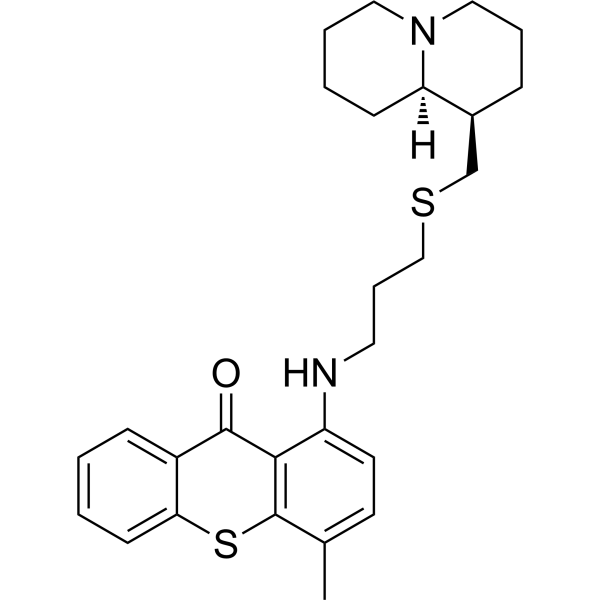
hBChE-IN-1 (compound 4), a quinolizidinyl derivative, is a potent hBChE inhibitor (IC50=7 nM) and highly selective over hAChE. hBChE-IN-1 shows inhibitory activity against tau and Aβ40 protein aggregation, with IC50 values of 20 and 4.3 μM, respectively. hBChE-IN-1 can be used for Alzheimer's disease research.
For research use only. We do not sell to patients.
- CAS No.: 1776948-12-9
- Formula: C27H34N2OS2
- Molecular Weight:466.70
-
Storage:
Please store the product under the recommended conditions in the Certificate of Analysis.

To place orders, for customer services and technical support, please contact: MedChemExpress USA
Tel: 609-228-6898 E-mail: [email protected] [email protected]


-
 Biological Activity
-
Chemical Information
- Protocols
- Purity & Documentation
- References
-
 Help & FAQs




Biological Activity
Description
IC50 & Target
|
hBCHE 0.0070 ± 0 μM (IC50) |
equine serum BChE 0.088 μM (IC50) |
EeAChE 0.18 μM (IC50) |
hAChE 7.84 ± 0.8 μM (IC50) |


Chemical Information
-
CAS No. 1776948-12-9
-
Molecular Weight 466.70
-
Formula C27H34N2OS2
-
SMILES
[H][C@]12CCCCN1CCC[C@H]2CSCCCNC3=CC=C(C4=C3C(C5=CC=CC=C5S4)=O)C
-
Shipping
Room temperature in continental US; may vary elsewhere.
-
Storage
Please store the product under the recommended conditions in the Certificate of Analysis.


Purity & Documentation
References

Calculators
Concentration (start) × Volume (start) = Concentration (final) × Volume (final)


hBChE-IN-1 Related Classifications
HY-149273 Related Classifications
 Powered by Bioz