



CRAMP (mouse)
Based on 1 publication(s) in Google Scholar
CRAMP (mouse) is an antibacterial peptide and a functional homolog of LL-37. CRAMP (mouse) exhibits potent antibacterial activity against Gram-negative bacteria. The complex formed by CRAMP (mouse) and CpG can activate macrophages to secrete TNF-α. CRAMP (mouse) plays a key role in wound healing, immune regulation and maintenance of intestinal homeostasis.
For research use only. We do not sell to patients.
- Purity: 98.97%
- CAS No.: 376364-36-2
- Formula: C178H302N50O46
- Molecular Weight:3878.61
-
Storage:
Sealed storage, away from moisture.
Powder -80°C, 2 years , -20°C, 1 year* In solvent : -80°C, 6 months; -20°C, 1 month (sealed storage, away from moisture)

To place orders, for customer services and technical support, please contact: MedChemExpress USA
Tel: 609-228-6898 E-mail: [email protected] [email protected]


-
 Biological Activity
-
Chemical Information
-
Solvent & Solubility
- Purity & Documentation
- References
-
 Help & FAQs





Publications Citing Use of MedChemExpress (MCE) CRAMP (mouse)
More

Biological Activity
CRAMP forms complexes with bacterial genomic DNA, as detected by gel shift assay[2].
The complex formed by CRAMP (at a 1:1 molar ratio with 3 μM CpG) and CpG activates RAW264.7 mouse macrophages to secrete TNF-α[2].
MedChemExpress (MCE) has not independently confirmed the accuracy of these methods. They are for reference only.
-
Cell Line:RAW264.7 murine macrophage
-
Concentration:1:1 molar ratio with 3 μM CpG
-
Incubation Time:15 min (with peptide-CpG mixture); overnight (fresh medium incubation)
-
Result:Activated RAW264.7 macrophages, inducing secretion of TNF-α.
Failed to activate RAW264.7 macrophages when a single arginine residue was substituted by citrulline and complexed with CpG.


Chemical Information
-
CAS No. 376364-36-2
-
Appearance Solid
-
Molecular Weight 3878.61
-
Formula C178H302N50O46
-
Color White to off-white
-
Sequence
Gly-Leu-Leu-Arg-Lys-Gly-Gly-Glu-Lys-Ile-Gly-Glu-Lys-Leu-Lys-Lys-Ile-Gly-Gln-Lys-Ile-Lys-Asn-Phe-Phe-Gln-Lys-Leu-Val-Pro-Gln-Pro-Glu-Gln
-
Sequence Shortening
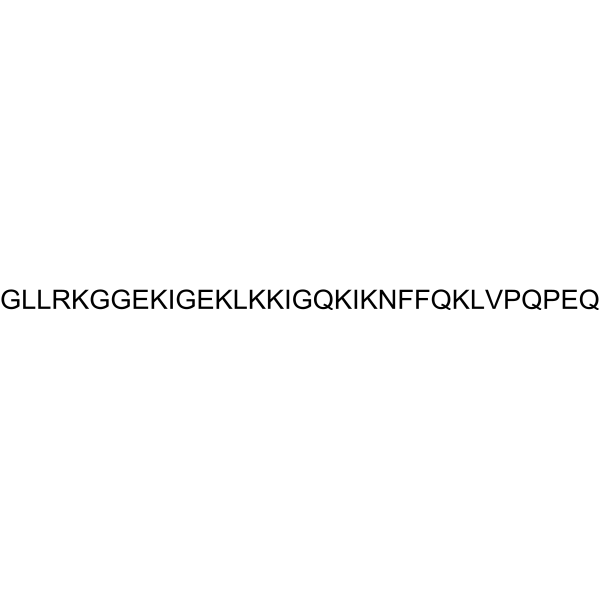
GLLRKGGEKIGEKLKKIGQKIKNFFQKLVPQPEQ
-
Shipping
Room temperature in continental US; may vary elsewhere.
-
Storage
Sealed storage, away from moisture
Powder -80°C 2 years -20°C 1 year * In solvent : -80°C, 6 months; -20°C, 1 month (sealed storage, away from moisture)


Publications (1)
-
Journal Impact Factor
-
Most Recent


Solvent & Solubility
H2O : 50 mg/mL (12.89 mM; Need ultrasonic)
DMSO : 3.33 mg/mL (0.86 mM; Need ultrasonic; Hygroscopic DMSO has a significant impact on the solubility of product, please use newly opened DMSO)
Please refer to the solubility information to select the appropriate solvent. Once prepared, please aliquot and store the solution to prevent product inactivation from repeated freeze-thaw cycles.
Storage method and period of stock solution: -80°C, 6 months; -20°C, 1 month (sealed storage, away from moisture). When stored at -80°C, please use it within 6 months. When stored at -20°C, please use it within 1 month.
* Note: If you choose water as the stock solution, please dilute it to the working solution, then filter and sterilize it with a 0.22 μm filter before use.
Please refer to the solubility information to select the appropriate solvent. Once prepared, please aliquot and store the solution to prevent product inactivation from repeated freeze-thaw cycles.
Storage method and period of stock solution: -80°C, 6 months; -20°C, 1 month (sealed storage, away from moisture). When stored at -80°C, please use it within 6 months. When stored at -20°C, please use it within 1 month.
* Note: If you choose water as the stock solution, please dilute it to the working solution, then filter and sterilize it with a 0.22 μm filter before use.
Concentration (start) × Volume (start) = Concentration (final) × Volume (final)


Purity & Documentation
-
Data Sheet (281 KB)
-
SDS (252 KB)
- English - EN (252 KB)
- Français - FR (252 KB)
- Deutsch - DE (252 KB)
- Norwegian - NO (252 KB)
- Español - ES (252 KB)
- Swedish - SV (252 KB)
- Italian - IT (252 KB)
- Korean - KR (252 KB)
- Portuguese - PT (252 KB)
-
Handling Instructions (2659 KB)
References
[1]. De Brucker K, et al. Derivatives of the mouse cathelicidin-related antimicrobial peptide (CRAMP) inhibit fungal and bacterial biofilm formation. Antimicrob Agents Chemother. 2014;58(9):5395-5404. [Content Brief]
[2]. Wong A, et al. A Novel Biological Role for Peptidyl-Arginine Deiminases: Citrullination of Cathelicidin LL-37 Controls the Immunostimulatory Potential of Cell-Free DNA. J Immunol. 2018;200(7):2327-2340. [Content Brief]


Complete Stock Solution Preparation Table
Please refer to the solubility information to select the appropriate solvent. Once prepared, please aliquot and store the solution to prevent product inactivation from repeated freeze-thaw cycles.
Storage method and period of stock solution: -80°C, 6 months; -20°C, 1 month (sealed storage, away from moisture). When stored at -80°C, please use it within 6 months. When stored at -20°C, please use it within 1 month.
| Optional Solvent | Concentration Solvent Mass | 1 mg | 5 mg | 10 mg | 25 mg |
|---|---|---|---|---|---|
| H2O | 1 mM | 0.2578 mL | 1.2891 mL | 2.5782 mL | 6.4456 mL |
| 5 mM | 0.0516 mL | 0.2578 mL | 0.5156 mL | 1.2891 mL | |
| 10 mM | 0.0258 mL | 0.1289 mL | 0.2578 mL | 0.6446 mL |
* Note: If you choose water as the stock solution, please dilute it to the working solution, then filter and sterilize it with a 0.22 μm filter before use.


CRAMP (mouse) Related Classifications
HY-P4855 Related Classifications
 Powered by Bioz