



ISB2001

Based on 1 Customer Validation
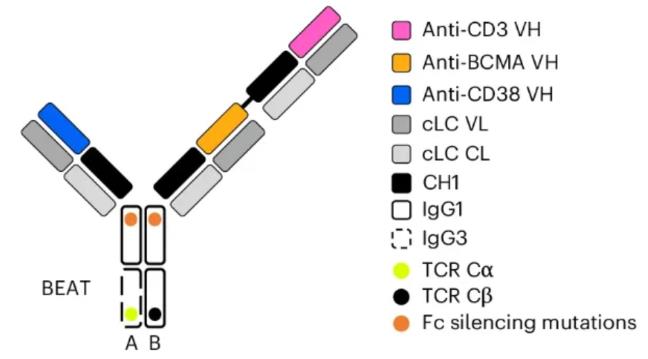
ISB2001 is a trispecific antibody targeting CD38, CD3 and BCMA. ISB2001 effectively counteracts tumor immune escape mechanisms caused by antigen downregulation, antigen loss, soluble factor competition and other factors. ISB2001 is applicable to relevant research on multiple myeloma and relapsed/refractory multiple myeloma.
For research use only. We do not sell to patients.
- Purity : 99.17%
- Molecular Weight:169.15 kDa
-
Storage:
Please store the product under the recommended conditions in the Certificate of Analysis.


To place orders, for customer services and technical support, please contact: MedChemExpress USA
Tel: 609-228-6898 E-mail: [email protected] [email protected]


-
 Biological Activity
-
Chemical Information
- Purity & Documentation
- References
-
 Help & FAQs





Biological Activity
Description
Isotype
Human IgG1 kappa-Fab
Recommend Isotype Controls
Species Reactivity
Human
IC50 & Target
CD38 & CD3 & BCMA
In Vitro
ISB2001 exhibits potent, affinity-driven tumor cell killing activity across multiple multiple myeloma (MM) cell lines, with subpicomolar EC50 values[2].
ISB2001 remains active against MM cells with single antigen loss, and can overcome the antigen escape mechanism that limits single antigen-targeted therapies[2].
ISB2001 is minimally affected by soluble factors (sBCMA, APRIL, sCD38) present in the serum of multiple myeloma (MM) patients, with only a 30-fold increase in its EC50; in contrast, the EC50 of BCMA-targeting TCEs increases to a significantly greater extent[2].
ISB2001 (0.01-1 nM) exhibits superior cytotoxicity against primary multiple myeloma (MM) cells derived from bone marrow aspirates and peripheral blood, inducing significant + CD138 tumor cell killing and CD8+ T cell activation[2].
MedChemExpress (MCE) has not independently confirmed the accuracy of these methods. They are for reference only.
In Vivo
ISB2001 (0.02-0.5 mg/kg, intravenous injection, once weekly for 3 consecutive weeks) induces significant, dose-dependent tumor growth inhibition and complete regression in the NCI-H929 multiple myeloma xenograft model[2].
ISB2001 (0.1-1 mg/kg; subcutaneous injection; once weekly for 3 consecutive weeks) induces complete tumor regression in all humanized HIS-NXG mice treated with 1 mg/kg, and elicits partial persistent rejection responses in mice treated with 0.1 mg/kg[2].
ISB2001 (1.5 mg/kg; subcutaneous injection; single administration) does not induce depletion of CD38-expressing bone marrow hematopoietic progenitor cells or lymphoid cells in humanized HIS-NXG mice, exhibiting favorable on-target off-tumor safety profiles[2].
MedChemExpress (MCE) has not independently confirmed the accuracy of these methods. They are for reference only.
-
Animal Model:NSG (NOD.Cg-Prkdcscid Il2rgtm1Wjl/SzJ) (female, 6-7 weeks old)[2]
-
Dosage:0.02 mg/kg; 0.1 mg/kg; 0.5 mg/kg
-
Administration:i.v.; once weekly; 3 weeks
-
Result:Induced significant tumor growth control relative to vehicle at all doses.
Induced complete tumor regression in all treated mice at 0.5 mg/kg and 0.1 mg/kg.
Induced partial efficacy with reduced tumor growth compared to vehicle at 0.02 mg/kg.
Elevated tumor-infiltrating CD8+ T cell expression of CD69 (84.3% positive cells) and CD25 (45.6% positive cells) two days after treatment, compared to vehicle-treated mice (2.8% CD69+, 0.0% CD25+) and CD3×DU×DU-treated mice (13.0% CD69+, 0.0% CD25+).
Elevated concentrations of IFNγ (mean 100-250 ng/g tumor) and TNF (mean 1000-2500 pg/g tumor) in tumor supernatants, with no significant systemic cytokine activation.
-
Animal Model:NCG (NOD-Prkdcem26Cd52Il2rgem26Cd22/NjuCrl) (female, 6-7 weeks old)[2]
-
Dosage:0.02 mg/kg; 0.1 mg/kg; 0.5 mg/kg
-
Administration:i.v.; once weekly; 3 weeks
-
Result:Induced significant tumor growth control at all tested doses relative to vehicle.
Induced complete tumor regression in all treated mice at 0.5 mg/kg and 0.1 mg/kg.
Induced partial tumor growth inhibition at 0.02 mg/kg.
-
Animal Model:HIS-NXG (human immunized system-NOD-Prkdcscid-IL2rgTm1/Rj, reconstituted with human cord blood CD34+ cells) (female, 24-30 weeks old)[2]
-
Dosage:0.1 mg/kg; 1 mg/kg
-
Administration:s.c.; once weekly; 3 weeks
-
Result:Induced complete tumor regression in all mice treated with 1 mg/kg.
Induced a treatment response in all mice treated with 0.1 mg/kg, with 4 out of 9 mice achieving durable tumor rejection; remaining mice with palpable tumors showed greatly reduced tumor regrowth kinetics compared to vehicle-treated mice.
Conjugated
Unconjugated
Reconsititution
The product can be reconstituted/diluted with sterile PBS or saline.
Format
-
Human IgG1 kappa-FAB
Application
ELISA, FACS, Functional assay
Verified Bioactivity
-
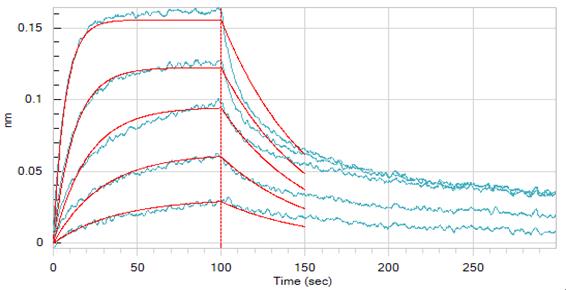
 Loaded ISB2001 on ProA biosensor, can bind Human BCMA/TNFRSF17 Protein, His Tag with an affinity constant of 1.30E-10 M as determined in BLI assay.
 -
-
 Loaded ISB2001 on ProA biosensor, can bind CD38-Avi tag His with an affinity constant of 9.09E-09 M as determined in BLI assay.


Chemical Information
-
Appearance Liquid
-
Molecular Weight 169.15 kDa
-
Color Colorless to light yellow
-
SMILES
[ISB2001]
-
Shipping
Shipping with dry ice.
-
Formulation
Please refer to the lot-specific COA for specific buffer information.
-
Storage
Please store the product under the recommended conditions in the Certificate of Analysis.


Purity & Documentation
-
Data Sheet (264 KB)
-
SDS (251 KB)
- English - EN (251 KB)
- Français - FR (251 KB)
- Deutsch - DE (251 KB)
- Norwegian - NO (251 KB)
- Español - ES (251 KB)
- Swedish - SV (251 KB)
- Italian - IT (251 KB)
- Korean - KR (251 KB)
- Portuguese - PT (251 KB)
-
Inhibitory Antibodies User Guide (603 KB)
References

Calculators
Concentration (start) × Volume (start) = Concentration (final) × Volume (final)


ISB2001 Related Classifications
HY-P991490 Related Classifications
 Powered by Bioz