



Phosphoramide mustard
Based on 10 publication(s) in Google Scholar
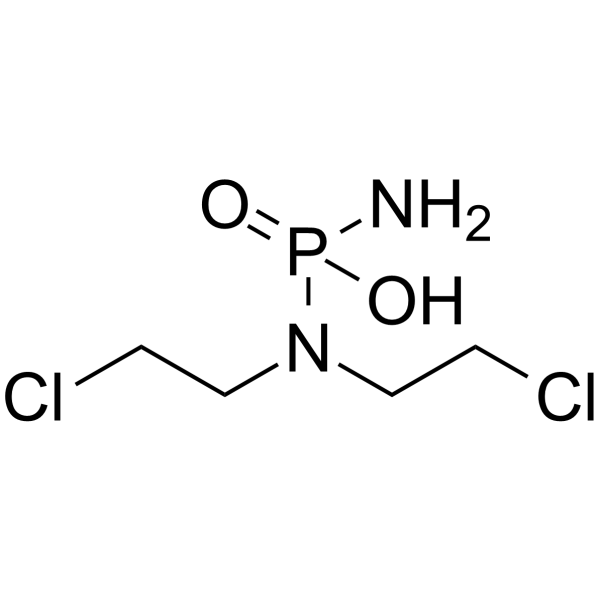
Phosphoramide mustard is a biologically active metabolite of Cyclophosphamide (HY-17420), with anticancer activitiy. Phosphoramide mustard induces DNA damage.
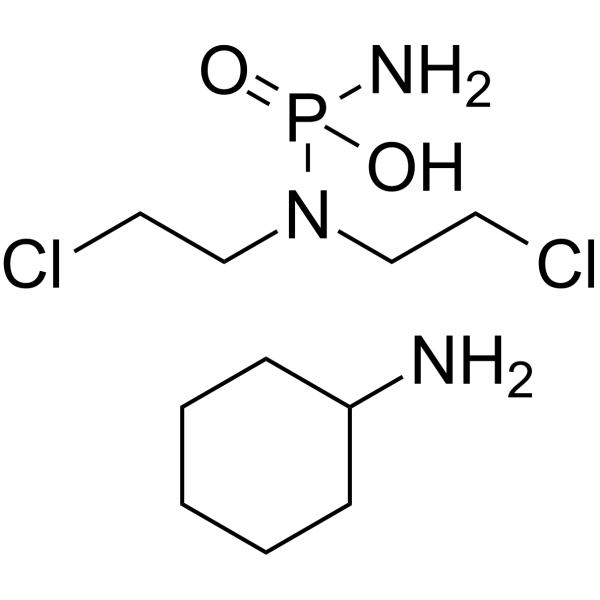
The free form of the compound is prone to instability, it is advisable to consider the stable salt form (Phosphoramide mustard cyclohexanamine) that retains the same biological activity.
For research use only. We do not sell to patients.
- CAS No.: 10159-53-2
- Formula: C4H11Cl2N2O2P
- Molecular Weight:221.02
-
Storage:
Please store the product under the recommended conditions in the Certificate of Analysis.

To place orders, for customer services and technical support, please contact: MedChemExpress USA
Tel: 609-228-6898 E-mail: [email protected] [email protected]
Other In-stock Forms of Phosphoramide mustard


-
 Biological Activity
-
Chemical Information
- Protocols
- Purity & Documentation
- References
-
 Help & FAQs



Publications Citing Use of MedChemExpress (MCE) Phosphoramide mustard
More- Sci Adv. 2026 Apr 3;12(14):eaec8684. [Abstract]
- Int J Nanomedicine. 2025 Aug 22:20:10195-10212. [Abstract]
- Stem Cell Res Ther. 2024 Apr 5;15(1):97. [Abstract]
- Sci Rep. 2024 Aug 16;14(1):19008. [Abstract]
- Climacteric. 2025 Apr;28(2):200-211. [Abstract]
- J Funct Foods. 2025 Jun.
- bioRxiv. 2026 Sep 8:2026.09.04.749413.
- SSRN. 2026 Jun 21.
- Tufts University. 2025.
- SSRN. 2024 Mar 21.
 Customer Validation & Images

-
Cell Proliferation/Viability Assay

-
Bio/Physico-chemical Assay

-
Cell Imaging/Staining

-
WB

-
Cell Imaging/Staining


Biological Activity
Description
IC50 & Target
DNA Alkylator[1]
Cellular Effect
|
Cell Line

|
Type | Value | Description | References |
|---|---|---|---|---|
| V79 | IC50 |
77 μM
Compound: 27
|
In vitro cytotoxicity against V-79 chinese hamster lung fibroblasts (3 hr drug exposure time) by clonogenic assay
In vitro cytotoxicity against V-79 chinese hamster lung fibroblasts (3 hr drug exposure time) by clonogenic assay
|
[PMID: 15239662] |
In Vitro
Phosphoramide mustard causes cytotoxicity through forming cross-linked DNA adducts which inhibit DNA strand separation during replication[1].
Phosphoramide mustard (3-6 μM; 48 hours) reduces cell viability in rat spontaneously immortalized granulosa cells (SIGCs)[1].
Phosphoramide mustard (3-6 μM; 24-48 hours) induces DNA adduct formation and ovarian DNA damage[1].
Phosphoramide mustard (3-6 μM; 24-48 hours) increases DNA damage responses (DDR) gene mRNA expression levels and DDR proteins[1].
MedChemExpress (MCE) has not independently confirmed the accuracy of these methods. They are for reference only.
-
Cell Line:SIGCs
-
Concentration:0.5 μM, 1 μM, 3 μM, 6 μM
-
Incubation Time:48 hours
-
Result:Reduced cell viability at concentrations of 3 μM and higher.
-
Cell Line:SIGCs
-
Concentration:3 μM, 6 μM
-
Incubation Time:24 hours, 48 hours
-
Result:Increased DDR gene mRNA expression levels.
-
Cell Line:SIGCs
-
Concentration:3 μM, 6 μM
-
Incubation Time:24 hours, 48 hours
-
Result:Generally increased DDR proteins.
In Vivo
Phosphoramide mustard exhibits terminal elimination half-lives (rat 15.1 min) following intravenous administration (rat 59.4 mg/kg)[2].
MedChemExpress (MCE) has not independently confirmed the accuracy of these methods. They are for reference only.
-
Animal Model:Rat, subcutaneously implanted Walker 256 carcinosarcoma tumor[2]
-
Dosage:2.1 mg/kg, 4.8 mg/kg, 10.4 mg/kg, 20.7 mg/kg
-
Administration:Intraperitoneal injection, once daily, for 5 consecutive days
-
Result:Required to produce 50% inhibition of subcutaneous tumor growth with dose of 12 mg/kg.
-
Animal Model:Rats[2]
-
Dosage:59.4 mg/kg (Pharmacokinetic Analysis)
-
Administration:Intravenous injection
-
Result:T1/2 (15.1 min).


Chemical Information
-
CAS No. 10159-53-2
-
Molecular Weight 221.02
-
Formula C4H11Cl2N2O2P
-
SMILES
O=P(N(CCCl)CCCl)(N)O
-
Shipping
Room temperature in continental US; may vary elsewhere.
-
Storage
Please store the product under the recommended conditions in the Certificate of Analysis.


Publications (10)
-
Journal Impact Factor
-
Most Recent
-
Sci Adv
Regulation of mitochondrial ROS by C15ORF48 in a basal cell subpopulation contributes to chemotherapy resistance in TNBC. [Abstract]2026 Apr 3;12(14):eaec8684. PMID: 41931605 -
Int J Nanomedicine
Exosomes Derived From Human Mesenchymal Stem Cells Mitigate Follicular Interstitial Cell Ferroptosis via the miR-26a-5p/PTEN/GPX4 Axis in Rats with Chemotherapy-Induced Premature Ovarian Insufficiency. [Abstract]2025 Aug 22:20:10195-10212. PMID: 40873678 -
Stem Cell Res Ther
Pyrroloquinoline quinone promotes human mesenchymal stem cell-derived mitochondria to improve premature ovarian insufficiency in mice through the SIRT1/ATM/p53 pathway. [Abstract]2024 Apr 5;15(1):97. PMID: 38581065 -
Sci Rep
hUMSCs restore ovarian function in POI mice by regulating GSK3β-mediated mitochondrial dynamic imbalances in theca cells. [Abstract]2024 Aug 16;14(1):19008. PMID: 39152165 -
Climacteric
Intravenous administration of mitochondria improves ovarian function by anti-apoptosis in the premature ovarian insufficiency model. [Abstract]2025 Apr;28(2):200-211. PMID: 39791362 -
Phosphoramide mustard purchased from MedChemExpress. Usage Cited in: J Funct Foods. 2025 Jun.
Phosphoramide mustard cyclohexanamine (PM) (3–120 μM; 48 h) significantly inhibited Caco-2 cell viability compared with the control-treated group.
Phosphoramide mustard purchased from MedChemExpress. Usage Cited in: J Funct Foods. 2025 Jun.
Phosphoramide mustard cyclohexanamine (PM) (15–120 μM; 48 h) (PM) promoted the increase of MDA content in Caco-2 cells in a concentration-dependent manner.
Phosphoramide mustard purchased from MedChemExpress. Usage Cited in: J Funct Foods. 2025 Jun.
Phosphoramide mustard cyclohexanamine (PM) (15–120 μM; 48 h) significantly enhanced the red fluorescence intensity emitted by RhoNox-1 staining, indicating the specific accumulation of Fe2+ in Caco-2 cells.
Phosphoramide mustard purchased from MedChemExpress. Usage Cited in: J Funct Foods. 2025 Jun.
Phosphoramide mustard cyclohexanamine (PM) (15–120 μM; 48 h) treatment of Caco-2 cells caused overexpression of NCOA4 protein in a concentration-dependent manner.
Phosphoramide mustard purchased from MedChemExpress. Usage Cited in: J Funct Foods. 2025 Jun.
Phosphoramide mustard cyclohexanamine (PM) (30 μM; 48 h) induced autophagy in Caco-2 cells, as evidenced by increased autophagosomes and autophagolysosomes.
-
-
-
-


Purity & Documentation
References
[1]. Shanthi Ganesan, et al. Phosphoramide mustard exposure induces DNA adduct formation and the DNA damage repair response in rat ovarian granulosa cells. Toxicol Appl Pharmacol. 2015 Feb 1; 282(3): 252–258. [Content Brief]
[2]. S Genka, et al. Brain and plasma pharmacokinetics and anticancer activities of cyclophosphamide and phosphoramide mustard in the rat. Cancer Chemother Pharmacol. 1990;27(1):1-7. [Content Brief]

Calculators
Concentration (start) × Volume (start) = Concentration (final) × Volume (final)


Phosphoramide mustard Related Classifications
HY-137316 Related Classifications
 Powered by Bioz