



Itepekimab
Based on 1 publication(s) in Google Scholar
Itepekimab (REGN-3500) is an IgG4 monoclonal antibody against IL-33. Itepekimab reduced airway inflammation and related tissue damage in preliminary clinical studies. Itepekimab has potential effects in asthma, chronic obstructive pulmonary disease (COPD), and atopic dermatitis (AD).
For research use only. We do not sell to patients.
- Purity : 99.496%
- CAS No.: 2226742-52-3
- Molecular Weight:144.64 kDa
-
Storage:
Please store the product under the recommended conditions in the Certificate of Analysis.


To place orders, for customer services and technical support, please contact: MedChemExpress USA
Tel: 609-228-6898 E-mail: [email protected] [email protected]


-
 Biological Activity
-
Chemical Information
- Protocols
- Purity & Documentation
- References
-
 Help & FAQs


-

HY-P99444
AstegolimabAnti-ST2 Antibody -

HY-P99550
TozorakimabInterleukin-33 Inhibitor -

HY-P99396
SpesolimabAnti-IL-36R Antibody -

HY-P99025
LebrikizumabIL-13 Inhibitor -

HY-P99729
MelrilimabMonoclonal Antibody -

HY-P99003
Human IgG4 (S228P) kappa, Isotype ControlIgG4κ Isotype Control -
HY-P99366A
Tezepelumab (anti-TSLP)Anti-TSLP Antibody -

HY-P99018
EtokimabIL-33 mAb -
HY-13030
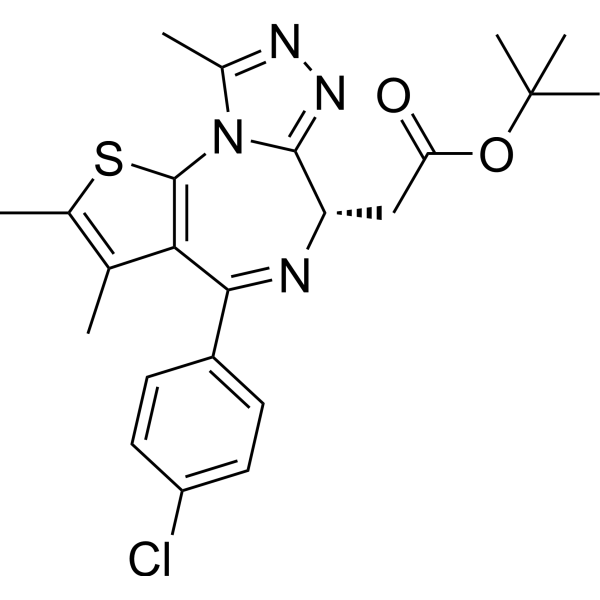
(+)-JQ-1BET Inhibitor -
HY-16297A
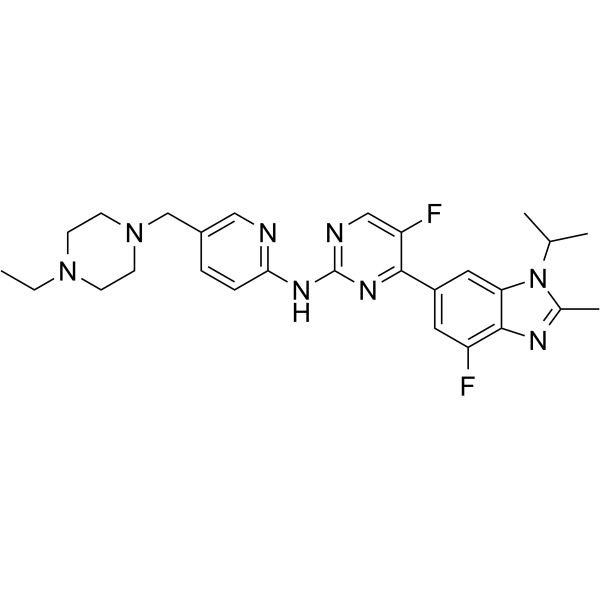
AbemaciclibCDK4/6 Inhibitor -

HY-108841
RaleukinIL-1R Antagonist -

HY-P990774
VerekitugTSLPR Inhibitor
Publications Citing Use of MedChemExpress (MCE) Itepekimab
More

Biological Activity
Description
Isotype
Human IgG4 kappa
Recommend Isotype Controls
Species Reactivity
Human
IC50 & Target
IL-33
In Vitro
Itepekimab can bind IL-33 with high affinity and prevent the binding of ST2 D3 domain to IL-33, thus preventing the formation of IL-33/ST2/IL-1RAcP signaling complex and blocking the production of airway inflammatory mediator[4].
Itepekimab also binds with subnanomolar affinity to different IL-33 cleavage variants, blocks NF-kB signaling in reporter cell lines, and prevents cytokine release from human peripheral blood mononuclear cell[4].
MedChemExpress (MCE) has not independently confirmed the accuracy of these methods. They are for reference only. Further protocols information, click here.
In Vivo
MedChemExpress (MCE) has not independently confirmed the accuracy of these methods. They are for reference only.
Clinical Trial
| NCT Number | Sponsor | Condition | Start Date |
Phase

|
|---|---|---|---|---|
| NCT01329991 | Plexxikon| | 2011-05 | PHASE1 |
Gene ID
Accession
Conjugated
Unconjugated
Reconsititution
The product can be reconstituted/diluted with sterile PBS or saline.
Format
-
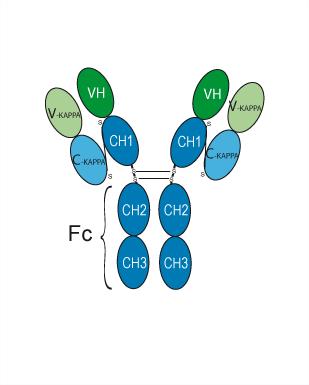
Human IgG4 kappa
Application
ELISA, FACS, Functional assay
Verified Bioactivity
-
 Immobilized IL-33 Protein, Human (His, HY-P70475) can bind Itepekimab. The EC50 for this effect is 157.7 ng/mL.
 -
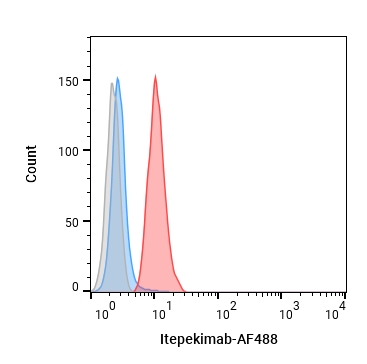 Flow cytometric analysis of 1.5×10⁶ HUVEC cells with Itepekimab (HY-P99673, red). Cells were fixed with 4% paraformaldehyde and permeabilised with 90% methanol. Then stained with the primary antibody at 1/200 dilution for an hour at 4℃. Alexa Goat Anti-Human IgG H&L (AF488) (HY-P83776) was used as the secondary antibody at 1/1,000 dilution for 30 minutes at 4℃. Human IgG4 kappa Isotype Control (HY-P99003, blue) was used as the isotype control, cells without incubation with primary antibody were used as the unlabeled control (black).


Chemical Information
-
CAS No. 2226742-52-3
-
Appearance Liquid
-
Molecular Weight 144.64 kDa
-
Color Colorless to light yellow
-
SMILES
[Itepekimab]
-
Synonyms
REGN-3500; SAR-440340
-
Shipping
Shipping with dry ice.
-
Formulation
Please refer to the lot-specific COA for specific buffer information.
-
Storage
Please store the product under the recommended conditions in the Certificate of Analysis.


Publications (1)
-
Journal Impact Factor
-
Most Recent

Protocols
-
TPA/Croton Oil Ear Edema and Dermatitis
The TPA (12-O-tetradecanoylphorbol-13-acetate) and croton oil-induced mouse ear edema model is a well-established acute cutaneous inflammation system used to evaluate topical anti-inflammatory activity by measuring edema formation, neutrophil infiltration, vascular permeability, and cytokine-mediated skin responses in vivo. The inflammatory response is triggered by topical application of phorbol esters (TPA) or croton oil constituents, leading to rapid activation of protein kinase C signaling, leukocyte recruitment, and increased vascular permeability, which can be quantified by ear thickness, weight, dye extravasation, and biochemical markers such as myeloperoxidase (MPO) activity and pro-inflammatory mediators in ear tissue homogenates. This model is widely used for screening anti-inflammatory agents, where reductions in edema and inflammatory biomarkers reflect suppression of acute dermal inflammation and immune cell infiltration. Histological evaluation typically confirms epidermal
-
Research Protocol for Inflammation-related Diseases
The NLRP3 inflammasome is a cytosolic innate immune signaling platform that integrates priming signals and danger-signal activation to promote caspase-1 activation, maturation of IL-1β and IL-18, and gasdermin D-mediated pyroptotic cell death. The core experimental logic is to determine whether inflammatory disease phenotypes are driven by increased NLRP3 expression, ASC-containing inflammasome assembly, caspase-1 cleavage, GSDMD cleavage, and extracellular release of IL-1β/IL-18 rather than by nonspecific cell injury alone. The pathway is strongly linked to inflammation-related disease phenotypes because monosodium urate crystals activate NALP3/NLRP3 inflammasome signaling in gout-like crystal inflammation, cholesterol crystals activate NLRP3 inflammasomes in atherogenesis models, and DSS-induced intestinal inflammation has been reported to involve NLRP3 inflammasome activity. However, experimental colitis studies also show context-dependent protective effects of NLRP3 inflammasome co


Purity & Documentation
-
Data Sheet (261 KB)
-
SDS (252 KB)
- English - EN (252 KB)
- Français - FR (252 KB)
- Deutsch - DE (252 KB)
- Norwegian - NO (252 KB)
- Español - ES (252 KB)
- Swedish - SV (252 KB)
- Italian - IT (252 KB)
- Korean - KR (252 KB)
- Portuguese - PT (252 KB)
-
Inhibitory Antibodies User Guide (603 KB)
References
[1]. Wechsler ME, et al. Efficacy and Safety of Itepekimab in Patients with Moderate-to-Severe Asthma. N Engl J Med. 2021 Oct 28;385(18):1656-1668. [Content Brief]
[2]. Rabe KF, et al. Safety and efficacy of itepekimab in patients with moderate-to-severe COPD: a genetic association study and randomised, double-blind, phase 2a trial. Lancet Respir Med. 2021 Nov;9(11):1288-1298. [Content Brief]
[3]. Kosloski MP, et al. Pharmacokinetics and pharmacodynamics of itepekimab in healthy adults and patients with asthma: Phase I first-in-human and first-in-patient trials. Clin Transl Sci. 2022 Feb;15(2):384-395. [Content Brief]

Calculators
Concentration (start) × Volume (start) = Concentration (final) × Volume (final)


Itepekimab Related Classifications
HY-P99673 Related Classifications
 Powered by Bioz