



Lysicamine

Based on 1 Customer Validation
Lysicamine, a natural compound, possesses antibacterial, anticancer and anti-inflammation activity.
For research use only. We do not sell to patients.
- Purity : 99.34%
- CAS No.: 15444-20-9
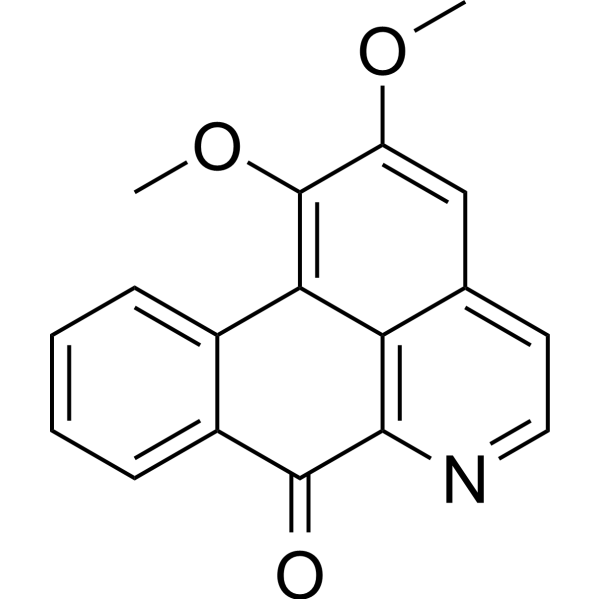
- Formula: C18H13NO3
- Molecular Weight:291.30
-
Storage:
-20°C, sealed storage, away from moisture
* In solvent : -80°C, 6 months; -20°C, 1 month (sealed storage, away from moisture)

To place orders, for customer services and technical support, please contact: MedChemExpress USA
Tel: 609-228-6898 E-mail: [email protected] [email protected]


-
 Biological Activity
-
Chemical Information
- Protocols
- Purity & Documentation
- References
-
 Help & FAQs




Biological Activity
Description
Cellular Effect
|
Cell Line

|
Type | Value | Description | References |
|---|---|---|---|---|
| HepG2 | IC50 |
>40 μM
Compound: 4K
|
Antiproliferative activity against human HepG2 cells assessed as cell growth inhibition measured after 48 hrs by MTT assay
Antiproliferative activity against human HepG2 cells assessed as cell growth inhibition measured after 48 hrs by MTT assay
|
[PMID: 35092899] |
| HepG2 | IC50 |
6.2 μg/mL
Compound: 7
|
Cytotoxicity against human HepG2 cells by MTT assay
Cytotoxicity against human HepG2 cells by MTT assay
|
[PMID: 11374955] |
| HepG2 2.2.15 | IC50 |
2.4 μg/mL
Compound: 7
|
Cytotoxicity against human HepG2(2.2.15) cells by MTT assay
Cytotoxicity against human HepG2(2.2.15) cells by MTT assay
|
[PMID: 11374955] |
| KB | ED50 |
>10 μg/mL
Compound: lysicamine
|
Cytotoxicity against human KB cells
Cytotoxicity against human KB cells
|
10.1021/np50019a011 |
| MGC-803 | IC50 |
15.8 μM
Compound: 4K
|
Antiproliferative activity against human MGC-803 cells assessed as cell growth inhibition measured after 48 hrs by MTT assay
Antiproliferative activity against human MGC-803 cells assessed as cell growth inhibition measured after 48 hrs by MTT assay
|
[PMID: 35092899] |
| RAW264.7 | IC50 |
6.4 μM
Compound: 9
|
Antiinflammatory activity in mouse RAW264.7 assessed as inhibition of LPS-induced NO production preincubated for 30 mins followed by LPS stimulation measured after 24 hrs by Griess reagent based assay
Antiinflammatory activity in mouse RAW264.7 assessed as inhibition of LPS-induced NO production preincubated for 30 mins followed by LPS stimulation measured after 24 hrs by Griess reagent based assay
|
[PMID: 33939429] |
| SK-OV-3 | IC50 |
12.1 μM
Compound: 4K
|
Antiproliferative activity against human SK-OV-3 cells assessed as cell growth inhibition measured after 48 hrs by MTT assay
Antiproliferative activity against human SK-OV-3 cells assessed as cell growth inhibition measured after 48 hrs by MTT assay
|
[PMID: 35092899] |
| T-24 | IC50 |
7.3 μM
Compound: 4K
|
Antiproliferative activity against human T24 cells assessed as cell growth inhibition measured after 48 hrs by MTT assay
Antiproliferative activity against human T24 cells assessed as cell growth inhibition measured after 48 hrs by MTT assay
|
[PMID: 35092899] |
| Vero | CC50 |
500 μM
Compound: 17
|
Cytotoxicity against african green monkey Vero cells
Cytotoxicity against african green monkey Vero cells
|
[PMID: 9584402] |
| WI-38 | IC50 |
6.7 μM
Compound: 4K
|
Antiproliferative activity against human WI-38 cells assessed as cell growth inhibition measured after 48 hrs by MTT assay
Antiproliferative activity against human WI-38 cells assessed as cell growth inhibition measured after 48 hrs by MTT assay
|
[PMID: 35092899] |


Chemical Information
-
CAS No. 15444-20-9
-
Appearance Solid
-
Molecular Weight 291.30
-
Formula C18H13NO3
-
Color Light yellow to yellow
-
SMILES
O=C1C2=CC=CC=C2C3=C(OC)C(OC)=CC4=CC=NC1=C43
-
Structure Classification
-
Initial Source
-
Shipping
Room temperature in continental US; may vary elsewhere.
-
Storage
-20°C, sealed storage, away from moisture
* In solvent : -80°C, 6 months; -20°C, 1 month (sealed storage, away from moisture)


Purity & Documentation
-
Data Sheet (270 KB)
-
SDS (251 KB)
- English - EN (251 KB)
- Français - FR (251 KB)
- Deutsch - DE (251 KB)
- Norwegian - NO (251 KB)
- Español - ES (251 KB)
- Swedish - SV (251 KB)
- Italian - IT (251 KB)
- Korean - KR (251 KB)
- Portuguese - PT (251 KB)
-
Handling Instructions (2659 KB)
References

Calculators
Concentration (start) × Volume (start) = Concentration (final) × Volume (final)


Lysicamine Related Classifications
HY-122930 Related Classifications
 Powered by Bioz