



Tyrene

Based on 1 Customer Validation
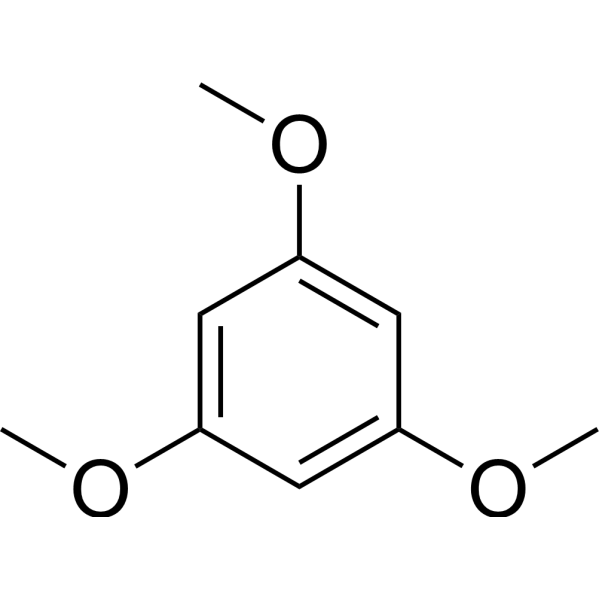
Tyrene (2,4,6-Trichloroanisole) is an off-flavor compound, cyclic nucleotide-gated (CNG) channel inhibitor, and olfactory transduction attenuator. Tyrene is formed by microbial O-methylation of 2,4,6-trichlorophenol. Tyrene inhibits channel activity in olfactory receptor cells by partitioning into the plasma membrane lipid bilayer, and also suppresses odorant- and cAMP-induced currents in individual olfactory receptor cells. Tyrene causes cork taint in wine. Tyrene also produces off-flavors in potato chips, dried fruits, coffee, and drinking water.
For research use only. We do not sell to patients.
- Purity : 99.96%
- CAS No.: 87-40-1
- Formula: C7H5Cl3O
- Molecular Weight:211.47
-
Storage:
Store at room temperature 3 years.
In solvent -80°C, 2 years , -20°C, 1 year


To place orders, for customer services and technical support, please contact: MedChemExpress USA
Tel: 609-228-6898 E-mail: [email protected] [email protected]


-
 Biological Activity
-
Chemical Information
-
Solvent & Solubility
- Purity & Documentation
- References
-
 Help & FAQs




Biological Activity
Description
In Vitro
Tyrene potently inhibits cyclic nucleotide-gated channel-mediated currents in isolated salamander olfactory receptor cells, with an EC50 of 0.19 μM[1].
Tyrene inhibits odorant-induced currents in dissociated salamander olfactory receptor cells[1].
Tyrene inhibits cyclic nucleotide-gated channel-mediated currents in isolated salamander olfactory receptor cells[1].
MedChemExpress (MCE) has not independently confirmed the accuracy of these methods. They are for reference only.


Chemical Information
-
CAS No. 87-40-1
-
Appearance Solid
-
Molecular Weight 211.47
-
Formula C7H5Cl3O
-
Color White to off-white
-
SMILES
ClC1=CC(Cl)=C(OC)C(Cl)=C1
-
Synonyms
2,4,6-Trichloroanisole
-
Shipping
Room temperature in continental US; may vary elsewhere.
-
Storage
Store at room temperature 3 years
In solvent -80°C 2 years -20°C 1 year


Solvent & Solubility
In Vitro:
DMSO : 100 mg/mL (472.88 mM; Need ultrasonic; Hygroscopic DMSO has a significant impact on the solubility of product, please use newly opened DMSO)
Please refer to the solubility information to select the appropriate solvent. Once prepared, please aliquot and store the solution to prevent product inactivation from repeated freeze-thaw cycles.
Storage method and period of stock solution: -80°C, 2 years; -20°C, 1 year. When stored at -80°C, please use it within 2 years. When stored at -20°C, please use it within 1 year.
Concentration (start) × Volume (start) = Concentration (final) × Volume (final)
In Vivo:
Select the appropriate dissolution method based on your experimental animal and administration route.
- For the following dissolution methods, please ensure to first prepare a clear stock solution using an In Vitro approach and then sequentially add co-solvents:
- To ensure reliable experimental results, the clarified stock solution can be appropriately stored based on storage conditions. As for the working solution for In Vivo experiments, it is recommended to prepare freshly and use it on the same day.
- The percentages shown for the solvents indicate their volumetric ratio in the final prepared solution. If precipitation or phase separation occurs during preparation, heat and/or sonication can be used to aid dissolution.
Add each solvent one by one: 10% DMSO 40% PEG300 5% Tween-80 45% Saline
Solubility: ≥ 5 mg/mL (23.64 mM); Clear solution
This protocol yields a clear solution of ≥ 5 mg/mL (saturation unknown).
Taking 1 mL working solution as an example, add 100 μL DMSO stock solution (50.0 mg/mL) to 400 μL PEG300, and mix evenly; then add 50 μL Tween-80 and mix evenly; then add 450 μL Saline to adjust the volume to 1 mL.
Preparation of Saline: Dissolve 0.9 g sodium chloride in ddH₂O and dilute to 100 mL to obtain a clear Saline solution.
In Vivo Dissolution Calculator
Please enter the basic information of animal experiments:
-
-
-
-
Recommended: Prepare an additional quantity of animals to account for potential losses during experiments.
Please enter your animal formula composition:
-
%DMSO +
Recommended: Keep the proportion of DMSO in working solution below 2% if your animal is weak.
-
%+
-
+%Tween-80 + +
-
%Saline +
The co-solvents required include: DMSO, . All of co-solvents are available by MedChemExpress (MCE). , Tween 80. All of co-solvents are available by MedChemExpress (MCE).
Working solution concentration: 0.22 mg/mL
Method for preparing stock solution: mg drug dissolved in μL DMSO. Stock solution concentration: mg/mL.
1. Take μL DMSO stock solution;
2. Add μL .
μL , mix evenly;
3. Then add μL Tween 80, mix evenly;
4. Then add μL
Please ensure that the stock solution in the first step is dissolved to a clear state, and add co-solvents in sequence. You can use ultrasonic heating (ultrasonic cleaner, recommended frequency 20-40 kHz), vortexing, etc. to assist dissolution.


Purity & Documentation
-
Data Sheet (276 KB)
-
SDS (393 KB)
- English - EN (393 KB)
- Français - FR (393 KB)
- Deutsch - DE (393 KB)
- Norwegian - NO (393 KB)
- Español - ES (393 KB)
- Swedish - SV (393 KB)
- Italian - IT (393 KB)
- Korean - KR (393 KB)
- Portuguese - PT (393 KB)
-
Handling Instructions (2659 KB)
References
[1]. Takeuchi H, et al. 2,4,6-trichloroanisole is a potent suppressor of olfactory signal transduction. Proc Natl Acad Sci U S A. 2013 Oct 1;110(40):16235-40. [Content Brief]
[2]. Taylor MK, et al. Supercritical fluid extraction of 2,4,6-trichloroanisole from cork stoppers. J Agric Food Chem. 2000 Jun;48(6):2208-11. [Content Brief]
[3]. Alvarez-Rodríguez ML, et al. Cork taint of wines: role of the filamentous fungi isolated from cork in the formation of 2,4,6-trichloroanisole by o methylation of 2,4,6-trichlorophenol. Appl Environ Microbiol. 2002 Dec;68(12):5860-9. [Content Brief]


Complete Stock Solution Preparation Table
Please refer to the solubility information to select the appropriate solvent. Once prepared, please aliquot and store the solution to prevent product inactivation from repeated freeze-thaw cycles.
Storage method and period of stock solution: -80°C, 2 years; -20°C, 1 year. When stored at -80°C, please use it within 2 years. When stored at -20°C, please use it within 1 year.
| Optional Solvent | Concentration Solvent Mass | 1 mg | 5 mg | 10 mg | 25 mg |
|---|---|---|---|---|---|
| DMSO | 1 mM | 4.7288 mL | 23.6440 mL | 47.2880 mL | 118.2201 mL |
| 5 mM | 0.9458 mL | 4.7288 mL | 9.4576 mL | 23.6440 mL | |
| 10 mM | 0.4729 mL | 2.3644 mL | 4.7288 mL | 11.8220 mL | |
| 15 mM | 0.3153 mL | 1.5763 mL | 3.1525 mL | 7.8813 mL | |
| 20 mM | 0.2364 mL | 1.1822 mL | 2.3644 mL | 5.9110 mL | |
| 25 mM | 0.1892 mL | 0.9458 mL | 1.8915 mL | 4.7288 mL | |
| 30 mM | 0.1576 mL | 0.7881 mL | 1.5763 mL | 3.9407 mL | |
| 40 mM | 0.1182 mL | 0.5911 mL | 1.1822 mL | 2.9555 mL | |
| 50 mM | 0.0946 mL | 0.4729 mL | 0.9458 mL | 2.3644 mL | |
| 60 mM | 0.0788 mL | 0.3941 mL | 0.7881 mL | 1.9703 mL | |
| 80 mM | 0.0591 mL | 0.2956 mL | 0.5911 mL | 1.4778 mL | |
| 100 mM | 0.0473 mL | 0.2364 mL | 0.4729 mL | 1.1822 mL |


Tyrene Related Classifications
HY-W097929 Related Classifications
 Powered by Bioz
Keywords
- Tyrene
- 87-40-1
- 2,4,6-Trichloroanisole
- Olfactory Receptor
- Drug Metabolite
- Biochemical Assay Reagents
- HCN Channel
- olfactory receptor cells
- 2,4,6-trichlorophenol
- SAM-dependent methyltransferase
- cyclic nucleotide-gated channel
- Trichoderma longibrachiatum
- Trichoderma viride
- plasma membrane lipid bilayers
- cAMP
- Fusarium oxysporum
- S-adenosyl-L-homocysteine
- Inhibitor
- inhibitor
- inhibit