



XQ2B

Based on 1 Customer Validation
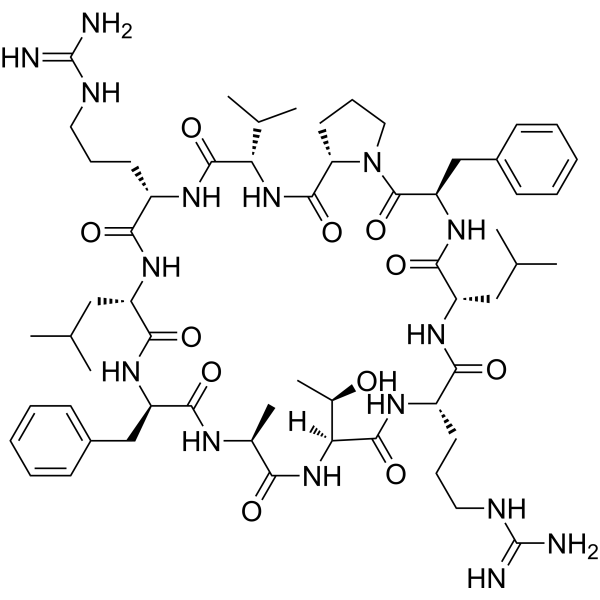
XQ2B is a specific cGAS inhibitor targeting protein-DNA interaction and phase separation. XQ2B markedly reduces ISD-induced Autophagy. XQ2B inhibits herpes simplex virus 1 (HSV-1)-induced antiviral immune responses and enhances HSV-1 infection.
商品は「研究用試薬」です。人や動物の医療用・臨床診断用・食品用の製品ではありません。
研究用途以外に使用した場合、当社は一切の責任を負いかねます。
- 純度 : 99.45%
- CAS 番号: 2104728-28-9
- 分子式: C59H92N16O11
- 分子量:1201.46
-
保管条件:
Sealed storage, away from moisture.
Powder -80°C, 2 years , -20°C, 1 year* In solvent : -80°C, 6 months; -20°C, 1 month (sealed storage, away from moisture)

To place orders, for customer services and technical support, please contact: MedChemExpress USA
Tel: 609-228-6898 E-mail: [email protected] [email protected]


-
 生物活性
生物活性
-
化学情報
-
溶剤 & 溶解度
- プロトコル
- 純度とドキュメンテーション
- 参考文献
-
 Help & FAQs




生物活性
製品説明
体外実験
XQ2B (10 μM; 24 h) inhibits the expression of Ifnb1, Cxcl10 and Il6 in Trex1-/- BMDMs[1].
MedChemExpress (MCE) has not independently confirmed the accuracy of these methods. They are for reference only.
体内実験
XQ2B (10 mg/kg; i.v.; every other day; 7 days) suppresses systemic inflammation in Trex1-/- mice[1].
MedChemExpress (MCE) has not independently confirmed the accuracy of these methods. They are for reference only.
-
Animal Model:C57BL/6 Trex1-/- male mice (8-week-old) with autoimmune disease model[1]
-
Dosage:10 mg/kg
-
Administration:Intravenous injection, every other day, 7-day cycle for evaluating anti-inflammatory effect and 11 - day cycle for survival analysis
-
Result:Attenuated the inflammation in heart, stomach, tongue, kidney, and skeletal muscle of Trex1-/- mice compared to untreated Trex1-/- mice (the 7-day cycle experiment).
Suppressed the mRNA level of Ifnb1, Cxcl10 and Il6 caused by Trex1 deficiency.
Showed no effect on mouse survival during the test period (the 11-day cycle experiment).


化学情報
-
CAS 番号 2104728-28-9
-
性状 Solid
-
分子量 1201.46
-
分子式 C59H92N16O11
-
Color White to off-white
-
配列
Cyclo({d-Phe}-Ala-Thr-Arg-Leu-{d-phe}-Pro-Val-Arg-Leu)
-
シーケンスの短縮
Cyclo({d-Phe}-ATRL-{d-phe}-PVRL)
-
輸送条件
Room temperature in continental US; may vary elsewhere.
-
保管条件
Sealed storage, away from moisture
Powder -80°C 2 years -20°C 1 year * In solvent : -80°C, 6 months; -20°C, 1 month (sealed storage, away from moisture)


溶剤 & 溶解度
体外:
H2O : 100 mg/mL (83.23 mM; Need ultrasonic)
Please refer to the solubility information to select the appropriate solvent. Once prepared, please aliquot and store the solution to prevent product inactivation from repeated freeze-thaw cycles.
Storage method and period of stock solution: -80°C, 6 months; -20°C, 1 month (sealed storage, away from moisture). When stored at -80°C, please use it within 6 months. When stored at -20°C, please use it within 1 month.
* Note: If you choose water as the stock solution, please dilute it to the working solution, then filter and sterilize it with a 0.22 μm filter before use.
Please refer to the solubility information to select the appropriate solvent. Once prepared, please aliquot and store the solution to prevent product inactivation from repeated freeze-thaw cycles.
Storage method and period of stock solution: -80°C, 6 months; -20°C, 1 month (sealed storage, away from moisture). When stored at -80°C, please use it within 6 months. When stored at -20°C, please use it within 1 month.
* Note: If you choose water as the stock solution, please dilute it to the working solution, then filter and sterilize it with a 0.22 μm filter before use.
濃度 (開始) × 体積 (開始) = 濃度 (終了) × 体積 (終了)


純度とドキュメンテーション
-
データシート (284 KB)
-
SDS (252 KB)
- English - EN (252 KB)
- Français - FR (252 KB)
- Deutsch - DE (252 KB)
- Norwegian - NO (252 KB)
- Español - ES (252 KB)
- Swedish - SV (252 KB)
- Italian - IT (252 KB)
- Korean - KR (252 KB)
- Portuguese - PT (252 KB)
-
取扱説明書 (2659 KB)
参考文献


Complete Stock Solution Preparation Table
Please refer to the solubility information to select the appropriate solvent. Once prepared, please aliquot and store the solution to prevent product inactivation from repeated freeze-thaw cycles.
Storage method and period of stock solution: -80°C, 6 months; -20°C, 1 month (sealed storage, away from moisture). When stored at -80°C, please use it within 6 months. When stored at -20°C, please use it within 1 month.
| Optional Solvent | Concentration Solvent Mass | 1 mg | 5 mg | 10 mg | 25 mg |
|---|---|---|---|---|---|
| H2O | 1 mM | 0.8323 mL | 4.1616 mL | 8.3232 mL | 20.8080 mL |
| 5 mM | 0.1665 mL | 0.8323 mL | 1.6646 mL | 4.1616 mL | |
| 10 mM | 0.0832 mL | 0.4162 mL | 0.8323 mL | 2.0808 mL | |
| 15 mM | 0.0555 mL | 0.2774 mL | 0.5549 mL | 1.3872 mL | |
| 20 mM | 0.0416 mL | 0.2081 mL | 0.4162 mL | 1.0404 mL | |
| 25 mM | 0.0333 mL | 0.1665 mL | 0.3329 mL | 0.8323 mL | |
| 30 mM | 0.0277 mL | 0.1387 mL | 0.2774 mL | 0.6936 mL | |
| 40 mM | 0.0208 mL | 0.1040 mL | 0.2081 mL | 0.5202 mL | |
| 50 mM | 0.0166 mL | 0.0832 mL | 0.1665 mL | 0.4162 mL | |
| 60 mM | 0.0139 mL | 0.0694 mL | 0.1387 mL | 0.3468 mL | |
| 80 mM | 0.0104 mL | 0.0520 mL | 0.1040 mL | 0.2601 mL |
* Note: If you choose water as the stock solution, please dilute it to the working solution, then filter and sterilize it with a 0.22 μm filter before use.


XQ2B 関連分類
HY-P5997 関連分類
 Powered by Bioz