



Bikinin
Based on 2 publication(s) in Google Scholar
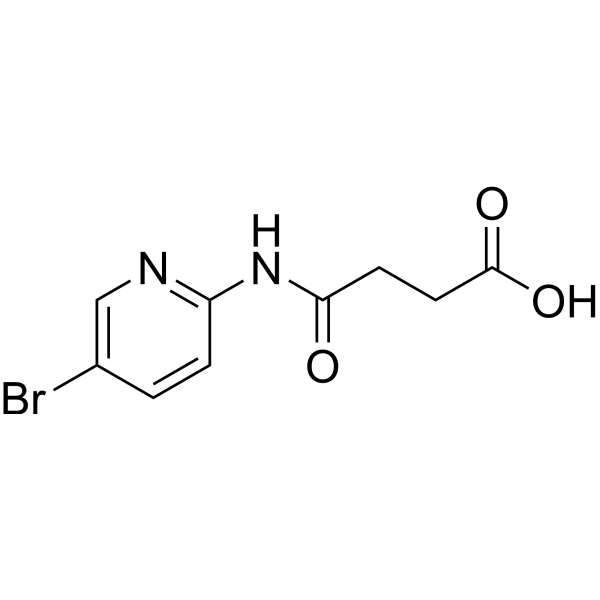
Bikinin is a non-steroidal, ATP-competitive inhibitor of plant GSK-3/Shaggy-like kinases and activates BR (brassinosteroids) signaling.
연구목적의 판매만을 진행합니다. 환자를 대상으로 한 판매는 하지 않습니다.
- Purity: 99.95%
- CAS No.: 188011-69-0
- 화학식: C9H9BrN2O3
- 분자량:273.08
-
보관:Powder -20°C, 3 years , 4°C, 2 years ; In solvent -80°C, 2 years , -20°C, 1 year

To place orders, for customer services and technical support, please contact: MedChemExpress USA
Tel: 609-228-6898 E-mail: [email protected] [email protected]


-
 Biological Activity
-
Chemical Information
-
용액&용해도
- Protocol
- 순도&문서
- References
-
 Help & FAQs
-

Reprogramming Compound Library
HY-L039
-
Oxygen Sensing Compound Library
HY-L045
-
Glycolysis Compound Library
HY-L058
-
Cytoskeleton Compound Library
HY-L060
-
Anti-Alzheimer's Disease Compound Library
HY-L069
-
Anti-Pancreatic Cancer Compound Library
HY-L077
-
Anti-Cancer Metabolism Compound Library
HY-L083
-
Neurodegenerative Disease-related Compound Library
HY-L086
-
Anti-Obesity Compound Library
HY-L087
-
Glucose Metabolism Compound Library
HY-L092
-
Targeted Diversity Library
HY-L099
-
Antidepressant Compound Library
HY-L108
-
Anti-Pulmonary Fibrosis Compound Library
HY-L125
-
Cancer Stem Cells Compound Library
HY-L135
-
Heterocyclic Compound Library
HY-L138
-
Metabolic Enzyme Compound Library
HY-L146
-
Serine/Threonine Kinase Inhibitor Library
HY-L164
-
Bioactive Compound Library Max
HY-L181
-
MCE Bioactive Compound Library
HY-L001V
-
Bioactive Compound Library
HY-L001
-
Protein Kinase Compound Library
HY-L196
-
Cell Proliferation Compound Library
HY-L201
-
High-Throughput Bioactive Compound Library
HY-L205
-
Posttranslational Modification Library
HY-L226
-
Kinase Inhibitor Library
HY-L009
-
PI3K/Akt/mTOR Compound Library
HY-L015
-
Protein Tyrosine Kinase Compound Library
HY-L016
-
Stem Cell Signaling Compound Library
HY-L017
-
Wnt/Hedgehog/Notch Compound Library
HY-L020
-
Anti-Aging Compound Library
HY-L034


Publications Citing Use of MedChemExpress (MCE) Bikinin
More

Biological Activity
|
GSK-3 |
Bikinin reduces transcript levels of NbRBOHB and BR-induced NbRBOHB expression in TRV:00, TRV:NbDWARF, TRV:NbBRI1, TRV:NbBSK1, TRV:NbBAK1, TRV:NbBIK1 and TRV:NbBSU1 plants. Bikinin largely inhibits BR-increased ROS accumulation. Moreover, Bikinin decreases the transcripts of these six genes in all plants, but fails to down-regulate transcripts of these genes in NbBES1/BZR1-silenced plants. Bikinin also inhibits BR-induced up-regulation of the six genes, and the inhibition effects are compromised in NbBES1/BZR1-silenced plants[1]. Bikinin is a potent inhibitor of group I and group II ASKs[2]. Bikinin directly binds the GSK3 BIN2 and acts as an ATP competitor. Furthermore, bikinin inhibits the activity of six other Arabidopsis GSK3s[3].
MedChemExpress (MCE) has not independently confirmed the accuracy of these methods. They are for reference only.


Chemical Information
-
CAS No. 188011-69-0
-
Appearance Solid
-
분자량 273.08
-
화학식 C9H9BrN2O3
-
Color White to off-white
-
SMILES
O=C(O)CCC(NC1=NC=C(Br)C=C1)=O
-
Synonyms
Abrasin
-
선적
Room temperature in continental US; may vary elsewhere.
-
보관
Powder -20°C 3 years 4°C 2 years In solvent -80°C 2 years -20°C 1 year


Publications (2)
-
Journal Impact Factor
-
Most Recent
-
Anal Chem
Exposome-Scale Investigation of Cl-/Br-Containing Chemicals Using High-Resolution Mass Spectrometry, Multistage Machine Learning, and Cloud Computing. [Abstract]2025 Jun 3;97(21):11099-11109. PMID: 40401576 -
Int J Mol Sci
Involvement of BIG5 and BIG3 in BRI1 Trafficking Reveals Diverse Functions of BIG-subfamily ARF-GEFs in Plant Growth and Gravitropism. [Abstract]2019 May 11;20(9):2339. PMID: 31083521


용액&용해도
DMSO : ≥ 100 mg/mL (366.19 mM; Hygroscopic DMSO has a significant impact on the solubility of product, please use newly opened DMSO)
* "≥" means soluble, but saturation unknown.
Please refer to the solubility information to select the appropriate solvent. Once prepared, please aliquot and store the solution to prevent product inactivation from repeated freeze-thaw cycles.
Storage method and period of stock solution: -80°C, 2 years; -20°C, 1 year. When stored at -80°C, please use it within 2 years. When stored at -20°C, please use it within 1 year.
Please refer to the solubility information to select the appropriate solvent. Once prepared, please aliquot and store the solution to prevent product inactivation from repeated freeze-thaw cycles.
Storage method and period of stock solution: -80°C, 2 years; -20°C, 1 year. When stored at -80°C, please use it within 2 years. When stored at -20°C, please use it within 1 year.
Concentration (start) × Volume (start) = Concentration (final) × Volume (final)
Select the appropriate dissolution method based on your experimental animal and administration route.
- For the following dissolution methods, please ensure to first prepare a clear stock solution using an In Vitro approach and then sequentially add co-solvents:
- To ensure reliable experimental results, the clarified stock solution can be appropriately stored based on storage conditions. As for the working solution for In Vivo experiments, it is recommended to prepare freshly and use it on the same day.
- The percentages shown for the solvents indicate their volumetric ratio in the final prepared solution. If precipitation or phase separation occurs during preparation, heat and/or sonication can be used to aid dissolution.
Add each solvent one by one: 10% DMSO 40% PEG300 5% Tween-80 45% Saline
Solubility: ≥ 2.5 mg/mL (9.15 mM); Clear solution
This protocol yields a clear solution of ≥ 2.5 mg/mL (saturation unknown).
Taking 1 mL working solution as an example, add 100 μL DMSO stock solution (25.0 mg/mL) to 400 μL PEG300, and mix evenly; then add 50 μL Tween-80 and mix evenly; then add 450 μL Saline to adjust the volume to 1 mL.
Preparation of Saline: Dissolve 0.9 g sodium chloride in ddH₂O and dilute to 100 mL to obtain a clear Saline solution.
Please enter the basic information of animal experiments:
-
-
-
-
Recommended: Prepare an additional quantity of animals to account for potential losses during experiments.
Please enter your animal formula composition:
-
%DMSO +
Recommended: Keep the proportion of DMSO in working solution below 2% if your animal is weak.
-
%+
-
+%Tween-80 + +
-
%Saline +
The co-solvents required include: DMSO, . All of co-solvents are available by MedChemExpress (MCE). , Tween 80. All of co-solvents are available by MedChemExpress (MCE).
Working solution concentration: 0.22 mg/mL
Method for preparing stock solution: mg drug dissolved in μL DMSO. Stock solution concentration: mg/mL.
1. Take μL DMSO stock solution;
2. Add μL .
μL , mix evenly;
3. Then add μL Tween 80, mix evenly;
4. Then add μL
Please ensure that the stock solution in the first step is dissolved to a clear state, and add co-solvents in sequence. You can use ultrasonic heating (ultrasonic cleaner, recommended frequency 20-40 kHz), vortexing, etc. to assist dissolution.

Protocol
ASKs are expressed as GST-fusion proteins in Escherichia coli BL21. In vitro kinase assays are performed by incubating 50 ng GST-fusion protein, 10 μg myelin basic protein (MBP) as a substrate and 0.15 MBq γ-[32P]-ATP as co-substrate at 25°C for 30 min. The reaction buffer consists of 20 mM HEPES/KOH pH 7.4, 15 mM MgCl2, 5 mM EGTA, 1 mM dithiothreitol and 1 μM cold ATP. The reaction products are separated by SDS-PAGE and the amount of radioactivity incorporated into MBP quantified using an Amersham storage phosphor imager screen and a Biorad Molecular Imager FX[2].
MedChemExpress (MCE) has not independently confirmed the accuracy of these methods. They are for reference only.


순도&문서
-
Data Sheet (273 KB)
-
SDS (393 KB)
- English - EN (393 KB)
- Français - FR (393 KB)
- Deutsch - DE (393 KB)
- Norwegian - NO (393 KB)
- Español - ES (393 KB)
- Swedish - SV (393 KB)
- Italian - IT (393 KB)
- Korean - KR (393 KB)
- Portuguese - PT (393 KB)
-
Handling Instructions (2659 KB)
References
[1]. Deng XG, et al. Role of brassinosteroid signaling in modulating Tobacco mosaic virus resistance in Nicotiana benthamiana. Sci Rep. 2016 Feb 3;6:20579. [Content Brief]
[2]. Rozhon W, et al. Bikinin-like inhibitors targeting GSK3/Shaggy-like kinases: characterisation of novel compounds and elucidation of their catabolism in planta. BMC Plant Biol. 2014 Jun 19;14:172. [Content Brief]
[3]. De Rybel B, et al. Chemical inhibition of a subset of Arabidopsis thaliana GSK3-like kinases activates brassinosteroid signaling. Chem Biol. 2009 Jun 26;16(6):594-604. [Content Brief]


Complete Stock Solution Preparation Table
Please refer to the solubility information to select the appropriate solvent. Once prepared, please aliquot and store the solution to prevent product inactivation from repeated freeze-thaw cycles.
Storage method and period of stock solution: -80°C, 2 years; -20°C, 1 year. When stored at -80°C, please use it within 2 years. When stored at -20°C, please use it within 1 year.
| Optional Solvent | Concentration Solvent Mass | 1 mg | 5 mg | 10 mg | 25 mg |
|---|---|---|---|---|---|
| DMSO | 1 mM | 3.6619 mL | 18.3097 mL | 36.6193 mL | 91.5483 mL |
| 5 mM | 0.7324 mL | 3.6619 mL | 7.3239 mL | 18.3097 mL | |
| 10 mM | 0.3662 mL | 1.8310 mL | 3.6619 mL | 9.1548 mL | |
| 15 mM | 0.2441 mL | 1.2206 mL | 2.4413 mL | 6.1032 mL | |
| 20 mM | 0.1831 mL | 0.9155 mL | 1.8310 mL | 4.5774 mL | |
| 25 mM | 0.1465 mL | 0.7324 mL | 1.4648 mL | 3.6619 mL | |
| 30 mM | 0.1221 mL | 0.6103 mL | 1.2206 mL | 3.0516 mL | |
| 40 mM | 0.0915 mL | 0.4577 mL | 0.9155 mL | 2.2887 mL | |
| 50 mM | 0.0732 mL | 0.3662 mL | 0.7324 mL | 1.8310 mL | |
| 60 mM | 0.0610 mL | 0.3052 mL | 0.6103 mL | 1.5258 mL | |
| 80 mM | 0.0458 mL | 0.2289 mL | 0.4577 mL | 1.1444 mL | |
| 100 mM | 0.0366 mL | 0.1831 mL | 0.3662 mL | 0.9155 mL |


Bikinin Related Classifications
HY-12524 Related Classifications
 Powered by Bioz