



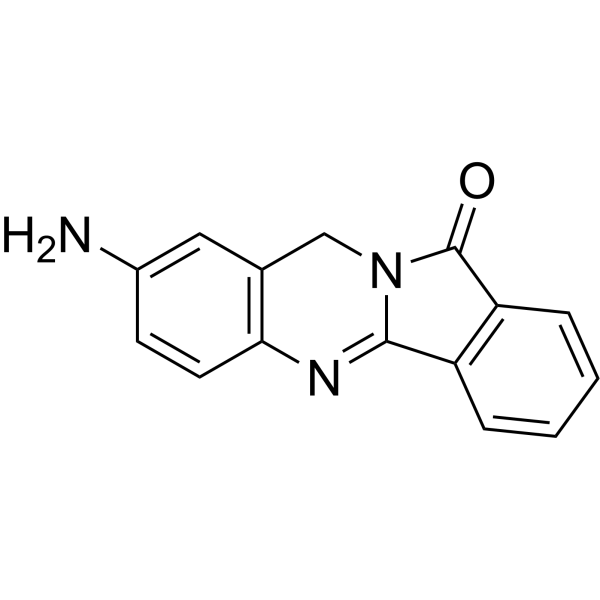
Batracylin
Batracylin (NSC320846) is a potent DNA Topoisomerases I and DNA Topoisomerases II inhibitor. Batracylin shows cytotoxicity and antiproliferative activity. Batracylin induces DNA breaks.
연구목적의 판매만을 진행합니다. 환자를 대상으로 한 판매는 하지 않습니다.
- CAS No.: 67199-66-0
- 화학식: C15H11N3O
- 분자량:249.27
-
보관:
Please store the product under the recommended conditions in the Certificate of Analysis.

To place orders, for customer services and technical support, please contact: MedChemExpress USA
Tel: 609-228-6898 E-mail: [email protected] [email protected]


-
 Biological Activity
-
Chemical Information
- Protocol
- 순도&문서
- References
-
 Help & FAQs


All Topoisomerase Isoforms
More

Biological Activity
제품 설명
Cellular Effect
|
Cell Line

|
Type | Value | Description | References |
|---|---|---|---|---|
| A549 | IC50 |
46.3 μM
Compound: BAT; Batracylin
|
Cytotoxicity against human A549 cells after 120 hrs by MTT assay
Cytotoxicity against human A549 cells after 120 hrs by MTT assay
|
[PMID: 26520842] |
| CCRF-CEM | IC50 |
14 μM
Compound: 1
|
Tested for the inhibitory activity against CCRF CEM T- cell leukemia cells
Tested for the inhibitory activity against CCRF CEM T- cell leukemia cells
|
[PMID: 7932571] |
| HCT-116 | IC50 |
88.7 μM
Compound: BAT; Batracylin
|
Cytotoxicity against human HCT116 cells after 120 hrs by MTT assay
Cytotoxicity against human HCT116 cells after 120 hrs by MTT assay
|
[PMID: 26520842] |
| HL-60 | IC50 |
66.6 μM
Compound: BAT; Batracylin
|
Cytotoxicity against human HL60 cells after 120 hrs by MTT assay
Cytotoxicity against human HL60 cells after 120 hrs by MTT assay
|
[PMID: 26520842] |
| HT-29 | IC50 |
64.3 μM
Compound: BAT; Batracylin
|
Cytotoxicity against human HT-29 cells after 120 hrs by MTT assay
Cytotoxicity against human HT-29 cells after 120 hrs by MTT assay
|
[PMID: 26520842] |
| L1210 | IC50 |
>100 μM
Compound: BAT; Batracylin
|
Cytotoxicity against mouse L1210 cells after 120 hrs by MTT assay
Cytotoxicity against mouse L1210 cells after 120 hrs by MTT assay
|
[PMID: 26520842] |
| LNCaP | IC50 |
90.2 μM
Compound: BAT; Batracylin
|
Cytotoxicity against human LNCAP cells after 120 hrs by MTT assay
Cytotoxicity against human LNCAP cells after 120 hrs by MTT assay
|
[PMID: 26520842] |
| MCF7 | IC50 |
>100 μM
Compound: BAT; Batracylin
|
Cytotoxicity against human MCF7 cells after 120 hrs by MTT assay
Cytotoxicity against human MCF7 cells after 120 hrs by MTT assay
|
[PMID: 26520842] |
| NIH3T3 | IC50 |
69.9 μM
Compound: BAT; Batracylin
|
Cytotoxicity against mouse NIH/3T3 cells after 120 hrs by MTT assay
Cytotoxicity against mouse NIH/3T3 cells after 120 hrs by MTT assay
|
[PMID: 26520842] |
| P388 | IC50 |
>100 μM
Compound: BAT; Batracylin
|
Cytotoxicity against mouse P388 cells after 120 hrs by MTT assay
Cytotoxicity against mouse P388 cells after 120 hrs by MTT assay
|
[PMID: 26520842] |
In Vitro
Batracylin (0-300 µM; 6 h) shows cytotoxicity with an IC50 value of 10.02 µM for HT29 cells[1].
Batracylin (100, 300 µM; 3 h) induces protein-linked DNA breaks consistent with topoisomerase targeting[1].
MedChemExpress (MCE) has not independently confirmed the accuracy of these methods. They are for reference only.
Clinical Trial
| NCT Number | Sponsor | Condition | Start Date |
Phase
|
|---|---|---|---|---|
| NCT01329991 | Plexxikon| | 2011-05 | PHASE1 |


Chemical Information
-
CAS No. 67199-66-0
-
분자량 249.27
-
화학식 C15H11N3O
-
SMILES
O=C1C2=C(C=CC=C2)C3=NC4=C(CN31)C=C(C=C4)N
-
Synonyms
NSC 320846; BAY-H 2049
-
선적
Room temperature in continental US; may vary elsewhere.
-
보관
Please store the product under the recommended conditions in the Certificate of Analysis.


순도&문서
References

Calculators
Concentration (start) × Volume (start) = Concentration (final) × Volume (final)


Batracylin Related Classifications
HY-119892 Related Classifications
 Powered by Bioz