



Mazorelvimab

Based on 1 Customer Validation
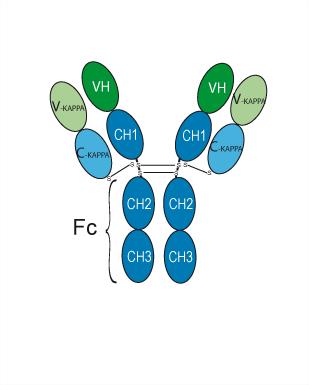
Mazorelvimab (CTB012) is an anti-rabies humanized IgG1κ monoclonal antibody that binds to the non-overlapping epitopes on the rabies virus (RABV) glycoprotein. Mazorelvimab binds to highly discontinuous conserved residues that are not in or near antigenic site III. Mezagitamab has potential application in the prevention of rabies.
연구목적의 판매만을 진행합니다. 환자를 대상으로 한 판매는 하지 않습니다.
- Purity : 97%
- CAS No.: 2419087-89-9
-
보관:Shipping with dry ice
Please store the product under the recommended conditions in the Certificate of Analysis.

To place orders, for customer services and technical support, please contact: MedChemExpress USA
Tel: 609-228-6898 E-mail: [email protected] [email protected]


-
 Biological Activity
-
Chemical Information
- 순도&문서
- References
-
 Help & FAQs





Biological Activity
제품 설명
IC50 & Target
RABVG
In Vitro
Mazorelvimab (0.01-100 µg/mL) shows cytotoxicity to CVS-11 infected BSR cells with dose-dependent manner, but without effecting on uninfected BSR cells[1].
MedChemExpress (MCE) has not independently confirmed the accuracy of these methods. They are for reference only.
Clinical Trial
| NCT Number | Sponsor | Condition | Start Date |
Phase

|
|---|---|---|---|---|
| NCT01329991 | 2011-05 | PHASE1 |
신청
ELISA, FACS, Functional assay


Product Details
-
CAS No. 2419087-89-9
-
Accession P08667
-
Synonyms CTB012
-
Species Reactivity
Virus
-
Conjugated
Unconjugated
-
Isotype
Human IgG1 kappa
-
Recommend Isotype Controls
-
Format
-
Human IgG1 kappa
-
Product Properties
-
Appearance
Liquid
-
Formulation
Please refer to the lot-specific COA for specific buffer information.
-
Purity
97%
-
Reconstitution
The product can be reconstituted/diluted with sterile PBS or saline.
-
Storage & Stability
Please store the product under the recommended conditions in the Certificate of Analysis.
-
선적
Shipping with dry ice.
순도&문서


References
[1]. Chao TY, et al. SYN023, a novel humanized monoclonal antibody cocktail, for post-exposure prophylaxis of rabies. PLoS Negl Trop Dis. 2017 Dec 20;11(12):e0006133. [Content Brief]
[2]. Chao TY, et al. In Vivo Efficacy of SYN023, an Anti-Rabies Monoclonal Antibody Cocktail, in Post-Exposure Prophylaxis Animal Models. Trop Med Infect Dis. 2020 Feb 21;5(1):31. [Content Brief]

Calculators
Concentration (start) × Volume (start) = Concentration (final) × Volume (final)


Mazorelvimab Related Classifications
HY-P99727 Related Classifications
 Powered by Bioz