



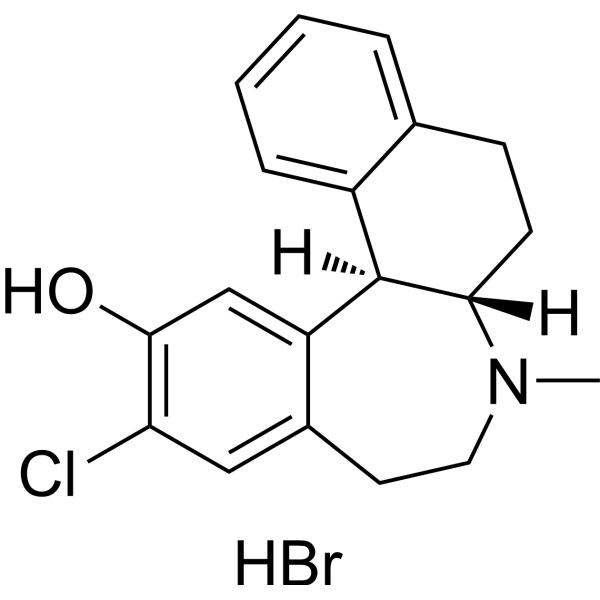
Ecopipam hydrobromide

Based on 1 Customer Validation
Ecopipam (SCH 39166) hydrobromide is a potent, selective and orally active antagonist of dopamine D1/D5 receptor, with Kis of 1.2 nM and 2.0 nM, respectively. Ecopipam hydrobromide shows more than 40-flod selectivity over D2, D4, 5-HT, and α2a receptor (Ki=0.98, 5.52, 0.08, and 0.73 μM, respectively). Ecopipam hydrobromide can be used for the research of schizophrenia and obesity.
연구목적의 판매만을 진행합니다. 환자를 대상으로 한 판매는 하지 않습니다.
- Purity : 99.0%
- CAS No.: 2587360-22-1
- 화학식: C19H21BrClNO
- 분자량:394.73
-
보관:
-20°C, sealed storage, away from moisture
* In solvent : -80°C, 6 months; -20°C, 1 month (sealed storage, away from moisture)

To place orders, for customer services and technical support, please contact: MedChemExpress USA
Tel: 609-228-6898 E-mail: [email protected] [email protected]


-
 Biological Activity
-
Chemical Information
- Protocol
- 순도&문서
- References
-
 Help & FAQs


All Dopamine Receptor Isoforms
MoreAll 5-HT Receptor Isoforms
MoreAll Adrenergic Receptor Isoforms
More

Biological Activity
제품 설명
IC50 & Target
[1]|
D1 Receptor 1.2 nM (Ki) |
D5 Receptor 2.0 nM (Ki) |
D2 Receptor 980 nM (Ki) |
D4 Receptor 5520 nM (Ki) |
5-HT Receptor 80 nM (Ki) |
Alpha-2A adrenergic receptor 731 nM (Ki) |
Cellular Effect
|
Cell Line

|
Type | Value | Description | References |
|---|---|---|---|---|
| HepG2 | EC50 |
12.6 μM
Compound: Ecopipam
|
Activation of human PXR expressed in human HepG2 (DPX-2) cells assessed as induction of CYP3A4 after 24 hrs by luminescent analysis
Activation of human PXR expressed in human HepG2 (DPX-2) cells assessed as induction of CYP3A4 after 24 hrs by luminescent analysis
|
[PMID: 20966043] |
| HepG2 | EC50 |
4 μM
Compound: Ecopipam
|
Activation of human PXR expressed in human HepG2 (DPX-2) cells after 24 hrs by luciferase reporter gene based luminescent analysis
Activation of human PXR expressed in human HepG2 (DPX-2) cells after 24 hrs by luciferase reporter gene based luminescent analysis
|
[PMID: 20966043] |
In Vitro
Ecopipam (2 μM) hydrobromide completely abolishes the proconvulsive effect of Dopamine (10 μM) in isolated corticohippocampal formation[2].
MedChemExpress (MCE) has not independently confirmed the accuracy of these methods. They are for reference only. Further protocols information, click here.
In Vivo
Ecopipam (5 and 10 μM, perfusion, 1 μL/min) reversibly and dose-dependently decreases acetylcholine release in the rat striatum[5].
MedChemExpress (MCE) has not independently confirmed the accuracy of these methods. They are for reference only.
-
Animal Model:Male young adult Long-Evans rats were injected with Nicotine[3]
-
Dosage:0.003, 0.01, 0.03, 0.1, 0.3 mg/kg
-
Administration:A single s.c. 20 min before Nicotine (0.1 mg/kg)
-
Result:Dose-dependently reduced pressing on both active and inactive levers.
Clinical Trial
| NCT Number | Sponsor | Condition | Start Date |
Phase
|
|---|---|---|---|---|
| NCT01329991 | Plexxikon| | 2011-05 | PHASE1 |


Chemical Information
-
CAS No. 2587360-22-1
-
Appearance Solid
-
분자량 394.73
-
화학식 C19H21BrClNO
-
Color White to off-white
-
SMILES
CN1[C@]2([H])[C@@](C3=CC=CC=C3CC2)([H])C4=CC(O)=C(Cl)C=C4CC1.Br
-
Synonyms
SCH 39166 hydrobromide
-
선적
Room temperature in continental US; may vary elsewhere.
-
보관
-20°C, sealed storage, away from moisture
* In solvent : -80°C, 6 months; -20°C, 1 month (sealed storage, away from moisture)

Protocol
-
Research Protocol for Metabolic Diseases
AMP-activated protein kinase, AMPK, is a conserved cellular energy sensor that responds to reduced cellular energy status and coordinates metabolism by increasing ATP-generating catabolic pathways while suppressing ATP-consuming anabolic processes. In metabolic disease research, the AMPK pathway is experimentally relevant because it regulates hepatic lipid synthesis, fatty acid oxidation, glucose production, skeletal-muscle glucose disposal, mTORC1-linked biosynthesis, autophagy, mitochondrial homeostasis, and whole-body energy balance. The central pathway logic is that energy stress, metformin, exercise-like stimulation, or direct AMPK activators increase AMPKα Thr172 phosphorylation and downstream substrate phosphorylation, including ACC and RAPTOR. Phosphorylation of ACC suppresses lipogenesis and supports fatty acid oxidation, whereas phosphorylation of RAPTOR suppresses mTORC1 signaling and links cellular energy status to growth and protein synthesis control. The pathway is linked


순도&문서
-
Data Sheet (281 KB)
-
SDS (252 KB)
- English - EN (252 KB)
- Français - FR (252 KB)
- Deutsch - DE (252 KB)
- Norwegian - NO (252 KB)
- Español - ES (252 KB)
- Swedish - SV (252 KB)
- Italian - IT (252 KB)
- Korean - KR (252 KB)
- Portuguese - PT (252 KB)
-
Handling Instructions (2659 KB)
References
[1]. Wu WL, et al. Dopamine D1/D5 receptor antagonists with improved pharmacokinetics: design, synthesis, and biological evaluation of phenol bioisosteric analogues of benzazepine D1/D5 antagonists. J Med Chem. 2005 Feb 10;48(3):680-93. [Content Brief]
[2]. Sharopov S, et al. Dopaminergic modulation of low-Mg²⁺-induced epileptiform activity in the intact hippocampus of the newborn mouse in vitro. J Neurosci Res. 2012 Oct;90(10):2020-33. [Content Brief]
[3]. Satanove DJ, et al. Nicotine-induced enhancement of a sensory reinforcer in adult rats: antagonist pretreatment effects. Psychopharmacology (Berl). 2021 Feb;238(2):475-486. [Content Brief]
[4]. R E Chipkin, et al. Pharmacological profile of SCH39166: a dopamine D1 selective benzonaphthazepine with potential antipsychotic activity. J Pharmacol Exp Ther. 1988 Dec;247(3):1093-102. [Content Brief]
[5]. E Acquas, et al. Local application of SCH 39166 reversibly and dose-dependently decreases acetylcholine release in the rat striatum. Eur J Pharmacol. 1999 Nov 3;383(3):275-9. [Content Brief]

Calculators
Concentration (start) × Volume (start) = Concentration (final) × Volume (final)


Ecopipam hydrobromide Related Classifications
HY-110033 Related Classifications
 Powered by Bioz