



(rac)-Methyl jasmonate

Based on 1 Customer Validation
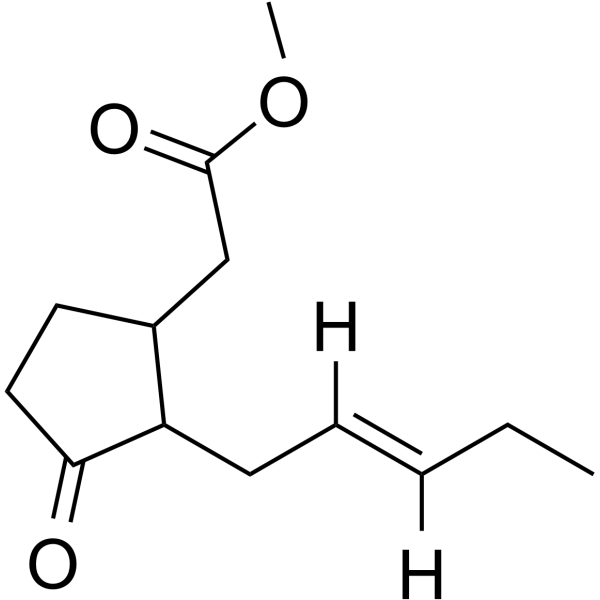
(rac)-Methyl jasmonate is the racemate of Methyl jasmonate (HY-135663). Methyl jasmonate is a phytohormone that regulates the defense response of plants under biotic and biotic stress through jasmonate signaling pathway. Methyl jasmonate inhibits the activation of NF-κB signaling pathway. Methyl jasmonate can promote the mitochondrial ROS production, but also scavenges free radicals and reduces the oxidative stress. Methyl jasmonate exhibits anti-inflammatory, antitumor, anticonvulsant, antinociceptive and sedative activities.
For research use only. We do not sell to patients.
- Purity : 99.09%
- CAS No.: 39924-52-2
- Formula: C13H20O3
- Molecular Weight:224.30
-
Storage:Pure form -20°C, 3 years , 4°C, 2 years ; In solvent -80°C, 6 months , -20°C, 1 month

To place orders, for customer services and technical support, please contact: MedChemExpress USA
Tel: 609-228-6898 E-mail: [email protected] [email protected]


-
 Biological Activity
-
Chemical Information
-
Solvent & Solubility
- Purity & Documentation
- References
-
 Help & FAQs




All Phytohormone Isoforms
More

Biological Activity
Description
In Vitro
Methyl jasmonate (1-2 mM, 24 h-14 days) suppresses the expression of PCNA, XIAP and survivin, inhibits the cell viability (IC50s for SK-N-SH and BE(2)-C are 1.39 mM and 1.35 mM) and colony formation of human neuroblastoma cells SK-N-SH and BE(2)-C, induces cell arrest at G0/G1 phase, and induces apoptosis in SK-N-SH and BE(2)-C cells[3].
MedChemExpress (MCE) has not independently confirmed the accuracy of these methods. They are for reference only.
In Vivo
Methyl jasmonate (10-40 mg/kg, ip, once daily for 7 days) inhibits the AChE activity in mice brains, enhances the spatial working memory of mice, and reverses Scopolamine (HY-N0296)-induced memory impairment in Swiss mouse models[5].
Methyl jasmonate (10-50 mg/kg, ip, single dose) exhibits anti-inflammatory and analgesic activities in Acetic acid (HY-Y0319)-induced mouse writhing models[6].
MedChemExpress (MCE) has not independently confirmed the accuracy of these methods. They are for reference only.
-
Animal Model:Freund’s adjuvant (HY-153808)-induced rats arthritis models[1]
-
Dosage:75-300 mg/kg
-
Administration:po, once daily for 18 days
-
Result:Reduced inflammatory markers in the brains of arthritic rats, such as MPO activity and NO levels.
Increased levels of oxidative stress markers, such as nitrates, nitrites, lipid peroxides and ROS. Increased the level of reduced glutathione (GSH) in rats brains
-
Animal Model:Scopolamine (HY-N0296)-induced memory impairment in Swiss mouse models[5]
-
Dosage:10-40 mg/kg
-
Administration:ip, once daily for 7 days
-
Result:Increased the alternation behavior and preference index in the Y-maze and ORT tests.
-
Animal Model:Acetic acid (HY-Y0319)-induced mouse writhing models[6]
-
Dosage:10-50 mg/kg
-
Administration:ip, single dose
-
Result:Reduced the number of writhing.


Chemical Information
-
CAS No. 39924-52-2
-
Appearance Liquid (Density: 1.003±0.06 g/cm3)
-
Molecular Weight 224.30
-
Formula C13H20O3
-
Color Colorless to light yellow
-
SMILES
O=C(OC)CC1C(C/C=C/CC)C(CC1)=O
-
Structure Classification
-
Initial Source
-
Shipping
Room temperature in continental US; may vary elsewhere.
-
Storage
Pure form -20°C 3 years 4°C 2 years In solvent -80°C 6 months -20°C 1 month


Solvent & Solubility
In Vitro:
DMSO : 100 mg/mL (445.83 mM; Need ultrasonic; Hygroscopic DMSO has a significant impact on the solubility of product, please use newly opened DMSO)
Please refer to the solubility information to select the appropriate solvent. Once prepared, please aliquot and store the solution to prevent product inactivation from repeated freeze-thaw cycles.
Storage method and period of stock solution: -80°C, 6 months; -20°C, 1 month. When stored at -80°C, please use it within 6 months. When stored at -20°C, please use it within 1 month.
Please refer to the solubility information to select the appropriate solvent. Once prepared, please aliquot and store the solution to prevent product inactivation from repeated freeze-thaw cycles.
Storage method and period of stock solution: -80°C, 6 months; -20°C, 1 month. When stored at -80°C, please use it within 6 months. When stored at -20°C, please use it within 1 month.
Concentration (start) × Volume (start) = Concentration (final) × Volume (final)
In Vivo:
Select the appropriate dissolution method based on your experimental animal and administration route.
- For the following dissolution methods, please ensure to first prepare a clear stock solution using an In Vitro approach and then sequentially add co-solvents:
- To ensure reliable experimental results, the clarified stock solution can be appropriately stored based on storage conditions. As for the working solution for In Vivo experiments, it is recommended to prepare freshly and use it on the same day.
- The percentages shown for the solvents indicate their volumetric ratio in the final prepared solution. If precipitation or phase separation occurs during preparation, heat and/or sonication can be used to aid dissolution.
Add each solvent one by one: 10% DMSO 40% PEG300 5% Tween-80 45% Saline
Solubility: ≥ 2.5 mg/mL (11.15 mM); Clear solution
This protocol yields a clear solution of ≥ 2.5 mg/mL (saturation unknown).
Taking 1 mL working solution as an example, add 100 μL DMSO stock solution (25.0 mg/mL) to 400 μL PEG300, and mix evenly; then add 50 μL Tween-80 and mix evenly; then add 450 μL Saline to adjust the volume to 1 mL.
Preparation of Saline: Dissolve 0.9 g sodium chloride in ddH₂O and dilute to 100 mL to obtain a clear Saline solution.
Add each solvent one by one: 10% DMSO 90% (20% SBE-β-CD in Saline)
Solubility: ≥ 2.5 mg/mL (11.15 mM); Clear solution
This protocol yields a clear solution of ≥ 2.5 mg/mL (saturation unknown).
Taking 1 mL working solution as an example, add 100 μL DMSO stock solution (25.0 mg/mL) to 900 μL 20% SBE-β-CD in Saline, and mix evenly.
Preparation of 20% SBE-β-CD in Saline (4°C, storage for one week): 2 g SBE-β-CD powder is dissolved in 10 mL Saline, completely dissolve until clear.
In Vivo Dissolution Calculator
Please enter the basic information of animal experiments:
-
-
-
-
Recommended: Prepare an additional quantity of animals to account for potential losses during experiments.
Please enter your animal formula composition:
-
%DMSO +
Recommended: Keep the proportion of DMSO in working solution below 2% if your animal is weak.
-
%+
-
+%Tween-80 + +
-
%Saline +
The co-solvents required include: DMSO, . All of co-solvents are available by MedChemExpress (MCE). , Tween 80. All of co-solvents are available by MedChemExpress (MCE).
Working solution concentration: 0.22 mg/mL
Method for preparing stock solution: mg drug dissolved in μL DMSO. Stock solution concentration: mg/mL.
1. Take μL DMSO stock solution;
2. Add μL .
μL , mix evenly;
3. Then add μL Tween 80, mix evenly;
4. Then add μL
Please ensure that the stock solution in the first step is dissolved to a clear state, and add co-solvents in sequence. You can use ultrasonic heating (ultrasonic cleaner, recommended frequency 20-40 kHz), vortexing, etc. to assist dissolution.


Purity & Documentation
-
Data Sheet (296 KB)
-
SDS (394 KB)
- English - EN (394 KB)
- Français - FR (394 KB)
- Deutsch - DE (394 KB)
- Norwegian - NO (394 KB)
- Español - ES (394 KB)
- Swedish - SV (394 KB)
- Italian - IT (394 KB)
- Korean - KR (394 KB)
- Portuguese - PT (394 KB)
-
Handling Instructions (2659 KB)
References
[1]. Pereira-Maróstica HV, et al., Methyl Jasmonate Reduces Inflammation and Oxidative Stress in the Brain of Arthritic Rats. Antioxidants (Basel). 2019 Oct 15;8(10):485. [Content Brief]
[2]. Yu X, et al., The roles of methyl jasmonate to stress in plants. Funct Plant Biol. 2019 Feb;46(3):197-212. [Content Brief]
[3]. Tong QS, et al., Methyl jasmonate downregulates expression of proliferating cell nuclear antigen and induces apoptosis in human neuroblastoma cell lines. Anticancer Drugs. 2008 Jul;19(6):573-81. [Content Brief]
[4]. Annafi OS, et al., Evaluation of the anticonvulsant and anxiolytic potentials of methyl jasmonate in mice. Sci Pharm. 2014 Mar 24;82(3):643-54. [Content Brief]
[5]. Eduviere AT, et al., Methyl jasmonate enhances memory performance through inhibition of oxidative stress and acetylcholinesterase activity in mice. Life Sci. 2015 Jul 1;132:20-6. [Content Brief]
[6]. Umukoro S, et al., Antinociceptive effects of methyl jasmonate in experimental animals. J Nat Med. 2011 Jul;65(3-4):466-70. [Content Brief]


Complete Stock Solution Preparation Table
Please refer to the solubility information to select the appropriate solvent. Once prepared, please aliquot and store the solution to prevent product inactivation from repeated freeze-thaw cycles.
Storage method and period of stock solution: -80°C, 6 months; -20°C, 1 month. When stored at -80°C, please use it within 6 months. When stored at -20°C, please use it within 1 month.
| Optional Solvent | Concentration Solvent Mass | 1 mg | 5 mg | 10 mg | 25 mg |
|---|---|---|---|---|---|
| DMSO | 1 mM | 4.4583 mL | 22.2916 mL | 44.5831 mL | 111.4579 mL |
| 5 mM | 0.8917 mL | 4.4583 mL | 8.9166 mL | 22.2916 mL | |
| 10 mM | 0.4458 mL | 2.2292 mL | 4.4583 mL | 11.1458 mL | |
| 15 mM | 0.2972 mL | 1.4861 mL | 2.9722 mL | 7.4305 mL | |
| 20 mM | 0.2229 mL | 1.1146 mL | 2.2292 mL | 5.5729 mL | |
| 25 mM | 0.1783 mL | 0.8917 mL | 1.7833 mL | 4.4583 mL | |
| 30 mM | 0.1486 mL | 0.7431 mL | 1.4861 mL | 3.7153 mL | |
| 40 mM | 0.1115 mL | 0.5573 mL | 1.1146 mL | 2.7864 mL | |
| 50 mM | 0.0892 mL | 0.4458 mL | 0.8917 mL | 2.2292 mL | |
| 60 mM | 0.0743 mL | 0.3715 mL | 0.7431 mL | 1.8576 mL | |
| 80 mM | 0.0557 mL | 0.2786 mL | 0.5573 mL | 1.3932 mL | |
| 100 mM | 0.0446 mL | 0.2229 mL | 0.4458 mL | 1.1146 mL |


(rac)-Methyl jasmonate Related Classifications
HY-W013507 Related Classifications
 Powered by Bioz