



Mezagitamab
Based on 1 publication(s) in Google Scholar
Mezagitamab (TAK-079) is a IgG1λ anti-CD38 monoclonal antibody. Mezagitamab depletes tumor cells expressing CD38 through antibody and complement dependent cytotoxicity. Mezagitamab has potential application in relapsed/refractory multiple myeloma (RRMM) and idiopathic thrombocytopenic purpura (ITP).
연구목적의 판매만을 진행합니다. 환자를 대상으로 한 판매는 하지 않습니다.
- Purity : 99.76%
- CAS No.: 2227490-52-8
- 분자량:143.7 kDa
-
보관:
Please store the product under the recommended conditions in the Certificate of Analysis.


To place orders, for customer services and technical support, please contact: MedChemExpress USA
Tel: 609-228-6898 E-mail: [email protected] [email protected]


-
 Biological Activity
-
Chemical Information
- Protocol
- 순도&문서
- References
-
 Help & FAQs


-

HY-P9915
DaratumumabAnti-CD38 Monoclonal Antibody -

HY-P9976
IsatuximabAnti-CD38 Monoclonal Antibody -
HY-P9976A
Isatuximab (anti-CD38)Anti-CD38 Antibody -

HY-P99616
FelzartamabAnti-CD38 Antibody -
HY-N0640
Kuromanin chlorideBlood glucose regulator -

HY-P9915A
Daratumumab (Anti-CD38)Anti-CD38 Monoclonal Antibody -
HY-P99992
Human IgG1 lambda1, Isotype ControlIgG1λ1 Isotype Control -

HY-N0640R
Kuromanin chloride (Standard)Blood glucose regulator
Publications Citing Use of MedChemExpress (MCE) Mezagitamab
More

Biological Activity
제품 설명
Isotype
Human IgG1 lambda
Recommend Isotype Controls
Species Reactivity
Human
IC50 & Target
CD38
In Vitro
Mezagitamab binds to CD38, allosterically inhibits the enzymatic activity of CD38, induces apoptosis by antibody-dependent cellular cytotoxicity (ADCC, activates immune cells such as NK cells) and complement-dependent cytotoxicity (CDC, activates the complement system)[4].
MedChemExpress (MCE) has not independently confirmed the accuracy of these methods. They are for reference only.
In Vivo
Mezagitamab (3 mg/kg, iv,once weekly for 8 weeks) prevents collagen-induced arthritis in cynomolgus monkey models[4].
MedChemExpress (MCE) has not independently confirmed the accuracy of these methods. They are for reference only.
-
Animal Model:Cynomolgus monkey models[4]
-
Dosage:0.03-100 mg/kg
-
Administration:iv, once or twice a week for 4-13 weeks
-
Result:Reduced numbers of NK/B/T cells.
-
Animal Model:Collagen-induced arthritis in cynomolgus monkey models[4]
-
Dosage:3 mg/kg
-
Administration:iv,once weekly for 8 weeks
-
Result:Inhibited the progression of arthritis.
Clinical Trial
| NCT Number | Sponsor | Condition | Start Date |
Phase

|
|---|---|---|---|---|
| NCT01329991 | 2011-05 | PHASE1 |
Gene ID
Accession
Conjugated
Unconjugated
Reconsititution
The product can be reconstituted/diluted with sterile PBS or saline.
Format
-
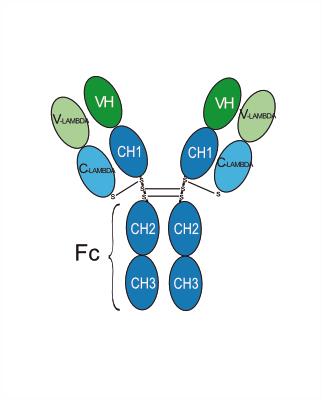
Human IgG1 lambda
신청
ELISA, FACS, Functional assay
Verified Bioactivity
-
 Immobilized CD38 Protein, Human can bind Mezagitamab. The EC50 for this effect is 61.97 ng/mL.
 -
 Flow Cytometry analysis of Raji cells labelling CD38 (red) with Mezagitamab (anti-CD38) (HY-P99730). Goat Anti-Human IgG (Alexa Fluor 488) (HY-P83776) at a dilution of 1/1000 was used as the secondary antibody. Blue-Human IgG1 lambda1 (HY-P99992). Black-Unlabelled control, cells without incubation with primary antibody.


Chemical Information
-
CAS No. 2227490-52-8
-
Appearance Liquid
-
분자량 143.7 kDa
-
Color Colorless to light yellow
-
SMILES
[Mezagitamab]
-
Synonyms
TAK-079
-
선적
Shipping with dry ice.
-
Formulation
Please refer to the lot-specific COA for specific buffer information.
-
보관
Please store the product under the recommended conditions in the Certificate of Analysis.


Publications (1)
-
Journal Impact Factor
-
Most Recent


순도&문서
-
Data Sheet (261 KB)
-
SDS (251 KB)
- English - EN (251 KB)
- Français - FR (251 KB)
- Deutsch - DE (251 KB)
- Norwegian - NO (251 KB)
- Español - ES (251 KB)
- Swedish - SV (251 KB)
- Italian - IT (251 KB)
- Korean - KR (251 KB)
- Portuguese - PT (251 KB)
-
Inhibitory Antibodies User Guide (603 KB)
References
[2]. Jadoon Y, et al. Immunotherapy in multiple myeloma. Cancer Treat Res Commun. 2021;29:100468. [Content Brief]
[3]. Kuter DJ. Novel therapies for immune thrombocytopenia. Br J Haematol. 2022 Mar;196(6):1311-1328. [Content Brief]
[4]. Roepcke S, et al., Pharmacokinetics and pharmacodynamics of the cytolytic anti-CD38 human monoclonal antibody TAK-079 in monkey - model assisted preparation for the first in human trial. Pharmacol Res Perspect. 2018 Jun;6(3):e00402. [Content Brief]
[5]. Korver W, et al., A Reduction in B, T, and Natural Killer Cells Expressing CD38 by TAK-079 Inhibits the Induction and Progression of Collagen-Induced Arthritis in Cynomolgus Monkeys. J Pharmacol Exp Ther. 2019 Aug;370(2):182-196. [Content Brief]

Calculators
Concentration (start) × Volume (start) = Concentration (final) × Volume (final)


Mezagitamab Related Classifications
HY-P99730 Related Classifications
 Powered by Bioz