



Bromfenac
Bromfenac is a potent and orally active inhibitor of COX, with IC50s of 5.56 and 7.45 nM for COX-1 and COX-2, respectively. Bromfenac can be used in ocular inflammation research.
At equivalent molar concentrations, both the salt and free forms of a compound exhibit comparable biological activity. Nevertheless, the salt form (Bromfenac sodium and Bromfenac sodium hydrate) usually boasts enhanced water solubility and stability.
For research use only. We do not sell to patients.
- CAS No.: 91714-94-2
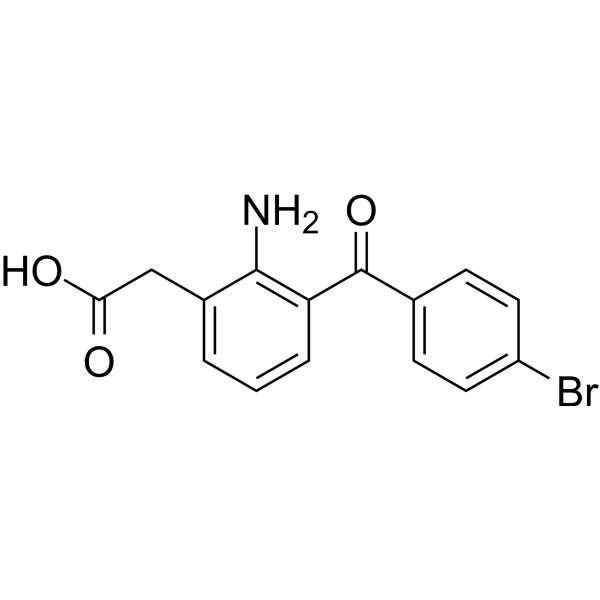
- Formula: C15H12BrNO3
- Molecular Weight:334.16
-
Storage:
Please store the product under the recommended conditions in the Certificate of Analysis.

To place orders, for customer services and technical support, please contact: MedChemExpress USA
Tel: 609-228-6898 E-mail: [email protected] [email protected]


-
 Biological Activity
-
Chemical Information
- Protocols
- Purity & Documentation
- References
-
 Help & FAQs




Biological Activity
Description
IC50 & Target
|
Human COX-1 5.56 nM (IC50) |
Human COX-2 7.45 nM (IC50) |
In Vitro
Bromfenac (0-80 μg/mL; 24 h) can inhibit transforming growth factor-β2-induced epithelial-mesenchymal transition in HLEC-B3 in a concentration-dependent manner[2].
Bromfenac (80 μg/mL; 48 h) inhibits transforming growth factor-β2-induced epithelial-mesenchymal transition in human anterior capsules[2].
MedChemExpress (MCE) has not independently confirmed the accuracy of these methods. They are for reference only.
-
Cell Line:Transforming growth factor-β2-treated human anterior capsules
-
Concentration:80 μg/mL
-
Incubation Time:48 hours
-
Result:Suppressed transforming growth factor-β2-induced epithelial-mesenchymal transition in primary lens epithelial cells (LECs).
-
Cell Line:HLEC-B3 cells
-
Concentration:0, 20, 40, 60, and 80 μg/mL
-
Incubation Time:24 hours
-
Result:Suppressed transforming growth factor-β2-induced cell migration in HLEC-B3 cells, and exhibited inhibition of the over-expression of epithelial-mesenchymal transition markers.
In Vivo
Bromfenac (0.032-3.16%; 100 μL; rubbed onto the paws) produces dose-related anti-inflammatory activity in rats[3].
Bromfenac (0.032-1.0%; 50 μL) is 26 times more potent than indomethacin in blocking the erythema when applied directly onto the skin area exposed to UV light in guinea pigs[3].
Bromfenac (0.0032-0.1%; 50 μL; rubbed onto the uninjected paw for 4 h per day and 5 days per week) produces a dose and time dependent reduction in the paw volume of both hind limbs in rats[3].
Bromfenac (0.32%; 50 μL; rubbed onto the abdomen) produces significant blockade of abdominal constriction to ACh challenge in mice[3].
Bromfenac (eyedrop instillation; 1 μL (0.09%) per eye; twice-daily; 4 w) partially reduces corneal staining, and becomes so more slowly by the 4-week time point[4].
MedChemExpress (MCE) has not independently confirmed the accuracy of these methods. They are for reference only.
-
Animal Model:Male Sprague-Dawley rats (150-250 g) are injected carrageenan[3]
-
Dosage:0.0032, 0.01, 0.032, 0.1, 0.32, 1.0, 3.16% (100 or 200 μL)
-
Administration:Rubbed onto the backs before 1-72 h of injected carrageenan
-
Result:Produced significant anti-inflammatory activity when applied 1, 2, and 4 h prior to carrageenan challenge at 0.32%.
Applied 1 or 4 h prior to carrageenan challenge was active, but not when applied 24 h (or longer) prior to challenge at 0.2%.
-
Animal Model:Male injected with Salin or BTX-B[4]
-
Dosage:1 μL (0.09%) per eye
-
Administration:Eyedrop instillation; 1 μL (0.09%) per eye; twice-daily; 4 weeks
-
Result:Improved the corneal fluorescein staining score later at 4 weeks after treatment.
Clinical Trial
| NCT Number | Sponsor | Condition | Start Date |
Phase

|
|---|---|---|---|---|
| NCT01329991 | 2011-05 | PHASE1 |


Chemical Information
-
CAS No. 91714-94-2
-
Molecular Weight 334.16
-
Formula C15H12BrNO3
-
SMILES
O=C(O)CC1=CC=CC(C(C2=CC=C(Br)C=C2)=O)=C1N
-
Shipping
Room temperature in continental US; may vary elsewhere.
-
Storage
Please store the product under the recommended conditions in the Certificate of Analysis.


Purity & Documentation
References
[1]. Tetsuo Kida, et al. Pharmacokinetics and efficacy of topically applied nonsteroidal anti-inflammatory drugs in retinochoroidal tissues in rabbits. PLoS One. 2014 May 5;9(5):e96481. [Content Brief]
[2]. Xiaobo Zhang, et al. Drug-eluting intraocular lens with sustained bromfenac release for conquering posterior capsular opacification. Bioact Mater. 2021 Jul 23;9:343-357. [Content Brief]
[3]. Nolan JC, et, al. The topical anti-inflammatory and analgesic properties of bromfenac in rodents. Agents Actions. 1988 Aug; 25(1-2): 77-85. [Content Brief]
[4]. Kaevalin Lekhanont, et al. Effects of topical anti-inflammatory agents in a botulinum toxin B-induced mouse model of keratoconjunctivitis sicca. J Ocul Pharmacol Ther. 2007 Feb;23(1):27-34. [Content Brief]

Calculators
Concentration (start) × Volume (start) = Concentration (final) × Volume (final)


Bromfenac Related Classifications
HY-B1888 Related Classifications
 Powered by Bioz