



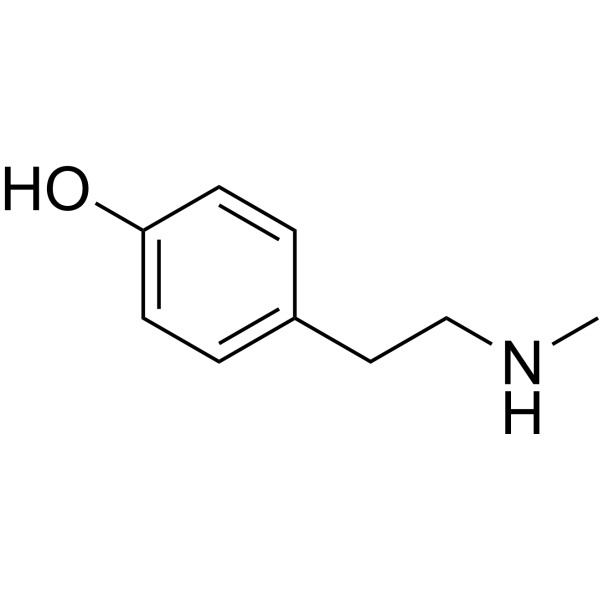
N-Methyltyramine

Based on 1 Customer Validation
N-Methyltyramine is an orally active α2-adrenoreceptor antagonist with an IC50 value of 5.53 μM against rat targets. N-Methyltyramine blocks α2-adrenoreceptors, while inhibiting lipolysis, hyperactivity responses and small intestinal peristalsis in mice. N-Methyltyramine promotes gastrin release and pancreatic juice secretion, upregulates appetite, blood pressure, myocardial contraction frequency and contraction intensity, and increases renal blood flow, renal vascular resistance and mean peripheral arterial resistance. N-Methyltyramine relaxes mouse small intestinal smooth muscle and undergoes biotransformation in vivo to produce adrenaline. N-Methyltyramine can be used in studies related to gastrointestinal diseases.
For research use only. We do not sell to patients.
- Purity : 99.83%
- CAS No.: 370-98-9
- Formula: C9H13NO
- Molecular Weight:151.21
-
Storage:
-20°C, protect from light
* In solvent : -80°C, 6 months; -20°C, 1 month (protect from light)

To place orders, for customer services and technical support, please contact: MedChemExpress USA
Tel: 609-228-6898 E-mail: [email protected] [email protected]


-
 Biological Activity
-
Chemical Information
-
Solvent & Solubility
- Purity & Documentation
- References
-
 Help & FAQs


All Adrenergic Receptor Isoforms
More

Biological Activity
Description
In Vitro
N-Methyltyramine mildly inhibits lipolysis in isolated rat and human adipocytes in vitro[1].
N-Methyltyramine inhibits the binding of [3H]-para-amino Clonidine (HY-12721) to α2-adrenergic receptors in crude synaptosomal membranes from rat brain, with an IC50 of 5.53 μM[2].
MedChemExpress (MCE) has not independently confirmed the accuracy of these methods. They are for reference only.
In Vivo
N-Methyltyramine (infused into stomach) dose-dependently stimulates pancreatic secretion in rats when infused into the stomach, with beer-derived NMT capable of driving greater than 50% secretion[1].
N-Methyltyramine administered intravenously at 0.04 mg/kg/min increases renal hemodynamic parameters and mean arterial pressure in dogs, while a 0.25 mg/kg i.v. bolus markedly elevates peripheral resistance[1].
Radio-labeled N-Methyltyramine (i.v.; single dose) distributes rapidly to all organs (with highest levels in liver and kidneys) and is rapidly excreted and metabolized in rabbits and mice following intravenous administration[1].
N-methyltyramine (20-100 mg/kg; i.p.; single dose) acts as an α2-adrenoceptor antagonist, dose-dependently inhibiting scopolamine (HY-N0296)-induced hypermotility in male ddY mice[2].
N-Methyltyramine (3-30 mg/kg; p.o.; single dose) dose-dependently inhibits mouse small intestinal propulsive function, with significant effects observed at 3 mg/kg, 9 mg/kg, and 30 mg/kg via oral administration[3].
MedChemExpress (MCE) has not independently confirmed the accuracy of these methods. They are for reference only.


Chemical Information
-
CAS No. 370-98-9
-
Appearance Solid
-
Molecular Weight 151.21
-
Formula C9H13NO
-
Color White to off-white
-
SMILES
CNCCC1=CC=C(C=C1)O
-
Structure Classification
-
Shipping
Room temperature in continental US; may vary elsewhere.
-
Storage
-20°C, protect from light
* In solvent : -80°C, 6 months; -20°C, 1 month (protect from light)


Solvent & Solubility
In Vitro:
DMSO : 100 mg/mL (661.33 mM; Need ultrasonic; Hygroscopic DMSO has a significant impact on the solubility of product, please use newly opened DMSO)
Please refer to the solubility information to select the appropriate solvent. Once prepared, please aliquot and store the solution to prevent product inactivation from repeated freeze-thaw cycles.
Storage method and period of stock solution: -80°C, 6 months; -20°C, 1 month (protect from light). When stored at -80°C, please use it within 6 months. When stored at -20°C, please use it within 1 month.
Please refer to the solubility information to select the appropriate solvent. Once prepared, please aliquot and store the solution to prevent product inactivation from repeated freeze-thaw cycles.
Storage method and period of stock solution: -80°C, 6 months; -20°C, 1 month (protect from light). When stored at -80°C, please use it within 6 months. When stored at -20°C, please use it within 1 month.
Concentration (start) × Volume (start) = Concentration (final) × Volume (final)
In Vivo:
Select the appropriate dissolution method based on your experimental animal and administration route.
- For the following dissolution methods, please ensure to first prepare a clear stock solution using an In Vitro approach and then sequentially add co-solvents:
- To ensure reliable experimental results, the clarified stock solution can be appropriately stored based on storage conditions. As for the working solution for In Vivo experiments, it is recommended to prepare freshly and use it on the same day.
- The percentages shown for the solvents indicate their volumetric ratio in the final prepared solution. If precipitation or phase separation occurs during preparation, heat and/or sonication can be used to aid dissolution.
Add each solvent one by one: 10% DMSO 40% PEG300 5% Tween-80 45% Saline
Solubility: ≥ 2.5 mg/mL (16.53 mM); Clear solution
This protocol yields a clear solution of ≥ 2.5 mg/mL (saturation unknown).
Taking 1 mL working solution as an example, add 100 μL DMSO stock solution (25.0 mg/mL) to 400 μL PEG300, and mix evenly; then add 50 μL Tween-80 and mix evenly; then add 450 μL Saline to adjust the volume to 1 mL.
Preparation of Saline: Dissolve 0.9 g sodium chloride in ddH₂O and dilute to 100 mL to obtain a clear Saline solution.
Add each solvent one by one: 10% DMSO 90% (20% SBE-β-CD in Saline)
Solubility: ≥ 2.5 mg/mL (16.53 mM); Clear solution
This protocol yields a clear solution of ≥ 2.5 mg/mL (saturation unknown).
Taking 1 mL working solution as an example, add 100 μL DMSO stock solution (25.0 mg/mL) to 900 μL 20% SBE-β-CD in Saline, and mix evenly.
Preparation of 20% SBE-β-CD in Saline (4°C, storage for one week): 2 g SBE-β-CD powder is dissolved in 10 mL Saline, completely dissolve until clear.
In Vivo Dissolution Calculator
Please enter the basic information of animal experiments:
-
-
-
-
Recommended: Prepare an additional quantity of animals to account for potential losses during experiments.
Please enter your animal formula composition:
-
%DMSO +
Recommended: Keep the proportion of DMSO in working solution below 2% if your animal is weak.
-
%+
-
+%Tween-80 + +
-
%Saline +
The co-solvents required include: DMSO, . All of co-solvents are available by MedChemExpress (MCE). , Tween 80. All of co-solvents are available by MedChemExpress (MCE).
Working solution concentration: 0.22 mg/mL
Method for preparing stock solution: mg drug dissolved in μL DMSO. Stock solution concentration: mg/mL. * In solvent : -80°C, 6 months; -20°C, 1 month (protect from light)
1. Take μL DMSO stock solution;
2. Add μL .
μL , mix evenly;
3. Then add μL Tween 80, mix evenly;
4. Then add μL
Please ensure that the stock solution in the first step is dissolved to a clear state, and add co-solvents in sequence. You can use ultrasonic heating (ultrasonic cleaner, recommended frequency 20-40 kHz), vortexing, etc. to assist dissolution.


Purity & Documentation
-
Data Sheet (272 KB)
-
SDS (393 KB)
- English - EN (393 KB)
- Français - FR (393 KB)
- Deutsch - DE (393 KB)
- Norwegian - NO (393 KB)
- Español - ES (393 KB)
- Swedish - SV (393 KB)
- Italian - IT (393 KB)
- Korean - KR (393 KB)
- Portuguese - PT (393 KB)
-
Handling Instructions (2659 KB)
References
[1]. Stohs SJ. A Review of the Receptor Binding and Pharmacological Effects of N-methyltyramine. Phytotherapy Research. 2014;29(1):14-16. [Content Brief]
[3]. Ni J, et al. Effect of N-methyltyramine on the regulation of adrenergic receptors via enzymatic epinephrine synthesis for the treatment of gastrointestinal disorders. Biomedicine & Pharmacotherapy. 2019;111:1393-1398. [Content Brief]


Complete Stock Solution Preparation Table
Please refer to the solubility information to select the appropriate solvent. Once prepared, please aliquot and store the solution to prevent product inactivation from repeated freeze-thaw cycles.
Storage method and period of stock solution: -80°C, 6 months; -20°C, 1 month (protect from light). When stored at -80°C, please use it within 6 months. When stored at -20°C, please use it within 1 month.
| Optional Solvent | Concentration Solvent Mass | 1 mg | 5 mg | 10 mg | 25 mg |
|---|---|---|---|---|---|
| DMSO | 1 mM | 6.6133 mL | 33.0666 mL | 66.1332 mL | 165.3330 mL |
| 5 mM | 1.3227 mL | 6.6133 mL | 13.2266 mL | 33.0666 mL | |
| 10 mM | 0.6613 mL | 3.3067 mL | 6.6133 mL | 16.5333 mL | |
| 15 mM | 0.4409 mL | 2.2044 mL | 4.4089 mL | 11.0222 mL | |
| 20 mM | 0.3307 mL | 1.6533 mL | 3.3067 mL | 8.2666 mL | |
| 25 mM | 0.2645 mL | 1.3227 mL | 2.6453 mL | 6.6133 mL | |
| 30 mM | 0.2204 mL | 1.1022 mL | 2.2044 mL | 5.5111 mL | |
| 40 mM | 0.1653 mL | 0.8267 mL | 1.6533 mL | 4.1333 mL | |
| 50 mM | 0.1323 mL | 0.6613 mL | 1.3227 mL | 3.3067 mL | |
| 60 mM | 0.1102 mL | 0.5511 mL | 1.1022 mL | 2.7555 mL | |
| 80 mM | 0.0827 mL | 0.4133 mL | 0.8267 mL | 2.0667 mL | |
| 100 mM | 0.0661 mL | 0.3307 mL | 0.6613 mL | 1.6533 mL |


N-Methyltyramine Related Classifications
HY-W153897 Related Classifications
 Powered by Bioz