



NC-R17
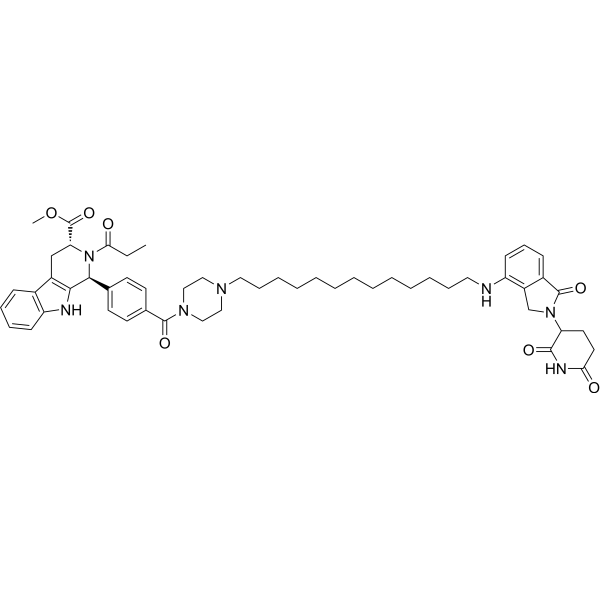
NC-R17 is a PROTAC degrader that targets glutathione peroxidase 4 (GPX4) for degradation by recruiting cereblon. With RSL3 as its parent core, NC-R17 binds non-covalently to GPX4. NC-R17 exhibits moderate GPX4 degradation activity in tumor cells and can be used in studies related to ferroptosis (ferroptosis) and tumors.
(Pink: GPX4 ligand (HY-135832); Blue: Cereblon ligand (HY-A0003); Black: linker (HY-169376)).
For research use only. We do not sell to patients.
- CAS No.: 3049087-34-2
- Formula: C53H67N7O7
- Molecular Weight:914.14
-
Storage:
Please store the product under the recommended conditions in the Certificate of Analysis.

To place orders, for customer services and technical support, please contact: MedChemExpress USA
Tel: 609-228-6898 E-mail: [email protected] [email protected]


-
 Biological Activity
-
Chemical Information
- Protocols
- Purity & Documentation
- References
-
 Help & FAQs


All PROTACs Isoforms
More

Biological Activity
Description
IC50 & Target
[1]|
GPX4 |
In Vitro
NC-R17 (0.1-20 μM; 24 h) induces moderate GPX4 protein degradation in HT1080 cells when treated at 20 μM or 10 μM for 24 h, with no detectable degradation at lower concentrations[1].
MedChemExpress (MCE) has not independently confirmed the accuracy of these methods. They are for reference only. Further protocols information, click here.
-
Cell Line:HT1080 human fibrosarcoma cells
-
Concentration:0.1 μM, 1 μM, 10 μM, 20 μM
-
Incubation Time:24 h
-
Result:Reduced GPX4 protein levels to 59% of the control level.
Reduced GPX4 protein levels to 68% of the control level.
Did not reduce GPX4 protein levels (levels were 106% of the control).
Did not reduce GPX4 protein levels (levels were 88% of the control).


Chemical Information
-
CAS No. 3049087-34-2
-
Molecular Weight 914.14
-
Formula C53H67N7O7
-
SMILES
O=C(OC)[C@@H]1N(C(CC)=O)[C@@H](C2=CC=C(C(N3CCN(CCCCCCCCCCCCCNC4=C(CN(C5C(NC(CC5)=O)=O)C6=O)C6=CC=C4)CC3)=O)C=C2)C7=C(C(C=CC=C8)=C8N7)C1
-
Shipping
Room temperature in continental US; may vary elsewhere.
-
Storage
Please store the product under the recommended conditions in the Certificate of Analysis.

Protocols
-
Ferroptosis Solutions
Ferroptosis is an iron-dependent, non-apoptotic form of regulated cell death characterized by lethal lipid peroxidation and sensitivity to suppression by iron chelators or lipophilic radical-trapping antioxidants. The core pathway links cystine uptake through system Xc−, glutathione availability, GPX4-dependent detoxification of phospholipid hydroperoxides, iron-dependent oxidative reactions, and polyunsaturated-phospholipid metabolism into a cell-death program that is biochemically and morphologically distinct from apoptosis, necrosis, and autophagy. The ferroptosis pathway is experimentally linked to phenotype through chemical and genetic perturbation. Erastin induces ferroptosis by inhibiting cystine uptake through system Xc− and weakening antioxidant defenses, while GPX4 inhibition or depletion causes lipid peroxide accumulation and ferroptotic cancer-cell death. ACSL4 and oxidizable arachidonoyl- or adrenoyl-containing phosphatidylethanolamines shape ferroptosis sensitivity by con


Purity & Documentation
References

Calculators
Concentration (start) × Volume (start) = Concentration (final) × Volume (final)


NC-R17 Related Classifications
HY-155075 Related Classifications
 Powered by Bioz