



Synephrine
Based on 3 publication(s) in Google Scholar
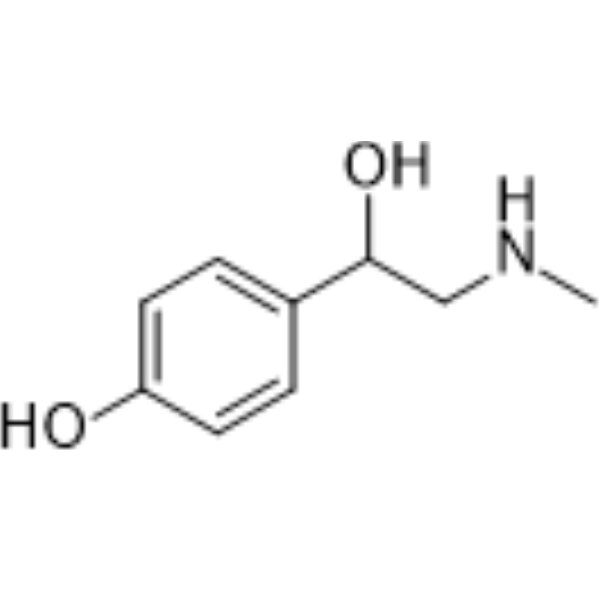
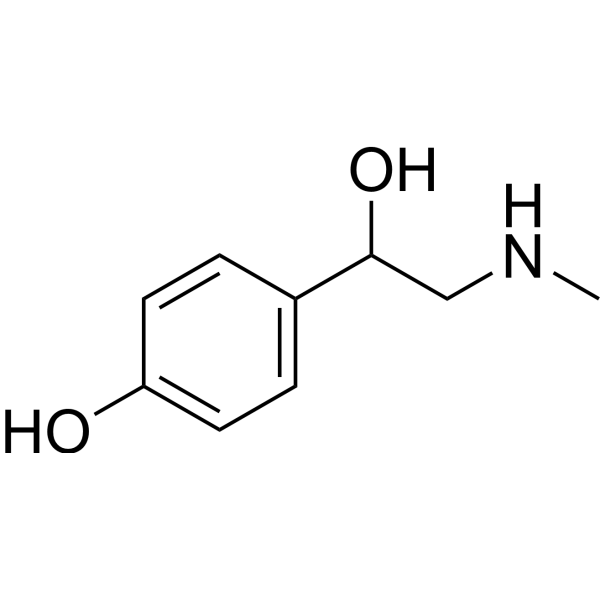
Synephrine (Oxedrine), an alkaloid, is an α-adrenergic and β-adrenergic agonist derived from the Citrus aurantium. Synephrine is a sympathomimetic compound and can be used for weight loss.
For research use only. We do not sell to patients.
- Purity : 98.0%
- CAS No.: 94-07-5
- Formula: C9H13NO2
- Molecular Weight:167.21
-
Storage:Powder -20°C, 3 years , 4°C, 2 years ; In solvent -80°C, 6 months , -20°C, 1 month

To place orders, for customer services and technical support, please contact: MedChemExpress USA
Tel: 609-228-6898 E-mail: [email protected] [email protected]


-
 Biological Activity
-
Chemical Information
-
Solvent & Solubility
- Purity & Documentation
- References
-
 Help & FAQs


Publications Citing Use of MedChemExpress (MCE) Synephrine
MoreAll Adrenergic Receptor Isoforms
MoreAll Endogenous Metabolite Isoforms
More

Biological Activity
Description
IC50 & Target
|
β adrenergic receptor |
Cellular Effect
|
Cell Line

|
Type | Value | Description | References |
|---|---|---|---|---|
| HEK293 | EC50 |
6.6 μM
Compound: p-Synephrine
|
Agonist activity at human NMU2R transfected in HEK293 cells after 7 hrs by luciferase reporter gene assay
Agonist activity at human NMU2R transfected in HEK293 cells after 7 hrs by luciferase reporter gene assay
|
[PMID: 25262941] |
In Vivo
MedChemExpress (MCE) has not independently confirmed the accuracy of these methods. They are for reference only.
-
Animal Model:Portal vein ligation (PVL) or bile duct ligation (BDL) rats[2]
-
Dosage:1 mg/kg per 12 hours
-
Administration:Oral gavage; for 8 days
-
Result:The portal venous pressure in PVL and BDL rats, portal tributary blood flow and cardiac index were significantly reduced, while mean arterial pressure and systemic as well as portal territory vascular resistance were enhanced.


Chemical Information
-
CAS No. 94-07-5
-
Appearance Solid
-
Molecular Weight 167.21
-
Formula C9H13NO2
-
Color Off-white to light brown
-
SMILES
OC(C1=CC=C(O)C=C1)CNC
-
Synonyms
Oxedrine
-
Structure Classification
-
Initial Source
-
Shipping
Room temperature in continental US; may vary elsewhere.
-
Storage
Powder -20°C 3 years 4°C 2 years In solvent -80°C 6 months -20°C 1 month


Publications (3)
-
Journal Impact Factor
-
Most Recent
-
Arch Toxicol
Quantitative in vitro-to-in vivo extrapolation of human adrenergic and trace amine-associated receptor 1 potencies of pre-workout supplement ingredients using physiologically based kinetic modelling-based reverse dosimetry. [Abstract]2025 May;99(5):1999-2021. PMID: 40178592 -
Toxicology
In vitro inhibition of monoamine transport by amphetamine-like pre-workout supplement ingredients. [Abstract]2026 Mar 6:154442. PMID: 41796714 -
Cardiovasc Toxicol
Potential Cardiovascular Risks of Phenethylamine Analogues in Food Supplements: Evidence from Vasocontraction of Rat Artery Segments. [Abstract]2026 Apr 4;26(4):36. PMID: 41934574


Solvent & Solubility
In Vitro:
DMSO : 83.33 mg/mL (498.36 mM; Need ultrasonic; Hygroscopic DMSO has a significant impact on the solubility of product, please use newly opened DMSO)
Please refer to the solubility information to select the appropriate solvent. Once prepared, please aliquot and store the solution to prevent product inactivation from repeated freeze-thaw cycles.
Storage method and period of stock solution: -80°C, 6 months; -20°C, 1 month. When stored at -80°C, please use it within 6 months. When stored at -20°C, please use it within 1 month.
Please refer to the solubility information to select the appropriate solvent. Once prepared, please aliquot and store the solution to prevent product inactivation from repeated freeze-thaw cycles.
Storage method and period of stock solution: -80°C, 6 months; -20°C, 1 month. When stored at -80°C, please use it within 6 months. When stored at -20°C, please use it within 1 month.
Concentration (start) × Volume (start) = Concentration (final) × Volume (final)
In Vivo:
Select the appropriate dissolution method based on your experimental animal and administration route.
- For the following dissolution methods, please ensure to first prepare a clear stock solution using an In Vitro approach and then sequentially add co-solvents:
- To ensure reliable experimental results, the clarified stock solution can be appropriately stored based on storage conditions. As for the working solution for In Vivo experiments, it is recommended to prepare freshly and use it on the same day.
- The percentages shown for the solvents indicate their volumetric ratio in the final prepared solution. If precipitation or phase separation occurs during preparation, heat and/or sonication can be used to aid dissolution.
Add each solvent one by one: 10% DMSO 40% PEG300 5% Tween-80 45% Saline
Solubility: ≥ 2.08 mg/mL (12.44 mM); Clear solution
This protocol yields a clear solution of ≥ 2.08 mg/mL (saturation unknown).
Taking 1 mL working solution as an example, add 100 μL DMSO stock solution (20.8 mg/mL) to 400 μL PEG300, and mix evenly; then add 50 μL Tween-80 and mix evenly; then add 450 μL Saline to adjust the volume to 1 mL.
Preparation of Saline: Dissolve 0.9 g sodium chloride in ddH₂O and dilute to 100 mL to obtain a clear Saline solution.
Add each solvent one by one: 10% DMSO 90% (20% SBE-β-CD in Saline)
Solubility: ≥ 2.08 mg/mL (12.44 mM); Clear solution
This protocol yields a clear solution of ≥ 2.08 mg/mL (saturation unknown).
Taking 1 mL working solution as an example, add 100 μL DMSO stock solution (20.8 mg/mL) to 900 μL 20% SBE-β-CD in Saline, and mix evenly.
Preparation of 20% SBE-β-CD in Saline (4°C, storage for one week): 2 g SBE-β-CD powder is dissolved in 10 mL Saline, completely dissolve until clear.
In Vivo Dissolution Calculator
Please enter the basic information of animal experiments:
-
-
-
-
Recommended: Prepare an additional quantity of animals to account for potential losses during experiments.
Please enter your animal formula composition:
-
%DMSO +
Recommended: Keep the proportion of DMSO in working solution below 2% if your animal is weak.
-
%+
-
+%Tween-80 + +
-
%Saline +
The co-solvents required include: DMSO, . All of co-solvents are available by MedChemExpress (MCE). , Tween 80. All of co-solvents are available by MedChemExpress (MCE).
Working solution concentration: 0.22 mg/mL
Method for preparing stock solution: mg drug dissolved in μL DMSO. Stock solution concentration: mg/mL.
1. Take μL DMSO stock solution;
2. Add μL .
μL , mix evenly;
3. Then add μL Tween 80, mix evenly;
4. Then add μL
Please ensure that the stock solution in the first step is dissolved to a clear state, and add co-solvents in sequence. You can use ultrasonic heating (ultrasonic cleaner, recommended frequency 20-40 kHz), vortexing, etc. to assist dissolution.


Purity & Documentation
-
Data Sheet (272 KB)
-
SDS (393 KB)
- English - EN (393 KB)
- Français - FR (393 KB)
- Deutsch - DE (393 KB)
- Norwegian - NO (393 KB)
- Español - ES (393 KB)
- Swedish - SV (393 KB)
- Italian - IT (393 KB)
- Korean - KR (393 KB)
- Portuguese - PT (393 KB)
-
Handling Instructions (2659 KB)
References
[1]. Thomas JE, et al. STEMI in a 24-year-old man after use of a synephrine-containing dietary supplement: a case report and review of the literature. Tex Heart Inst J. 2009;36(6):586-90. [Content Brief]
[2]. Huang YT, et al. Hemodynamic effects of synephrine treatment in portal hypertensive rats. Jpn J Pharmacol. 2001 Feb;85(2):183-8. [Content Brief]


Complete Stock Solution Preparation Table
Please refer to the solubility information to select the appropriate solvent. Once prepared, please aliquot and store the solution to prevent product inactivation from repeated freeze-thaw cycles.
Storage method and period of stock solution: -80°C, 6 months; -20°C, 1 month. When stored at -80°C, please use it within 6 months. When stored at -20°C, please use it within 1 month.
| Optional Solvent | Concentration Solvent Mass | 1 mg | 5 mg | 10 mg | 25 mg |
|---|---|---|---|---|---|
| DMSO | 1 mM | 5.9806 mL | 29.9029 mL | 59.8058 mL | 149.5144 mL |
| 5 mM | 1.1961 mL | 5.9806 mL | 11.9612 mL | 29.9029 mL | |
| 10 mM | 0.5981 mL | 2.9903 mL | 5.9806 mL | 14.9514 mL | |
| 15 mM | 0.3987 mL | 1.9935 mL | 3.9871 mL | 9.9676 mL | |
| 20 mM | 0.2990 mL | 1.4951 mL | 2.9903 mL | 7.4757 mL | |
| 25 mM | 0.2392 mL | 1.1961 mL | 2.3922 mL | 5.9806 mL | |
| 30 mM | 0.1994 mL | 0.9968 mL | 1.9935 mL | 4.9838 mL | |
| 40 mM | 0.1495 mL | 0.7476 mL | 1.4951 mL | 3.7379 mL | |
| 50 mM | 0.1196 mL | 0.5981 mL | 1.1961 mL | 2.9903 mL | |
| 60 mM | 0.0997 mL | 0.4984 mL | 0.9968 mL | 2.4919 mL | |
| 80 mM | 0.0748 mL | 0.3738 mL | 0.7476 mL | 1.8689 mL | |
| 100 mM | 0.0598 mL | 0.2990 mL | 0.5981 mL | 1.4951 mL |


Synephrine Related Classifications
HY-N0132 Related Classifications
 Powered by Bioz