



PCNA-I1

Based on 1 Customer Validation
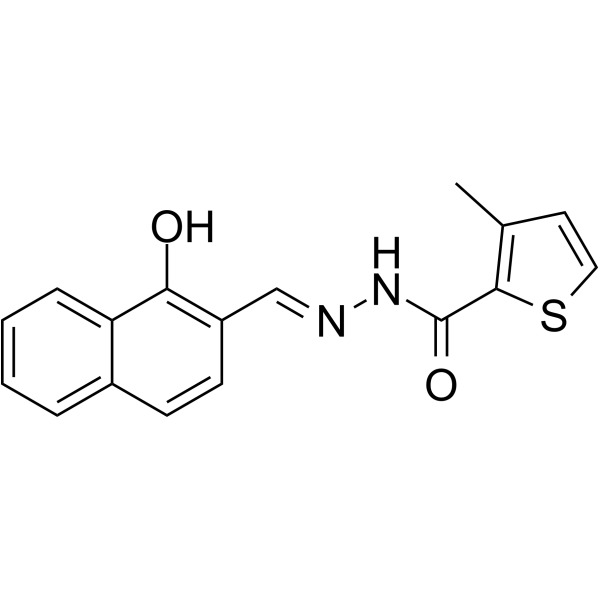
PCNA-I1 is a selective small molecule inhibitor targeting proliferating cell nuclear antigen (PCNA) with anticancer activity. PCNA-I1 can stabilize the PCNA trimer structure (Kd=0.14-0.41μM), reduce its binding to chromatin, induce tumor cell cycle arrest, inhibit DNA replication and repair, and enhance the anti-tumor effect of DNA damaging agents. PCNA-I1 can be used in the study of targeted therapy for prostate cancer, lung cancer and other tumors.
For research use only. We do not sell to patients.
- Purity : 98.78%
- CAS No.: 444930-42-1
- Formula: C17H14N2O2S
- Molecular Weight:310.37
-
Storage:Powder -20°C, 3 years , 4°C, 2 years ; In solvent -80°C, 6 months , -20°C, 1 month

To place orders, for customer services and technical support, please contact: MedChemExpress USA
Tel: 609-228-6898 E-mail: [email protected] [email protected]


-
 Biological Activity
-
Chemical Information
-
Solvent & Solubility
- Protocols
- Purity & Documentation
- References
-
 Help & FAQs


All DNA/RNA Synthesis Isoforms
More

Biological Activity
Description
In Vitro
PCNA-I1 (0.05-10 μM; 72 h) inhibits the cell viability of human prostate cancer (PC-3, LNCaP), breast cancer (MCF-7), melanoma (A375) cell lines in a concentration-dependent manner, with an average IC50 of 0.17 μM, which is significantly lower than that of normal cells[1].
PCNA-I1 (1 μM; 24-48 h) induces cell cycle arrest in S and G2/M phases and increases cell apoptosis[1].
PCNA-I1 (1 μM; 48 h) reduces PCNA binding to chromatin in PC-3 cells (NP-R fragment decreased by 50%), accompanied by nuclear p21 aggregation[1].
PCNA-I1 (1 μM; 24 h) increases the expression of γH2AX (a DNA damage marker) in PC-3 cells[2].
MedChemExpress (MCE) has not independently confirmed the accuracy of these methods. They are for reference only. Further protocols information, click here.
-
Cell Line:PC-3, LNCaP (prostate cancer); MCF-7 (breast cancer); A375 (melanoma)
-
Concentration:0.05, 0.1, 0.5, 1, 5, 10 μM
-
Incubation Time:72 h
-
Result:Dose-dependent inhibited cell growth with IC50 values: PC-3 (0.24 μM), LNCaP (0.14 μM), MCF-7 (0.15 μM), A375 (0.16 μM), while exhibited IC50 >1 μM against normal cells (e.g., HUVEC, mesenchymal stem cells).
In Vivo
MedChemExpress (MCE) has not independently confirmed the accuracy of these methods. They are for reference only.
-
Animal Model:Male BALB/c nude mice (8-10 weeks old) bearing LNCaP prostate cancer xenografts[3]
-
Dosage:10 mg/kg
-
Administration:Intravenous injection, 5 days/week for 2 consecutive weeks
-
Result:Significantly retarded tumor growth, with tumor weight in treated mice being 28% of that in vehicle controls. No significant changes in body weight or hematology profiles (leukocytes, erythrocytes, thrombocytes) were observed, indicating minimal systemic toxicity.


Chemical Information
-
CAS No. 444930-42-1
-
Appearance Solid
-
Molecular Weight 310.37
-
Formula C17H14N2O2S
-
Color Light yellow to yellow
-
SMILES
O=C(N/N=C/C1=C(C2=CC=CC=C2C=C1)O)C3=C(C=CS3)C
-
Shipping
Room temperature in continental US; may vary elsewhere.
-
Storage
Powder -20°C 3 years 4°C 2 years In solvent -80°C 6 months -20°C 1 month


Solvent & Solubility
In Vitro:
DMSO : 100 mg/mL (322.20 mM; ultrasonic and warming and heat to 60°C; Hygroscopic DMSO has a significant impact on the solubility of product, please use newly opened DMSO)
Please refer to the solubility information to select the appropriate solvent. Once prepared, please aliquot and store the solution to prevent product inactivation from repeated freeze-thaw cycles.
Storage method and period of stock solution: -80°C, 6 months; -20°C, 1 month. When stored at -80°C, please use it within 6 months. When stored at -20°C, please use it within 1 month.
Please refer to the solubility information to select the appropriate solvent. Once prepared, please aliquot and store the solution to prevent product inactivation from repeated freeze-thaw cycles.
Storage method and period of stock solution: -80°C, 6 months; -20°C, 1 month. When stored at -80°C, please use it within 6 months. When stored at -20°C, please use it within 1 month.
Concentration (start) × Volume (start) = Concentration (final) × Volume (final)

Protocols
-
PCNA Immunodetection Proliferation Assay
PCNA immunodetection measures proliferative activity by detecting proliferating cell nuclear antigen, a nuclear protein associated with DNA polymerase δ function and DNA replication. The assay readout is the proportion of PCNA-positive nuclei among total counted cells, but PCNA labeling is not identical to BrdU labeling because PCNA can mark late G1/early S-associated replication competence and may persist beyond active DNA synthesis depending on fixation and extraction conditions.
-
Flow cytometric DNA-content cell-cycle staining
Flow cytometric DNA-content cell-cycle staining measures the fluorescence intensity of DNA-bound fluorochromes in single cells or nuclei to estimate DNA content distributions, allowing assignment of populations to G0/G1, S, and G2/M phases by DNA histogram deconvolution. Propidium iodide (PI) intercalates into DNA, and PI fluorescence is proportional to cellular DNA content when staining is performed under conditions that make DNA accessible and minimize non-DNA signal. Cells with G2/M DNA content are expected to show approximately twice the fluorescence intensity of G0/G1 cells, while S-phase cells occupy intermediate fluorescence values. PI-based DNA-content analysis can also detect cells with fractional DNA content, often reported as sub-G1, when DNA fragmentation and extraction during staining reduce retained DNA signal in apoptotic cells. DAPI is an alternative DNA fluorochrome for univariate DNA-content analysis, while bivariate approaches combining DNA content with proliferation
-
BrdU Incorporation Assay
Bromodeoxyuridine (BrdU) incorporation assay is based on the principle that BrdU, a thymidine analog, is incorporated into newly synthesized DNA during the S phase of the cell cycle, thereby serving as a marker of DNA replication and cellular proliferation. Incorporated BrdU can be detected using anti-BrdU antibodies following DNA denaturation, enabling visualization or quantification of proliferating cells through immunochemical detection methods such as immunofluorescence or immunohistochemistry.
-
Protocol for Cell Cycle
Cell-cycle analysis by flow cytometry measures DNA content in single cells to estimate the fraction of cells in G0/G1, S, and G2/M phases. Propidium iodide intercalates into DNA, and after RNA removal with RNase, fluorescence intensity reflects cellular DNA content: 2N cells are assigned to G0/G1, cells between 2N and 4N to S phase, and 4N cells to G2/M. DNA-content analysis alone cannot reliably separate G0 from G1 or G2 from M. Ki-67 can distinguish quiescent G0 cells from cycling cells, EdU or BrdU incorporation marks active DNA synthesis in S phase, and phospho-histone H3 staining identifies mitotic cells within the 4N population.


Purity & Documentation
-
Data Sheet (275 KB)
-
SDS (393 KB)
- English - EN (393 KB)
- Français - FR (393 KB)
- Deutsch - DE (393 KB)
- Norwegian - NO (393 KB)
- Español - ES (393 KB)
- Swedish - SV (393 KB)
- Italian - IT (393 KB)
- Korean - KR (393 KB)
- Portuguese - PT (393 KB)
-
Handling Instructions (2659 KB)
References
[1]. Tan Z, et al. Small-molecule targeting of proliferating cell nuclear antigen chromatin association inhibits tumor cell growth. Mol Pharmacol. 2012 Jun;81(6):811-9. [Content Brief]
[2]. Lu S, et al. Additive effects of a small molecular PCNA inhibitor PCNA-I1S and DNA damaging agents on growth inhibition and DNA damage in prostate and lung cancer cells. PLoS One. 2019 Oct 10;14(10):e0223894. [Content Brief]
[3]. Dillehay KL, et al. Antitumor effects of a novel small molecule targeting PCNA chromatin association in prostate cancer. Mol Cancer Ther. 2014 Dec;13(12):2817-26. [Content Brief]


Complete Stock Solution Preparation Table
Please refer to the solubility information to select the appropriate solvent. Once prepared, please aliquot and store the solution to prevent product inactivation from repeated freeze-thaw cycles.
Storage method and period of stock solution: -80°C, 6 months; -20°C, 1 month. When stored at -80°C, please use it within 6 months. When stored at -20°C, please use it within 1 month.
| Optional Solvent | Concentration Solvent Mass | 1 mg | 5 mg | 10 mg | 25 mg |
|---|---|---|---|---|---|
| DMSO | 1 mM | 3.2220 mL | 16.1098 mL | 32.2196 mL | 80.5490 mL |
| 5 mM | 0.6444 mL | 3.2220 mL | 6.4439 mL | 16.1098 mL | |
| 10 mM | 0.3222 mL | 1.6110 mL | 3.2220 mL | 8.0549 mL | |
| 15 mM | 0.2148 mL | 1.0740 mL | 2.1480 mL | 5.3699 mL | |
| 20 mM | 0.1611 mL | 0.8055 mL | 1.6110 mL | 4.0275 mL | |
| 25 mM | 0.1289 mL | 0.6444 mL | 1.2888 mL | 3.2220 mL | |
| 30 mM | 0.1074 mL | 0.5370 mL | 1.0740 mL | 2.6850 mL | |
| 40 mM | 0.0805 mL | 0.4027 mL | 0.8055 mL | 2.0137 mL | |
| 50 mM | 0.0644 mL | 0.3222 mL | 0.6444 mL | 1.6110 mL | |
| 60 mM | 0.0537 mL | 0.2685 mL | 0.5370 mL | 1.3425 mL | |
| 80 mM | 0.0403 mL | 0.2014 mL | 0.4027 mL | 1.0069 mL | |
| 100 mM | 0.0322 mL | 0.1611 mL | 0.3222 mL | 0.8055 mL |


PCNA-I1 Related Classifications
HY-124012 Related Classifications
 Powered by Bioz