



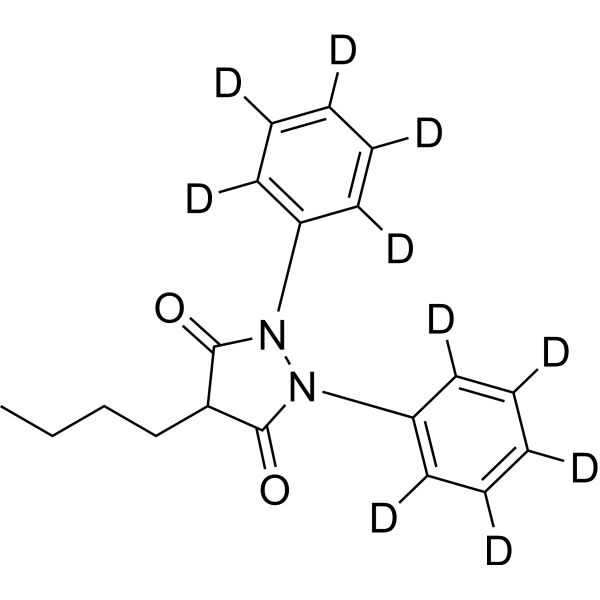
Phenylbutazone(diphenyl-d10)

Based on 1 Customer Validation
Phenylbutazone(diphenyl-d10) is the deuterium labeled Phenylbutazone. Phenylbutazone is an efficient reducing cofactor for the peroxidase activity of prostaglandin H synthase (PHS). Phenylbutazone, a hepatotoxin, is a nonsteroidal anti-inflammatory agent (NSAID). Phenylbutazone induces muscle blind-like protein 1 (MBNL1) expression and has the potential for ankylosing spondylitis research.
For research use only. We do not sell to patients.
- Purity : 99.90%
- CAS No.: 1219794-69-0
- Formula: C19H10D10N2O2
- Molecular Weight:318.44
-
Storage:Powder -20°C, 3 years ; In solvent -80°C, 6 months , -20°C, 1 month

To place orders, for customer services and technical support, please contact: MedChemExpress USA
Tel: 609-228-6898 E-mail: [email protected] [email protected]


-
 Biological Activity
-
Chemical Information
-
Solvent & Solubility
- Protocols
- Purity & Documentation
- References
-
 Help & FAQs




Biological Activity
Description
In Vitro
Stable heavy isotopes of hydrogen, carbon, and other elements have been incorporated into drug molecules, largely as tracers for quantitation during the drug development process. Deuteration has gained attention because of its potential to affect the pharmacokinetic and metabolic profiles of drugs[1].
MedChemExpress (MCE) has not independently confirmed the accuracy of these methods. They are for reference only. Further protocols information, click here.
Application
1. This compound can be used as a tracer
2. This compound can be used as an internal standard for quantitative analysis by NMR, GC-MS, or LC-MS.


Chemical Information
-
CAS No. 1219794-69-0
-
Unlabeled CAS 50-33-9
-
Appearance Solid
-
Molecular Weight 318.44
-
Formula C19H10D10N2O2
-
Color White to off-white
-
SMILES
O=C1N(N(C(=O)C1CCCC)C2=C(C(=C(C(=C2[2H])[2H])[2H])[2H])[2H])C3=C(C(=C(C(=C3[2H])[2H])[2H])[2H])[2H]
-
Shipping
Room temperature in continental US; may vary elsewhere.
-
Storage
Powder -20°C 3 years In solvent -80°C 6 months -20°C 1 month


Solvent & Solubility
In Vitro:
DMSO : ≥ 100 mg/mL (314.03 mM; Hygroscopic DMSO has a significant impact on the solubility of product, please use newly opened DMSO)
H2O : 0.67 mg/mL (2.10 mM; Need ultrasonic)
* "≥" means soluble, but saturation unknown.
Please refer to the solubility information to select the appropriate solvent. Once prepared, please aliquot and store the solution to prevent product inactivation from repeated freeze-thaw cycles.
Storage method and period of stock solution: -80°C, 6 months; -20°C, 1 month. When stored at -80°C, please use it within 6 months. When stored at -20°C, please use it within 1 month.
* Note: If you choose water as the stock solution, please dilute it to the working solution, then filter and sterilize it with a 0.22 μm filter before use.
Please refer to the solubility information to select the appropriate solvent. Once prepared, please aliquot and store the solution to prevent product inactivation from repeated freeze-thaw cycles.
Storage method and period of stock solution: -80°C, 6 months; -20°C, 1 month. When stored at -80°C, please use it within 6 months. When stored at -20°C, please use it within 1 month.
* Note: If you choose water as the stock solution, please dilute it to the working solution, then filter and sterilize it with a 0.22 μm filter before use.
Concentration (start) × Volume (start) = Concentration (final) × Volume (final)

Protocols
-
RNA extraction experimental
By lysing cells, releasing RNA, and removing impurities such as proteins and DNA, high-purity RNA products are finally obtained. The commonly used traditional method is the guanidine isothiocyanate/phenol/chloroform method (Trizol), which is suitable for a variety of animal materials including animal tissues, microorganisms, cultured cells, etc., and most plant materials.
-
Research Protocol for Inflammation-related Diseases
The NLRP3 inflammasome is a cytosolic innate immune signaling platform that integrates priming signals and danger-signal activation to promote caspase-1 activation, maturation of IL-1β and IL-18, and gasdermin D-mediated pyroptotic cell death. The core experimental logic is to determine whether inflammatory disease phenotypes are driven by increased NLRP3 expression, ASC-containing inflammasome assembly, caspase-1 cleavage, GSDMD cleavage, and extracellular release of IL-1β/IL-18 rather than by nonspecific cell injury alone. The pathway is strongly linked to inflammation-related disease phenotypes because monosodium urate crystals activate NALP3/NLRP3 inflammasome signaling in gout-like crystal inflammation, cholesterol crystals activate NLRP3 inflammasomes in atherogenesis models, and DSS-induced intestinal inflammation has been reported to involve NLRP3 inflammasome activity. However, experimental colitis studies also show context-dependent protective effects of NLRP3 inflammasome co


Purity & Documentation
-
Data Sheet (279 KB)
-
SDS (252 KB)
- English - EN (252 KB)
- Français - FR (252 KB)
- Deutsch - DE (252 KB)
- Norwegian - NO (252 KB)
- Español - ES (252 KB)
- Swedish - SV (252 KB)
- Italian - IT (252 KB)
- Korean - KR (252 KB)
- Portuguese - PT (252 KB)
-
Handling Instructions (2659 KB)
References
[1]. Russak EM, et al. Impact of Deuterium Substitution on the Pharmacokinetics of Pharmaceuticals. Ann Pharmacother. 2019;53(2):211-216. [Content Brief]
[2]. G A Reed, et al. Inactivation of prostaglandin H synthase and prostacyclin synthase by phenylbutazone. Requirement for peroxidative metabolism. Mol Pharmacol. 1985 Jan;27(1):109-14. [Content Brief]
[3]. Guiying Chen, et al. Phenylbutazone induces expression of MBNL1 and suppresses formation of MBNL1-CUG RNA foci in a mouse model of myotonic dystrophy. Sci Rep. 2016 Apr 29;6:25317. [Content Brief]
[4]. Beretta C, et al. COX-1 and COX-2 inhibition in horse blood by phenylbutazone, flunixin, carprofen and meloxicam: an in vitro analysis. Pharmacol Res. 2005 Oct;52(4):302-6. [Content Brief]


Complete Stock Solution Preparation Table
Please refer to the solubility information to select the appropriate solvent. Once prepared, please aliquot and store the solution to prevent product inactivation from repeated freeze-thaw cycles.
Storage method and period of stock solution: -80°C, 6 months; -20°C, 1 month. When stored at -80°C, please use it within 6 months. When stored at -20°C, please use it within 1 month.
| Optional Solvent | Concentration Solvent Mass | 1 mg | 5 mg | 10 mg | 25 mg |
|---|---|---|---|---|---|
| H2O / DMSO | 1 mM | 3.1403 mL | 15.7015 mL | 31.4031 mL | 78.5077 mL |
| DMSO | 5 mM | 0.6281 mL | 3.1403 mL | 6.2806 mL | 15.7015 mL |
| 10 mM | 0.3140 mL | 1.5702 mL | 3.1403 mL | 7.8508 mL | |
| 15 mM | 0.2094 mL | 1.0468 mL | 2.0935 mL | 5.2338 mL | |
| 20 mM | 0.1570 mL | 0.7851 mL | 1.5702 mL | 3.9254 mL | |
| 25 mM | 0.1256 mL | 0.6281 mL | 1.2561 mL | 3.1403 mL | |
| 30 mM | 0.1047 mL | 0.5234 mL | 1.0468 mL | 2.6169 mL | |
| 40 mM | 0.0785 mL | 0.3925 mL | 0.7851 mL | 1.9627 mL | |
| 50 mM | 0.0628 mL | 0.3140 mL | 0.6281 mL | 1.5702 mL | |
| 60 mM | 0.0523 mL | 0.2617 mL | 0.5234 mL | 1.3085 mL | |
| 80 mM | 0.0393 mL | 0.1963 mL | 0.3925 mL | 0.9813 mL | |
| 100 mM | 0.0314 mL | 0.1570 mL | 0.3140 mL | 0.7851 mL |
* Note: If you choose water as the stock solution, please dilute it to the working solution, then filter and sterilize it with a 0.22 μm filter before use.


Phenylbutazone(diphenyl-d10) Related Classifications
HY-B0230S Related Classifications
 Powered by Bioz