



Propiolactone
Based on 1 publication(s) in Google Scholar
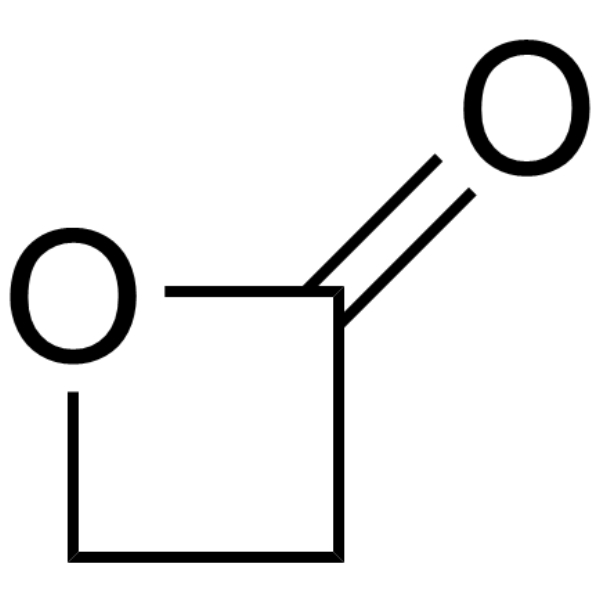
Propiolactone (β-propiolactone; 2-Oxetanone) is a viral chemical inactivator that causes the infectious inactivation of viruses. Propiolactone was co-incubated with SARS-CoV at a ratio of 1:1000 (v:v) and used as a bacteriostatic agent to formulate the BPL-inactivated influenza virus vaccine (Flu-BPL).
Nur für Forschungszwecke. Wir verkaufen nicht an Patienten.
- Reinheit : 99.97%
- CAS. Nr.: 57-57-8
- Formel: C3H4O2
- Molecular Weight:72.06
-
Speicherung:Pure form -20°C, 3 years ; In solvent -80°C, 6 months , -20°C, 1 month

To place orders, for customer services and technical support, please contact: MedChemExpress USA
Tel: 609-228-6898 E-mail: [email protected] [email protected]


-
 Biologische Aktivität
-
Chemical Information
-
Lösungsmittel & Löslichkeit
- Reinheit & Dokumentation
- Verweise
-
 Help & FAQs


-
HY-15141
StaurosporinePKC/PKA Inhibitor -
HY-10071
Y-27632ROCK Inhibitor -
HY-15142
Doxorubicin hydrochlorideTopoisomerase Inhibitor -
HY-13259
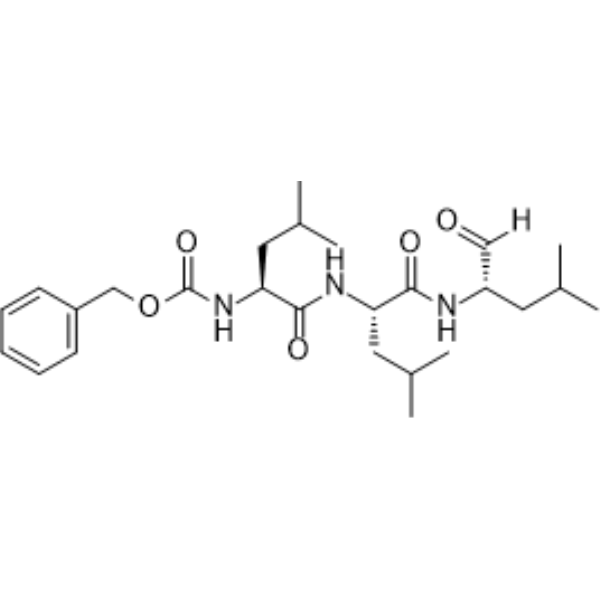
MG-132Proteasome Inhibitor -

HY-107931R
Propiolactone (Standard)SARS-CoV Chemical Inactivator -
HY-15917
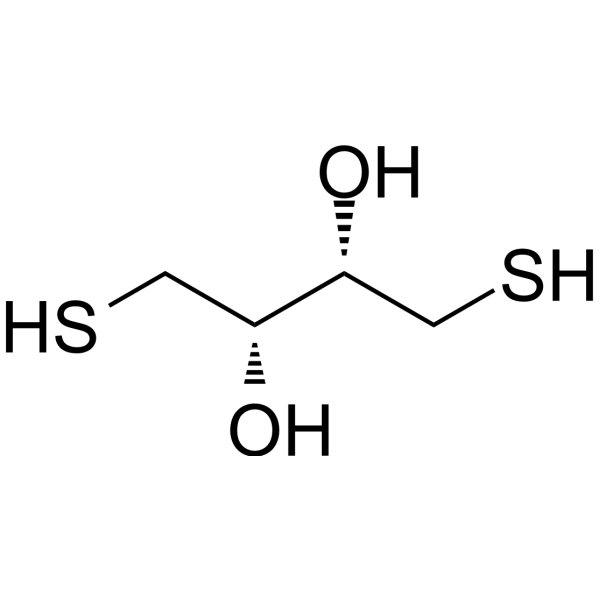
DL-DithiothreitolReducing Agent -

HY-W105735
1,16-HexadecanediolDiol Compound
Publications Citing Use of MedChemExpress (MCE) Propiolactone
More

Biologische Aktivität
Beschreibung
IC50 & Target
SARS-CoV-2[1]
In Vitro
Propiolactone (β-propiolactone) can be used for vaccine purification. After cells were harvested by low-speed centrifugation, SARS-CoV was chemically inactivated with Propiolactone (1:1000 v:v). Propiolactone was incubated with SARS-CoV for 24 h at 4°C. A second incubation at room temperature was performed to hydrolyze residual propiolactone. and concentration of the vaccine. Following BPL inactivation. a polvethylene glycol-sodium chloride (PEG-NaCl) mixture was added to precipitate the inactivated virus. After cen and concentration of the vaccine. After propiolactone inactivation, a polyethylene glycol-sodium chloride (PEG-NaCl) mixture is added to precipitate the inactivated virus. Finally, Propiolactone (1:10000 v:v) was added as a bacteriostatic agent.
Propiolactone-inactivated virus loses infectivity in Vero cells[1].
Note: Propiolactone is unstable in water and prone to hydrolysis. It should be used immediately after being dissolved in water.
MedChemExpress (MCE) has not independently confirmed the accuracy of these methods. They are for reference only.
In Vivo
MedChemExpress (MCE) has not independently confirmed the accuracy of these methods. They are for reference only.


Chemical Information
-
CAS. Nr. 57-57-8
-
Appearance Liquid (Density: 1.146 g/cm3)
-
Molecular Weight 72.06
-
Formel C3H4O2
-
Color Colorless to light yellow
-
SMILES
O=C1OCC1
-
Synonyms
β-propiolactone; 2-Oxetanone; Betaprone
-
Versand
Room temperature in continental US; may vary elsewhere.
-
Speicherung
Pure form -20°C 3 years In solvent -80°C 6 months -20°C 1 month


Publications (1)
-
Journal Impact Factor
-
Most Recent
-
Fish Shellfish Immunol
Antibody-dependent immune response of olive flounder (Paralichthys olivaceus) induced by inactivated viral hemorrhagic septicemia virus (VHSV) vaccine. [Abstract]2026 Jun 22:176:111535. PMID: 42331240


Lösungsmittel & Löslichkeit
In Vitro:
DMSO : 100 mg/mL (1387.73 mM; Need ultrasonic; Hygroscopic DMSO has a significant impact on the solubility of product, please use newly opened DMSO)
Please refer to the solubility information to select the appropriate solvent. Once prepared, please aliquot and store the solution to prevent product inactivation from repeated freeze-thaw cycles.
Storage method and period of stock solution: -80°C, 6 months; -20°C, 1 month. When stored at -80°C, please use it within 6 months. When stored at -20°C, please use it within 1 month.
Please refer to the solubility information to select the appropriate solvent. Once prepared, please aliquot and store the solution to prevent product inactivation from repeated freeze-thaw cycles.
Storage method and period of stock solution: -80°C, 6 months; -20°C, 1 month. When stored at -80°C, please use it within 6 months. When stored at -20°C, please use it within 1 month.
Konzentration (Stammlösung) × Volumen (Stammlösung) = Konzentration (Ziellösung) × Volumen (Ziellösung)
In Vivo:
Select the appropriate dissolution method based on your experimental animal and administration route.
- For the following dissolution methods, please ensure to first prepare a clear stock solution using an In Vitro approach and then sequentially add co-solvents:
- To ensure reliable experimental results, the clarified stock solution can be appropriately stored based on storage conditions. As for the working solution for In Vivo experiments, it is recommended to prepare freshly and use it on the same day.
- The percentages shown for the solvents indicate their volumetric ratio in the final prepared solution. If precipitation or phase separation occurs during preparation, heat and/or sonication can be used to aid dissolution.
Add each solvent one by one: 10% DMSO 40% PEG300 5% Tween-80 45% Saline
Solubility: ≥ 2.5 mg/mL (34.69 mM); Clear solution
This protocol yields a clear solution of ≥ 2.5 mg/mL (saturation unknown).
Taking 1 mL working solution as an example, add 100 μL DMSO stock solution (25.0 mg/mL) to 400 μL PEG300, and mix evenly; then add 50 μL Tween-80 and mix evenly; then add 450 μL Saline to adjust the volume to 1 mL.
Preparation of Saline: Dissolve 0.9 g sodium chloride in ddH₂O and dilute to 100 mL to obtain a clear Saline solution.
Add each solvent one by one: 10% DMSO 90% (20% SBE-β-CD in Saline)
Solubility: ≥ 2.5 mg/mL (34.69 mM); Clear solution
This protocol yields a clear solution of ≥ 2.5 mg/mL (saturation unknown).
Taking 1 mL working solution as an example, add 100 μL DMSO stock solution (25.0 mg/mL) to 900 μL 20% SBE-β-CD in Saline, and mix evenly.
Preparation of 20% SBE-β-CD in Saline (4°C, storage for one week): 2 g SBE-β-CD powder is dissolved in 10 mL Saline, completely dissolve until clear.
In Vivo Dissolution Calculator
Please enter the basic information of animal experiments:
-
-
-
-
Recommended: Prepare an additional quantity of animals to account for potential losses during experiments.
Please enter your animal formula composition:
-
%DMSO +
Recommended: Keep the proportion of DMSO in working solution below 2% if your animal is weak.
-
%+
-
+%Tween-80 + +
-
%Saline +
The co-solvents required include: DMSO, . All of co-solvents are available by MedChemExpress (MCE). , Tween 80. All of co-solvents are available by MedChemExpress (MCE).
Working solution concentration: 0.22 mg/mL
Method for preparing stock solution: mg drug dissolved in μL DMSO. Stock solution concentration: mg/mL.
1. Take μL DMSO stock solution;
2. Add μL .
μL , mix evenly;
3. Then add μL Tween 80, mix evenly;
4. Then add μL
Please ensure that the stock solution in the first step is dissolved to a clear state, and add co-solvents in sequence. You can use ultrasonic heating (ultrasonic cleaner, recommended frequency 20-40 kHz), vortexing, etc. to assist dissolution.


Reinheit & Dokumentation
-
Data Sheet (277 KB)
-
SDS (647 KB)
- English - EN (647 KB)
- Français - FR (647 KB)
- Deutsch - DE (647 KB)
- Norwegian - NO (647 KB)
- Español - ES (647 KB)
- Swedish - SV (647 KB)
- Italian - IT (647 KB)
- Korean - KR (647 KB)
- Portuguese - PT (647 KB)
-
Handling Instructions (2659 KB)
Verweise
[1]. Roberts A, et al. Immunogenicity and protective efficacy in mice and hamsters of a β-propiolactone inactivated whole virus SARS-CoV vaccine. Viral Immunol. 2010 Oct;23(5):509-19 [Content Brief]
[2]. Kulkarni R, et al. Anti-SARS-CoV-2 IgG antibody response among Indian COVID-19 patients using β-propiolactone-inactivated, whole virus-based indirect ELISA. J Virol Methods. 2021 Jan;287:113996. [Content Brief]


Complete Stock Solution Preparation Table
Please refer to the solubility information to select the appropriate solvent. Once prepared, please aliquot and store the solution to prevent product inactivation from repeated freeze-thaw cycles.
Storage method and period of stock solution: -80°C, 6 months; -20°C, 1 month. When stored at -80°C, please use it within 6 months. When stored at -20°C, please use it within 1 month.
| Optional Solvent | Concentration Solvent Mass | 1 mg | 5 mg | 10 mg | 25 mg |
|---|---|---|---|---|---|
| DMSO | 1 mM | 13.8773 mL | 69.3866 mL | 138.7732 mL | 346.9331 mL |
| 5 mM | 2.7755 mL | 13.8773 mL | 27.7546 mL | 69.3866 mL | |
| 10 mM | 1.3877 mL | 6.9387 mL | 13.8773 mL | 34.6933 mL | |
| 15 mM | 0.9252 mL | 4.6258 mL | 9.2515 mL | 23.1289 mL | |
| 20 mM | 0.6939 mL | 3.4693 mL | 6.9387 mL | 17.3467 mL | |
| 25 mM | 0.5551 mL | 2.7755 mL | 5.5509 mL | 13.8773 mL | |
| 30 mM | 0.4626 mL | 2.3129 mL | 4.6258 mL | 11.5644 mL | |
| 40 mM | 0.3469 mL | 1.7347 mL | 3.4693 mL | 8.6733 mL | |
| 50 mM | 0.2775 mL | 1.3877 mL | 2.7755 mL | 6.9387 mL | |
| 60 mM | 0.2313 mL | 1.1564 mL | 2.3129 mL | 5.7822 mL | |
| 80 mM | 0.1735 mL | 0.8673 mL | 1.7347 mL | 4.3367 mL | |
| 100 mM | 0.1388 mL | 0.6939 mL | 1.3877 mL | 3.4693 mL |


Propiolactone Related Classifications
HY-107931 Related Classifications
 Powered by Bioz