



Rabdosin B
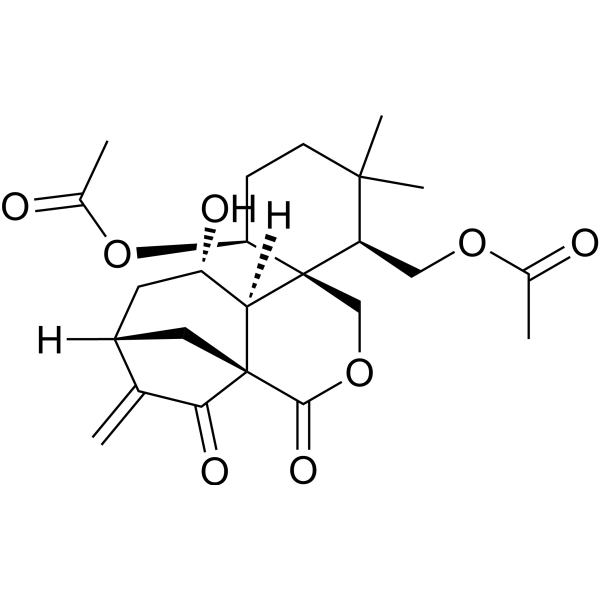
Rabdosin B is an ent-kaurene diterpenoid with anticancer effects. Rabdosin B induces DNA damage in cells, and inhibits lettuce root hair development of seedlings.
For research use only. We do not sell to patients.
- CAS No.: 84304-92-7
- Formula: C24H32O8
- Molecular Weight:448.51
-
Storage:
Please store the product under the recommended conditions in the Certificate of Analysis.

To place orders, for customer services and technical support, please contact: MedChemExpress USA
Tel: 609-228-6898 E-mail: [email protected] [email protected]


-
 Biological Activity
-
Chemical Information
- Protocols
- Purity & Documentation
- References
-
 Help & FAQs


All DNA/RNA Synthesis Isoforms
More

Biological Activity
Description
In Vitro
Rabdosin B (200 μM; 3-12 h) induces cell cycle retardation of the G2 phase and S phase in root meristematic cells. Rabdosin B shows a time- and dose-dependent increase in DNA damage[1].
Rabdosin B shows a biphasic, dose-dependent effect on root growth and a strong inhibitory effect on root hair development in lettuce seedlings (Lactuca sativa L.). Lower concentrations of Rabdosin B (20-80 μM) significantly promots root growth, but its higher levels at 120-200 μM, by contrast, has inhibitory effects. Additionally, all tested concentrations (10-40 μM) inhibits root hair development of seedlings in a dose-dependent manner[1].
Rabdosin B has cytotoxic against human tumour HepG2, GLC-82 and HL-60 cell lines with IC50 values of 8.95 μM, 4.47 μM and 10.22 μM, respectively[2].
Rabdosin B (6 μM, 9 μM, 12 μM, 15 μM; 24-48 hours) induces significant DNA damage to HepG2 cells in a time- and dose-dependent manner[2].
MedChemExpress (MCE) has not independently confirmed the accuracy of these methods. They are for reference only. Further protocols information, click here.
-
Cell Line:Root meristematic cells<
-
Concentration:200 μM
-
Incubation Time:3 h, 6 h, 9 h, and 12 h
-
Result:Induced cell cycle retardation of the G2 phase and S phase.


Chemical Information
-
CAS No. 84304-92-7
-
Molecular Weight 448.51
-
Formula C24H32O8
-
SMILES
CC(OC[C@H](C1(C)C)[C@]([C@H](CC1)OC(C)=O)(COC2=O)[C@@]3([H])[C@]2(C(C4=C)=O)C[C@@]4([H])C[C@@H]3O)=O
-
Shipping
Room temperature in continental US; may vary elsewhere.
-
Storage
Please store the product under the recommended conditions in the Certificate of Analysis.

Protocols
-
Genotoxicity/Mutagenicity Study
The bacterial reverse mutation assay detects point mutations that restore amino-acid prototrophy in auxotrophic Salmonella typhimurium or Escherichia coli tester strains; after exposure to a test article, mutagenic activity is read out as an increased number of revertant colonies on minimal agar compared with the vehicle control. The assay uses tester strains with different mutation targets so that base-substitution and frameshift mutagens can be detected, and testing is performed with and without exogenous mammalian metabolic activation because some chemicals require biotransformation to become mutagenic.


Purity & Documentation
References
[1]. Lan Ding, et al. Regulation of cell division and growth in roots of Lactuca sativa L. seedlings by the Ent-Kaurene diterpenoid rabdosin B. J Chem Ecol. 2010 May;36(5):553-63. [Content Brief]
[2]. Lan Ding, et al. Comparison of cytotoxicity and DNA damage potential induced by ent-kaurene diterpenoids from Isodon plant. Nat Prod Res. 2011 Sep;25(15):1402-11. [Content Brief]

Calculators
Concentration (start) × Volume (start) = Concentration (final) × Volume (final)


Rabdosin B Related Classifications
HY-N7229 Related Classifications
 Powered by Bioz