



VK-28

Based on 1 Customer Validation
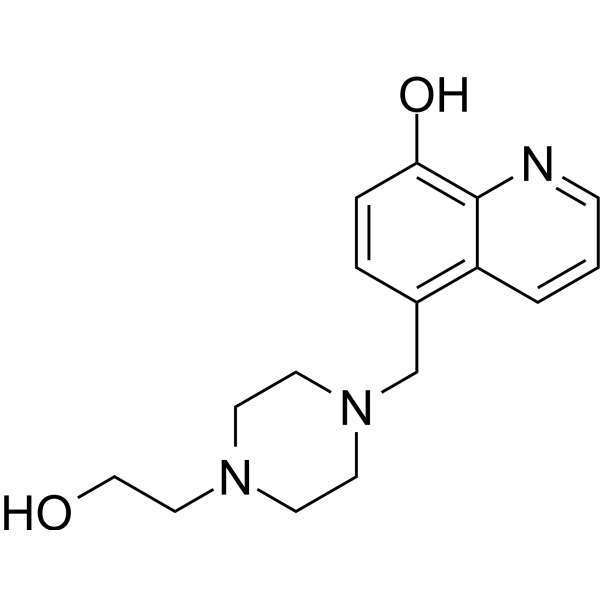
VK-28 is a blood-brain barrier-permeable iron chelator. VK-28 inhibits mitochondrial membrane lipid peroxidation and the iron-dependent generation of reactive hydroxyl radicals. VK-28 exhibits neuroprotective activity and protects rats against 6-OHDA-induced striatal dopaminergic damage. VK-28 can be used in studies related to Parkinson's disease.
For research use only. We do not sell to patients.
- Purity : 97.17%
- CAS No.: 312611-92-0
- Formula: C16H21N3O2
- Molecular Weight:287.36
-
Storage:Powder -20°C, 3 years ; In solvent -80°C, 6 months , -20°C, 1 month

To place orders, for customer services and technical support, please contact: MedChemExpress USA
Tel: 609-228-6898 E-mail: [email protected] [email protected]


-
 Biological Activity
-
Chemical Information
- Protocols
- Purity & Documentation
- References
-
 Help & FAQs


All Dopamine Receptor Isoforms
More

Biological Activity
Description
In Vitro
VK-28 (10-7-10-3 M; 90 min) potently inhibits basal lipid peroxidation and iron-induced lipid peroxidation in mitochondrial membrane homogenates from rat cerebral cortex, with an IC50 of 12.7 µM[1].
VK-28 (1-10 μM; 24 h) exhibits neuroprotective activity by reducing serum deprivation-induced PC12 cell death[2].
MedChemExpress (MCE) has not independently confirmed the accuracy of these methods. They are for reference only.
-
Cell Line:PC12 cells
-
Concentration:1 μM, 10 μM
-
Incubation Time:24 h
-
Result:Rescued PC12 cells from serum-free induced death, resulting in ~1000% of control OD at 1 μM and ~900% of control OD at 10 μM.
Reduced cell death compared to untreated serum-free cells.
Showed neuroprotective activity comparable to rasagiline.
In Vivo
MedChemExpress (MCE) has not independently confirmed the accuracy of these methods. They are for reference only.
-
Animal Model:Sprague-Dawley (male, 230-270 g, 8-10 per group, intracerebroventricular 6-hydroxydopamine-induced striatal dopaminergic lesion)[1]
-
Dosage:1 µg
-
Administration:i.c.v.; single dose (30 minutes before 6-OHDA)
-
Result:Prevented the 78% reduction in striatal dopamine (DA), 73% reduction in dihydroxyphenylacetic acid (DOPAC), and 59% reduction in homovanilic acid (HVA) caused by 6-OHDA alone.
Reduced the 6-OHDA-induced increase in striatal dopamine turnover ratio (DOPAC+HVA/DA) to near baseline levels.
Left striatal serotonin (5-HT), 5-hydroxyindolacetic acid (5-HIAA), and norepinephrine (NE) concentrations unaffected.


Chemical Information
-
CAS No. 312611-92-0
-
Appearance Solid
-
Molecular Weight 287.36
-
Formula C16H21N3O2
-
Color White to off-white
-
SMILES
OCCN1CCN(CC1)CC2=C3C=CC=NC3=C(C=C2)O
-
Shipping
Room temperature in continental US; may vary elsewhere.
-
Storage
Powder -20°C 3 years In solvent -80°C 6 months -20°C 1 month


Purity & Documentation
-
Data Sheet (272 KB)
-
SDS (393 KB)
- English - EN (393 KB)
- Français - FR (393 KB)
- Deutsch - DE (393 KB)
- Norwegian - NO (393 KB)
- Español - ES (393 KB)
- Swedish - SV (393 KB)
- Italian - IT (393 KB)
- Korean - KR (393 KB)
- Portuguese - PT (393 KB)
-
Handling Instructions (2659 KB)
References
[1]. Shachar DB, et al. Neuroprotection by a novel brain permeable iron chelator, VK-28, against 6-hydroxydopamine lession in rats. Neuropharmacology. 2004;46(2):254-263. [Content Brief]
[2]. Youdim MB, et al. Bifunctional drug derivatives of MAO-B inhibitor rasagiline and iron chelator VK-28 as a more effective approach to treatment of brain ageing and ageing neurodegenerative diseases. Mech Ageing Dev. 2005;126(2):317-326. [Content Brief]

Calculators
Concentration (start) × Volume (start) = Concentration (final) × Volume (final)


VK-28 Related Classifications
HY-W686216 Related Classifications
 Powered by Bioz
Keywords