396 Results for "

Fluorescence Probe

" in MedChemExpress (MCE) Product Catalog:
Products (396)

396 Results for "Fluorescence Probe" in MCE Product Catalog:

Cat. No.: HY-P4948
CAS No.: 1926163-49-6
Research Areas:  

Others

Coumarin-phalloidin is a kind of phalloidin labeled with Coumarin (HY-N0709). Coumarin-phalloidin is a new type of actin probe that can be used for triple immunofluorescence microscopic observation of the cell skeleton .
loading...
    loading...
Cat. No.: HY-110210
CAS No.: 146616-66-2
Purity:  99.80%
Synonyms: BODIPY FL,SE
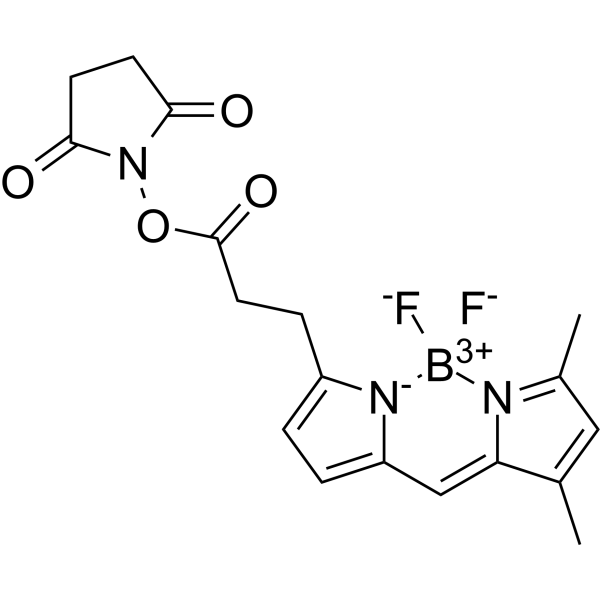
BODIPY FL NHS ester (BODIPY FL, SE) is a cell membranes-penatrable amine-reactive fluorescent probe. The maximum excitation/emission wavelength of the BODIPY-FL NHS ester are 502/511 nm, respectively. BODIPY-FL NHS ester has high stability and is insensitive to the polarity, pH and type of solvent, and can maintain stable fluorescence properties under different environmental conditions. BODIPY-FL NHS ester can be used for the synthesis of protease substrates, live cell imaging, protein labeling and immunoassay .
loading...
    loading...
Cat. No.: HY-150145
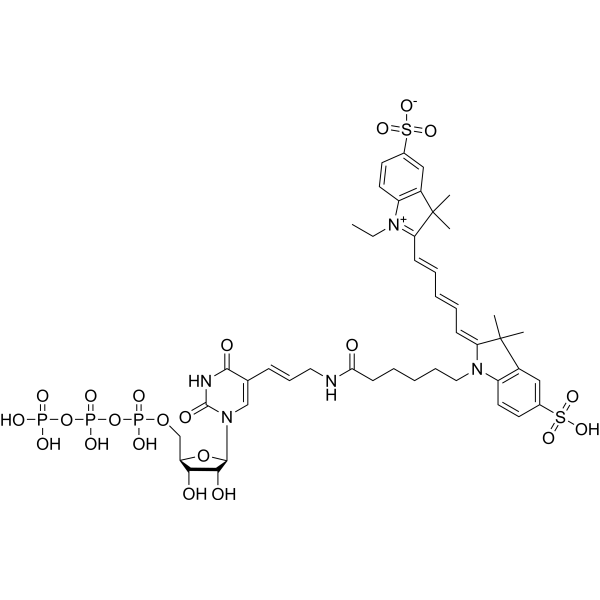
Cy5-UTP is a fluorescently labeled ribonucleotide triphosphate that can be used as a substrate for terminal deoxynucleotidyl transferase (TdT). Cy5-UTP can be employed to label RNA probes generated in vitro (Ex/Em: 650/665 nm). Cy5-UTP can be applied in FISH, multi-color fluorescence analysis, especially in dual-color expression arrays that combine with Cy5-UTP .
loading...
    loading...
Cat. No.: HY-150145A
Purity:  99.26%
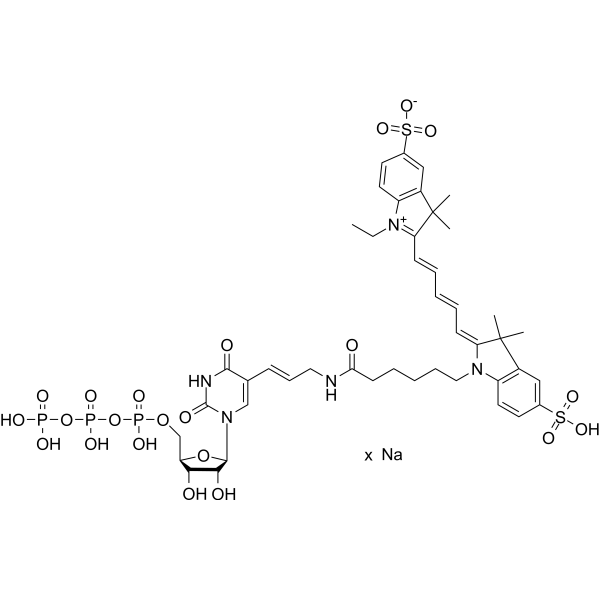
Cy5-UTP sodium (10 mM in water) is a fluorescently labeled ribonucleotide triphosphate that can be used as a substrate for terminal deoxynucleotide transferase (TdT). Cy5-UTP sodium can be used to label RNA probes generated in vitro (Ex/Em: 650/665 nm). Cy5-UTP sodium can be applied in FISH, multi-color fluorescence analysis, especially in dual-color expression arrays combined with Cy5-UTP .
loading...
    loading...
Cat. No.: HY-189294
CAS No.: 2894038-40-3
HBT-CUR is a lysosome-targeted and polarity-responsive tumor photosensitizer. HBT-CUR generates singlet oxygen under light irradiation. HBT-CUR induces photodynamic apoptosis through oxidative stress. As a polarity-sensitive NIR fluorescent probe, HBT-CUR distinguishes tumor cells and tissues from normal ones. HBT-CUR enables tumor-specific in vivo fluorescence imaging with rapid response and long-lasting duration. HBT-CUR is used for breast cancer research .
loading...
    loading...
Cat. No.: HY-D2204
CAS No.: 2956720-62-8
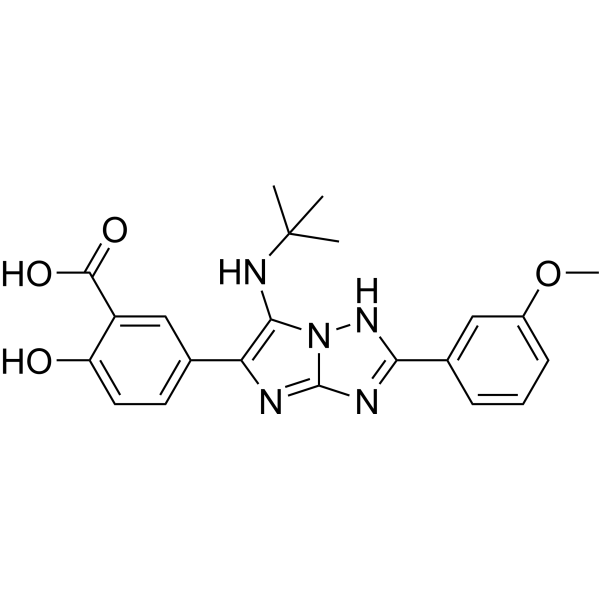
SHP1-IN-1 (compound 5p) is a fluorescent probe for the protein tyrosine phosphatase SHP1 containing the Src homology 2 domain. SHP1-IN-1 has SHP1 inhibitory activity, selectivity for Fe 3+ ions and good fluorescence properties. SHP1-IN-1 exhibits aggregation post-quenching (ACQ) effect, good interference immunity and low detection limit (5.55 μM) .
loading...
    loading...
Cat. No.: HY-D2890
CAS No.: 321862-17-3
Target:  

Fluorescent Dye

Research Areas:  

Others

5-TAMRA-NHS is a fluorescent dye composed of 5-TAMRA (HY-15942) and a hydroxysuccinimide (NHS) group. The NHS ester of 5-TAMRA-NHS forms amide bonds with primary amino groups, which is used to construct fluorescently labeled probes and conjugates. The labeled products are suitable for fluorescence anisotropy, confocal imaging and flow cytometry assays. 5-TAMRA-NHS can be used for fluorescent labeling and imaging (Ex/Em = 541/567 nm) .
loading...
    loading...
Cat. No.: HY-D3113
Target:  

Fluorescent Dye

Research Areas:  

Cancer

BF6 is a blood-brain barrier permeable NIR probe. BF6 can diffuse from intracranial blood vessels into brain tissue, enabling visualization of brain structures and differentiation between glioblastoma (GBM) and normal tissues. The absorption peaks of BF6 in DMSO and FBS range from 727 to 859 nm, with a broad fluorescence emission band spanning 800 to 1400 nm; its emission wavelength falls within the NIR-II region (800-1400 nm) .
loading...
    loading...
Cat. No.: HY-D3159
CAS No.: 2304942-78-5
Research Areas:  

Others

BTC1070 is an anti-quenching pentamethine cyanine NIR-II fluorescent probe. BTC1070 exhibits high brightness and excellent photostability in aqueous solution (Ex/Em = 1015/1065 nm). BTC1070 can clearly visualize lymphatic structures after intradermal injection, and produces a ratiometric fluorescence response in the acidic range to non-invasively quantify gastric pH. BTC1070 is applicable to studies related to in vivo deep tissue imaging and gastric pH sensing .
loading...
    loading...
Cat. No.: HY-D2962
CAQ is a near-infrared fluorescent probe based on a curcumin scaffold (Ex/Em = 565/635). CAQ exhibits high affinity for Aβ1-42 aggregates (Kd = 78.89 nM) and excellent selectivity toward common biomolecules. CAQ’s emission wavelength shows significant solvent dependence. CAQ, by incorporating intramolecular rotation donors and quinoline functional groups, can be used for the specific detection and imaging of Aβ aggregates in Alzheimer's disease .
loading...
    loading...
Cat. No.: HY-159500
CAS No.: 2206660-94-6
Synonyms: OTL-0078; OTL78
Target:  

PSMA

Research Areas:  

Cancer

Zopocianine (OTL-0078; OTL78) is a near-infrared optical probe targeting PSMA. Zopocianine binds to PSMA on the surface of PSMA-expressing cells, enters cells via receptor-mediated endocytosis, and accumulates in acidic endosomes. Zopocianine selectively accumulates in PSMA-positive cancer tissues and enables the detection of small tumors, primary prostate tumors, and locoregional metastases. Zopocianine helps achieve negative tumor surgical margins during fluorescence-guided surgery. Zopocianine is applicable to research related to prostate cancer .
loading...
    loading...
Cat. No.: HY-159500A
CAS No.: 2206660-95-7
Synonyms: OTL-0078 sodium; OTL78 sodium
Target:  

PSMA

Research Areas:  

Cancer

Zopocianine sodium (OTL-0078 sodium; OTL78 sodium) is a near-infrared optical probe targeting PSMA. Zopocianine sodium binds to PSMA on the surface of PSMA-expressing cells, enters cells via receptor-mediated endocytosis, and accumulates in acidic endosomes. Zopocianine sodium selectively accumulates in PSMA-positive cancer tissues and enables the detection of small tumors, primary prostate tumors, and locoregional metastases. Zopocianine sodium helps achieve negative tumor surgical margins during fluorescence-guided surgery. Zopocianine sodium is applicable to research related to prostate cancer .
loading...
    loading...
Cat. No.: HY-D2413
CAS No.: 2770675-66-4
Synonyms: BODIPY FL PEG4-VH032
BODIPY FL VH032 is a high-affinity VHL fluorescent probe with a Kd value of 3.01 nM. BODIPY FL VH032 consists of von Hippel-Lindau (VHL) ligand VH032 (HY-120217) and BODIPY FL (HY-43520). BODIPY FL VH032 can be used for time-resolved fluorescence resonance energy transfer (TR-FRET) detection for high-throughput identification and characterization of VHL ligands with maximum excitation emission wavelength: 504/520 nm .
loading...
    loading...
Cat. No.: HY-D2415
CAS No.: 2411845-57-1
BODIPY-FL staurosporine (Compound 8a) is a fluorescence probe based on staurosporine, exhibiting high specificity towards tyrosine kinases (TK) and tyrosine kinase-like (TKL) family kinases. BODIPY-FL staurosporine has the potential to develop binding assays for kinases that are not recommended for use with Kinase Tracer 236, such as PIM3, CDC42BPG, MAP2K7, TXK, and SIK3. BODIPY-FL staurosporine can be a powerful tool for analyzing kinase selectivity in kinase drug discovery .
loading...
    loading...
Cat. No.: HY-D2817
Target:  

Fluorescent Dye

Research Areas:  

Others

FITC-PLL is a fluorescently labeled polycationic polypeptide probe composed of polylysine (PLL) and FITC (HY-66019), with a typical Ex/Em of 495/520 nm. The fluorescence intensity and lifetime of FITC-PLL are sensitive to pH and FITC density. FITC-PLL can be used for quantifying hapten receptor binding and endocytosis kinetics in macrophages, as a patternable substrate for neuron guidance, for negatively charged phospholipid membrane binding and transmembrane transport, and for live-cell imaging of starch nanoparticle conjugates and lysosome labeling .
loading...
    loading...
Cat. No.: HY-D3132
CAS No.: 1616505-01-1
Target:  

Fluorescent Dye

Research Areas:  

Others

Spring Red is a fluorescent probe for mitochondrial pH detection (Ex/Em = 530/680 nm) that can be taken up by live cells and mitochondria. The detection mechanism of Spring Red depends on pH changes and mitochondrial membrane potential. Fluorescence intensity increases with elevated pH, and a significant pH-dependent fluorescent response is observed in the pH range of 5.0‑8.0. Spring Red is suitable for long-term live-cell imaging and in vivo imaging, and can be used to monitor dynamic mitochondrial pH changes .
loading...
    loading...
Cat. No.: HY-D3172
CAS No.: 1180112-32-6
Synonyms: Glucagon Yellow
BD-105 (Glucagon Yellow) is a glucagon-binding fluorescent probe with a KD value of 13.3 μM. BD-105 exhibits changes in fluorescence intensity upon interaction with glucagon, and colocalizes with glucagon in cells and tissues. BD-105 is a selective cell stain that labels glucagon-secreting cells without staining insulin-secreting cells or non-endocrine control cells. BD-105 serves as an imaging reagent for glucagon in live cells and tissues (Ex/Em = 540 nm/580 nm) .
loading...
    loading...
Cat. No.: HY-D3174
CAS No.: 2688758-23-6
PiF is a fluorescent probe with high specificity for pancreatic β-cells (Ex/Em = 535 nm/565 nm), and its fluorescence signal increases significantly with elevated insulin concentrations in in vitro experiments. PiF enables visualization of rat and human islets transplanted via the portal vein in mouse livers with low liver background signals. The fluorine atom of PiF can be replaced by radioactive 18F to prepare a PET tracer. PiF can be used for research on type 1 diabetes .
loading...
    loading...
Cat. No.: HY-D3211
CAS No.: 2442502-32-9
HJTA is a selective, pH/GSH dual-responsive Fluorescent probe and anticancer agent. HJTA selectively undergoes an enzymatic reaction with GSTπ. HJTA induces Apoptosis and Autophagy by regulating the expression of apoptotic and autophagic proteins. HJTA exhibits pH- and GSH-dual-responsive fluorescence in tumor cells. HJTA selectively illuminates tumor tissues, enabling precise in situ visualization of colon tumors. HJTA exerts anticancer effects against colon cancer. HJTA can be used for colon cancer research .
loading...
    loading...
Cat. No.: HY-D3224
CAS No.: 2413777-91-8
HCP is a two-photon fluorescent probe capable of crossing the blood-brain barrier, which is specifically designed for real-time detection of hypochlorous acid (HClO/ClO -) produced by myeloperoxidase (MPO). Chlorination of the quinoline skeleton of HCP generates HCP-Cl, which eliminates intramolecular charge transfer (ICT) quenching and thereby produces fluorescence. HCP is suitable for in vivo dynamic imaging of HClO in the brains of epileptic mice and high-throughput screening of antiepileptic drugs (HCP-Cl: Ex/Em = 800 nm/495 nm) .
loading...
    loading...

