
71 Results for "

proteolysis

" in MedChemExpress (MCE) Product Catalog:
Products (71)

71 Results for "proteolysis" in MCE Product Catalog:

Cat. No.: HY-N2334R
CAS No.: 640-79-9
Synonyms: Chenodeoxycholylglycine (Standard)
Glycochenodeoxycholic acid (Standard) is the analytical standard of Glycochenodeoxycholic acid. This product is intended for research and analytical applications. Glycochenodeoxycholic acid (Chenodeoxycholylglycine) is a relatively toxic bile salt generated in the liver from chenodeoxycholic acid and glycine. Glycochenodeoxycholic acid inhibits Autophagosome formation and impairs lysosomal function by inhibiting lysosomal proteolysis and increasing lysosomal pH in human normal liver cells, leading to the Apoptosis of human hepatocyte cells. Glycochenodeoxycholic acid induces stemness and chemoresistance via activating STAT3 signaling pathway in hepatocellular carcinoma cells (HCC). Glycochenodeoxycholic acid is promising for research in the field of cholestasis desease, hepatocellular carcinoma and primary sclerosing cholangitis (PSC)[1][2][3][4].
loading...
    loading...
Cat. No.: HY-P2802B
CAS No.: 9001-42-7
Target:  

Glycosidase

Research Areas:  

Metabolic Disease

α-Glucosidase, rice is a GH31 glycoside hydrolase in rice seeds, with high selectivity for α-1,4-glycosidic bonds. α-Glucosidase, rice can be inhibited by rice husk extracts (IC50 = 1.25 μg/mL) and steroidal components (IC50 = 1.83 μg/mL). α-Glucosidase, rice exists in two major isoforms, among which isoform II is more sensitive to inhibitors. α-Glucosidase, rice can directly bind to and degrade starch granules in rice seeds. α-Glucosidase, rice can form ONG2-I and ONG2-II via post-translational proteolysis. α-Glucosidase, rice can be used in type 2 diabetes research .
loading...
    loading...
Cat. No.: HY-N2306R
CAS No.: 57576-44-0
Synonyms: Aclarubicin (Standard)
Aclacinomycin A (Standard) is the analytical standard of Aclacinomycin A. This product is intended for research and analytical applications. Aclacinomycin A (Aclarubicin) is an orally active and potent anthracycline antitumor antibiotic. Aclacinomycin A is an inhibitor of topoisomerase I and II. Aclacinomycin A inhibits synthesis of nucleic acid, especially RNA. Aclacinomycin A might inhibit the 26S protease complex as well as the ubiquitin-ATP-dependent proteolysis .
loading...
    loading...
Cat. No.: HY-163019
CAS No.: 2189497-60-5
EN884 is a BRD4 degrader via a SKP1- and proteasome-dependent manner. EN884 can be used in synthetic proteolysis targeting chimeras (PROTACs) .
loading...
    loading...
Cat. No.: HY-153735
CAS No.: 2087490-46-6
Target:  

PROTACs ERK

Research Areas:  

Cancer

ERK-CLIPTAC is a ERK CLIPTAC (click chemistry-synthesized proteolysis-targeting chimera) degrader. ERK-CLIPTAC forms intracellularly via click chemistry from ERK1/2-IN-14 (HY-175578) and Tz-thalidomide (HY-101460). The formed ERK-CLIPTAC recruits the E3 ubiquitin ligase CRBN to ERK1/2, thereby inducing ubiquitination and subsequent degradation of ERK1/2. Due to its lack of cell permeability, ERK-CLIPTAC cannot induce ERK1/2 degradation in cells. ERK-CLIPTAC can be used in research related to melanoma and colorectal cancer .
loading...
    loading...
Cat. No.: HY-178496
Research Areas:  

Cancer

DDO3602 is a PARP1 HSPTAC (HSP90-mediated proteolysis-targeting chimera) degrader, with a DC50 of 490.3 nM against PARP1; its Kd values for PARP1 and HSP90 are 66.5 nM and 1.64 nM, respectively. DDO3602 induces the formation of an unnatural PARP1-HSP90 ternary complex, recruits E3 ubiquitin ligase, and promotes PARP1 degradation via the ubiquitin-proteasome pathway. DDO3602 induces G2/M cell cycle arrest, DNA damage, inhibits cell migration, and exhibits antiproliferative activity in breast cancer cells. DDO3602 can be used in breast cancer-related research .
loading...
    loading...
Cat. No.: HY-P34013
CAS No.: 164859-77-2
Target:  

Ser/Thr Protease

Research Areas:  

Cancer

Urinary Trypsin Inhibitor Fragment is a fragment derived from urinary trypsin inhibitor by proteolysis. Urinary Trypsin Inhibitor Fragment can inhibit tumor cell invasion by limited proteolysis .
loading...
    loading...
Cat. No.: HY-P3149
CAS No.: 2096980-79-7
Target:  

TNF Receptor

Research Areas:  

Inflammation/Immunology

LEESGGGLVQPGGSMK, a proteolysis peptide, is a component of Infliximab. LEESGGGLVQPGGSMK can be used for quantitative analysis of Infliximab. Infliximab is a chimeric monoclonal IgG1 antibody that specifically binds to TNF-α .
loading...
    loading...
Cat. No.: HY-123531
CAS No.: 400797-24-2
Target:  

Cathepsin

Research Areas:  

Inflammation/Immunology

JNJ 10329670 is a potent and selective noncovalent cathepsin S inhibitor with a Ki value of 34 nM for human cathepsin S. JNJ 10329670 blocks invariant chain proteolysis in B cells and dendritic cells, as well as antigen-induced T cell proliferation .
loading...
    loading...
Cat. No.: HY-156814
CAS No.: 3093738-79-2
Target:  

Hedgehog

Research Areas:  

Cancer

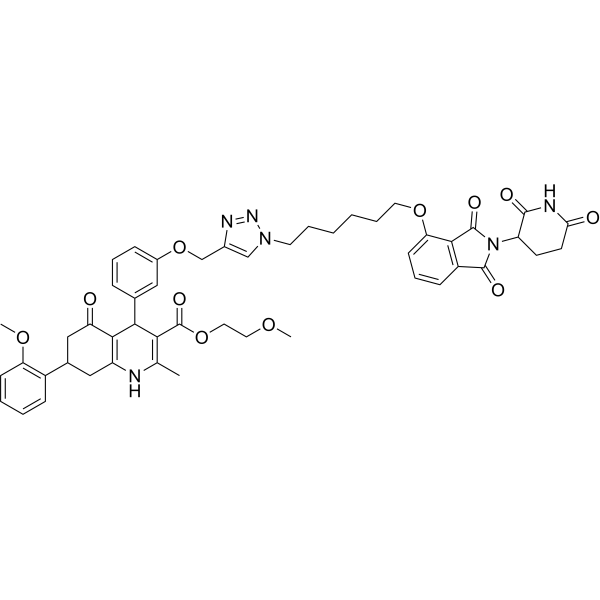
HPP-9 is a Proteolysis-Targeting Chimeras (PROTACs) based on Hedgehog Pathway Inhibitor-1 (HPI-1), with the pIC50 of 6.71, that can degrade BET bromodomains. HPP-9 has antitumor activity [1[.
loading...
    loading...
Cat. No.: HY-130073
CAS No.: 80489-90-3
Amorfrutin A is the inhibition of NF-κB activation, that inhibits TNF-α-induced IκBα degradation, p65 nuclear translocation, and DNA-binding activity. Amorfrutin A promotes TNF-α-induced apoptosis in HeLa cell through promotion of caspase-3 and PARP proteolysis .
loading...
    loading...
Cat. No.: HY-P0063A
CAS No.: 300801-03-0
Synonyms: GHK-Cu acetate
Research Areas:  

Inflammation/Immunology

Copper tripeptide (GHK-Cu) acetate is a tripeptide. During wound healing, Copper tripeptide acetate may be freed from existing extracellular proteins via proteolysis and serves as a chemoattractant for inflammatory and endothelial cells. Copper tripeptide acetate has been shown to increase messenger RNA production for collagen, elastin, proteoglycans, and glycosaminoglycans in fibroblasts. Copper tripeptide acetate is a natural modulator of multiple cllular pathways in skin regeneration .
loading...
    loading...
Cat. No.: HY-P5525
Synonyms: Autocamtide-3 Derived Inhibitory Peptide
Target:  

CaMK

Research Areas:  

Others

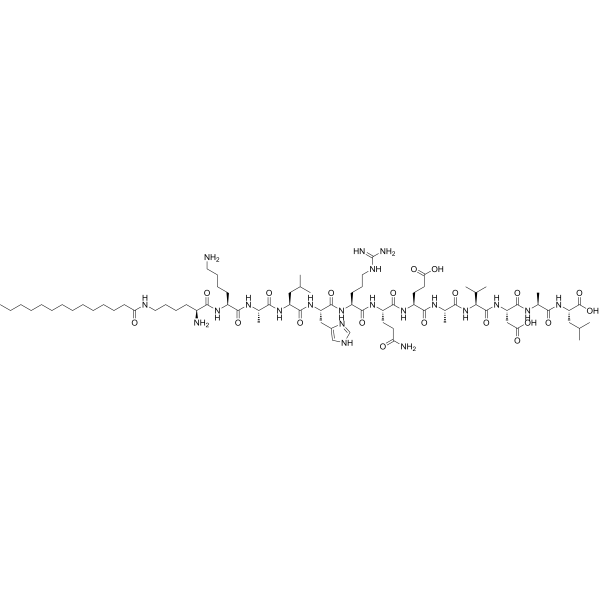
AC3-I, myristoylated is a biological active peptide. (This is a myristoylated form of Autocamtide-3-Derived Inhibitory Peptide (AC3-I), a highly specific inhibitor of Calmodulin-Dependent Protein Kinase ll (CaMKII) that is resistant to proteolysis. AC3-I is derived from Autocamtide-3, a substrate for CaMKII, with the Thr-9 phosphorylation site substituted with Ala.)
loading...
    loading...
Cat. No.: HY-175179
Research Areas:  

Cancer

LO-3-61, a JQ-1 (HY-13030) analog bearing a truncated fumaramide handle, is a PROTAC (proteolysis-targeting chimeras)-like BRD4 degrader. LO-3-61 degrades both the long and short isoforms of BRD4 CUL4DcAr16-dependently in cells. LO-3-61 shows selectivity for BRD3 and BRD4 degradation in MDA-MB-231 cells .
loading...
    loading...
Cat. No.: HY-P10567
Target:  

Inhibitory Antibodies

Research Areas:  

Others

Pip6a is an arginine-rich cell-penetrating peptide. Pip6a has the ability to deliver associated cargoes across the plasma and endosomal membranes and is stable to serum proteolysis. Pip6a is composed of a hydrophobic core region flanked on each side by arginine-rich domains containing β-alanine and aminohexanoyl spacers. Pip6a-conjugated morpholino phosphorodiamidate oligomer (PMO) dramatically enhanced antisense oligonucleotide (ASO) delivery into striated muscles of myotonic dystrophy (DM1) mice .
loading...
    loading...
Cat. No.: HY-161804
Target:  

PROTACs Dengue Virus

Research Areas:  

Infection

GNF-2-deg is a PROTAC degrader targeting the dengue virus envelope protein (DENV E protein), with a DC50 of 0.83 μM in Huh7.5 cells. GNF-2-deg induces CRBN- and proteasome-dependent proteolysis of intracellular E protein. GNF-2-deg inhibits E protein-mediated membrane fusion and blocks viral particle production. GNF-2-deg reduces viral yield in infected cells and retains activity against E protein βOG pocket mutant virus-like particles (VLP). GNF-2-deg can be used in the research of dengue virus infection, Zika virus infection, Japanese encephalitis, West Nile virus infection and yellow fever .
loading...
    loading...
Cat. No.: HY-P3149B
Target:  

TNF Receptor

Research Areas:  

Inflammation/Immunology

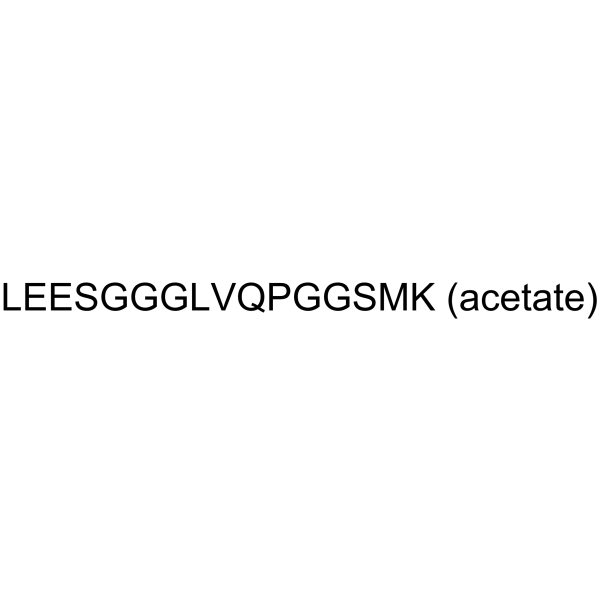
LEESGGGLVQPGGSMK acetate, a proteolysis peptide, is a component of Infliximab. LEESGGGLVQPGGSMK acetate can be used for quantitative analysis of Infliximab. Infliximab is a chimeric monoclonal IgG1 antibody that specifically binds to TNF-α .
loading...
    loading...
Cat. No.: HY-174719
Target:  

mRNA

Research Areas:  

Inflammation/Immunology

Human ELANE mRNA encodes the human elastase (ELANE) protein, a member of serine proteases family. ELANE may play a role in degenerative and inflammatory diseases through proteolysis of collagen-IV and elastin.
loading...
    loading...
Cat. No.: HY-P3149A
Target:  

TNF Receptor

Research Areas:  

Inflammation/Immunology

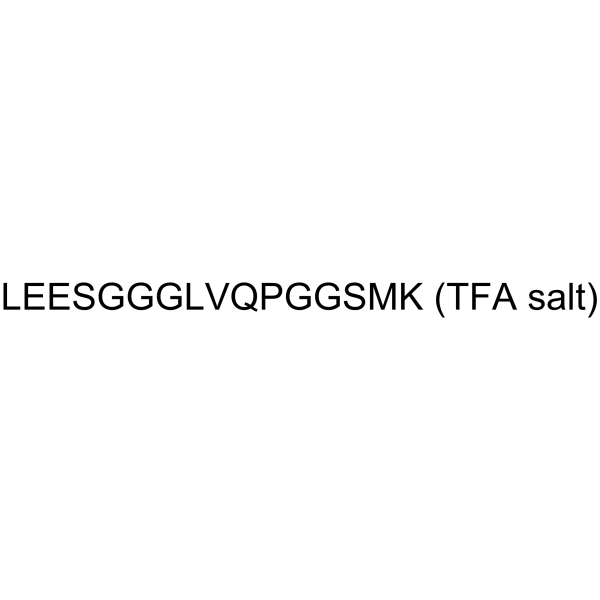
LEESGGGLVQPGGSMK TFA, a proteolysis peptide, is a component of Infliximab. LEESGGGLVQPGGSMK TFA can be used for quantitative analysis of Infliximab. Infliximab is a chimeric monoclonal IgG1 antibody that specifically binds to TNF-α .
loading...
    loading...
Cat. No.: HY-126822
CAS No.: 123285-50-7
Target:  

Elastase

Research Areas:  

Others

MDL27324 is an inhibitor of neutrophil proteases. MDL27324 can be taken up by the cell and has a modest inhibitory effect on the proteolysis of ingested fluoresceinated immune complexes (200 μM, 20% inhibition) .
loading...
    loading...

