34 Results for "

PMA/MCM-41

" in MedChemExpress (MCE) Product Catalog:
Products (34)

34 Results for "PMA/MCM-41" in MCE Product Catalog:

Cat. No.: HY-N5051
CAS No.: 125225-63-0
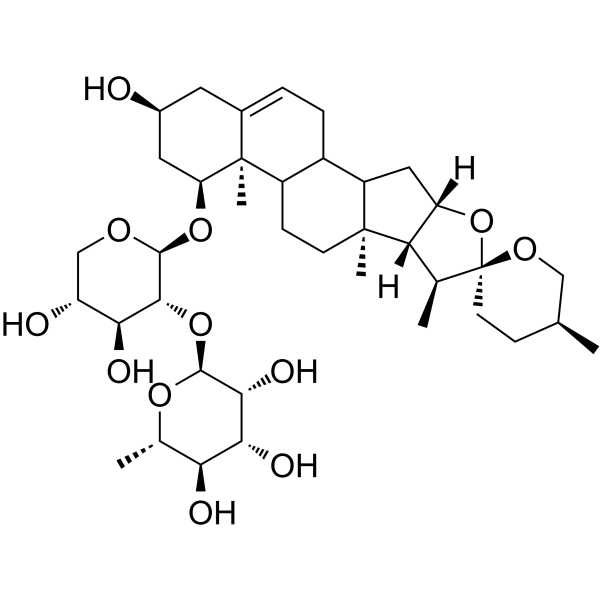
25(S)-Ruscogenin-1-O-α-L-rhamnopyranosyl (1→2)-β-D-xylopyranoside shows inhibitory activity of neutrophil respiratory burst stimulated by PMA(phorbol myristate acetate) .
loading...
    loading...
Cat. No.: HY-N13177
CAS No.: 1869126-66-8
25(S)Ruscogenin 3-O-α-L-rhamnopyranoside is from the fibrous roots of Ophiopogon japonicus and Liriope spicata var. prolifera. 25(S)Ruscogenin 3-O-α-L-rhamnopyranoside exhibits anti-inflammatory activity by inhibiting neutrophil responses to PMA (HY-18739), with an IC50 value of 1.13 μM .
loading...
    loading...
Cat. No.: HY-N14549
CAS No.: 193481-66-2
Cycloepoxydon inhibits the Phorbol 12-myristate 13-acetate (HY-18739) (PMA)-induced NF-KB and AP-1 mediated secreted alkaline phosphatase (SEAP) expression with IC50s of 1-2 μg/mL (4.2-8.4 μM) and 3-5 μg/mL (12.6-21 μM), respectively .
loading...
    loading...
Cat. No.: HY-N7576
CAS No.: 221317-02-8
Anemarrhenasaponin Ia is a steroidal saponin that can be isolated from the rhizomes of Anemarrhena asphodeloides Bunge. Anemarrhenasaponin Ia inhibits platelet aggregation. Anemarrhenasaponin Ia induces mild concentration-dependent hemolysis. Anemarrhenasaponin Ia inhibits fMLP- and AA-induced superoxide anion production, while enhancing PMA-induced superoxide anion production. Anemarrhenasaponin Ia can be used in studies related to thrombosis .
loading...
    loading...
Cat. No.: HY-P810353
Synonyms: Adult T cell leukemia derived PMA responsive, APR, APR_HUMAN, ATL-derived, Immediate early response protein APR, Immediate-early-response protein APR, NOXA, Phorbol 12 myristate 13 acetate induced protein 1, Phorbol-12-myristate-13-acetate-induced protein 1, PMA induced protein 1

Host:  

Rabbit

Application:  

WB, IHC-P

Reactivity:  

Human, Mouse, Rat

loading...
    loading...
Cat. No.: HY-116509
CAS No.: 19878-10-5
Synonyms: Linoleic acid anilide; LAA
Linoleylanilide (Linoleic acid anilide) is a Linoleic acid (HY-N0729) derivative. Linoleylanilide slightly inhibits the PMA (HY-18739)-induced expression of CD11b. Linoleylanilide inhibits serum LDH, GOT and GPT activities. Linoleylanilide decreases red cell counts and hemoglobin content .
loading...
    loading...
Cat. No.: HY-N2180A
CAS No.: 25305-05-9
Synonyms: (±)-Eudesmine
(±)-Eudesmin ((±)-Eudesmine) is a natural compound found in Fragaria nubicola with in vitro anti-inflammatory activity. (±)-Eudesmin inhibits NO production in LPS-activated macrophages; suppresses myeloperoxidase-dependent ROS production in zymosan-activated phagocytes; and inhibits superoxide anion production in PMA-activated macrophages. (±)-Eudesmin can be used for the research of inflammation-related diseases .
loading...
    loading...
Cat. No.: HY-184882
CAS No.: 2771021-30-6
Research Areas:  

Inflammation/Immunology Cancer

NLRP3-IN-95 is an NLRP3 inflammasome inhibitor with an IC50 of 27 nM. NLRP3-IN-95 inhibits IL-1β secretion in PMA-differentiated THP-1 cells. NLRP3-IN-95 can be used in studies related to acute monocytic leukemia and inflammatory diseases .
loading...
    loading...
Cat. No.: HY-184844
CAS No.: 2771020-68-7
NLRP3 modulator 8 (compound 248) is a NLRP3 inhibitor. NLRP3 modulator 8 inhibits LPS (HY-D1056)-induced IL-1β secretion in PMA-differentiated THP-1 cells with an IC50 of 3 nM. NLRP3 modulator 8 can be used in studies related to NLRP3 inflammasome activation and innate immune signaling .
loading...
    loading...
Cat. No.: HY-W723158
CAS No.: 100992-60-7
Epibestatin hydrochloride is an epimer of Bestatin (HY-B0134), a DPP4 inhibitor and protease inhibitor, with an IC50 of 17 μM against DPP4. As a stabilizer, Epibestatin hydrochloride binds to the cleft between 14-3-3 protein and plant proton pump PMA2, selectively stabilizing their interaction without affecting other 14-3-3 client proteins. Epibestatin hydrochloride triggers stomatal opening in leaf epidermis of Commelina communis. Epibestatin hydrochloride can be used in studies related to type 2 diabetes .
loading...
    loading...
Cat. No.: HY-N18117
CAS No.: 1429747-14-7
21-Hydroxyisoohchininolide is a salannin-type limonoid. 21-Hydroxyisoohchininolide inhibits lipopolysaccharide (LPS, HY-D1056)-induced nitric oxide production in mouse macrophages. 21-Hydroxyisoohchininolide exhibits cytotoxic activity against leukemia cells and breast cancer cells. 21-Hydroxyisoohchininolide suppresses phorbol 12-myristate 13-acetate (PMA) (HY-18739)-induced activation of Epstein-Barr virus early antigen in lymphocytes. 21-Hydroxyisoohchininolide can be used for the research of leukemia, breast cancer and inflammatory diseases .
loading...
    loading...
Cat. No.: HY-180181
Target:  

RAR/RXR

Research Areas:  

Metabolic Disease Cancer

RXR antagonist 6 (Compound 34) is a selective partial retinoid X receptor (RXR) antagonist. RXR antagonist 6 shows no agonistic activity for any of the human RXRα/β/γ subtypes but it can strongly inhibit the receptor activation induced by full agonists of RXR (such as Bezafibrate (HY-B0637)) with an IC50 of 2.7 μM. RXR antagonist 6 can enhance PMA (HY-18739)-induced THP-1 cell differentiation. RXR antagonist 6 can be used for the research of cancer, metabolic and neurological disease, such as lymphoma .
loading...
    loading...
Cat. No.: HY-138135
CAS No.: 1030825-28-5
Synonyms: Fidaxomicin metabolite OP-1118
Research Areas:  

Infection

OP-1118 (Fidaxomicin metabolite OP-1118) is an orally active dual inhibitor of NF-κB and ERK1/2, with low systemic plasma exposure, no accumulation, and primary excretion via feces. By inhibiting the phosphorylation of NF-κB and ERK1/2 and reducing the expression of pro-inflammatory cytokines, OP-1118 exerts significant anti-inflammatory, cytoprotective, anti-apoptotic and antibacterial activities. In Clostridium difficile infection models, OP-1118 effectively blocks toxin-mediated intestinal inflammation, cell rounding, histological damage and apoptosis, and its protective effect can be reversed by PMA (HY-18739) .
loading...
    loading...
Cat. No.: HY-P11467
Gy-CATH is an anionic antimicrobial peptide. Gy-CATH activates MAPK and NF-κB signaling pathways (elevated levels of phospho-ERK, -p38, -JNK, -p65, and -IκBα). Gy-CATH upregulates the expression levels of three physiological anticoagulant pathways. Gy-CATH inhibits ADP-, Collagen-, and PMA-induced platelet aggregation. Gy-CATH has no direct antimicrobial activity, but shows significant preventive abilities against mice infected with Staphylococcus aureus, Escherichia coli, and Methicillin (HY-121544)-resistant Staphylococcus aureus. Gy-CATH exhibits potent immunomodulatory activity, enhancing macrophage-and neutrophil-mediated bactericidal functions. Gy-CATH significantly reduces the extent of pulmonary fibrin deposition and prevents thrombosis in mice .
loading...
    loading...

