436 Results for "

SRC

" in MedChemExpress (MCE) Product Catalog:
Products (436)

436 Results for "SRC" in MCE Product Catalog:

Cat. No.: HY-P77626
Purity:  ≥ 95%, as determined by Bis-Tris PAGE.
Synonyms: CDCP1; Subtractive Immunization M Plus HEp3-Associated 135 KDa Protein; CUB Domain Containing Protein 1; Transmembrane And Associated With SRC Kinases; SIMA135; Membrane Glycoprotein Gp140; CUB Domain-Containing Protein 1; TRASK; CD318; CD318 Antigen
Species:  
Rhesus Macaque
Source:  
HEK293
loading...
    loading...
Cat. No.: HY-P77893
Purity:  ≥ 95%, as determined by Bis-Tris PAGE.
Synonyms: CDCP1; Subtractive Immunization M Plus HEp3-Associated 135 KDa Protein; CUB Domain Containing Protein 1; Transmembrane And Associated With SRC Kinases; SIMA135; Membrane Glycoprotein Gp140; CUB Domain-Containing Protein 1; TRASK; CD318; CD318 Antigen
Species:  
Human
Source:  
HEK293
loading...
    loading...
Cat. No.: HY-P78101
Purity:  ≥ 95%, as determined by Bis-Tris PAGE.
Synonyms: CDCP1; Subtractive Immunization M Plus HEp3-Associated 135 KDa Protein; CUB Domain Containing Protein 1; Transmembrane And Associated With SRC Kinases; SIMA135; Membrane Glycoprotein Gp140; CUB Domain-Containing Protein 1; TRASK; CD318; CD318 Antigen
Species:  
Mouse
Source:  
HEK293
loading...
    loading...
Cat. No.: HY-P700969
Purity:  ≥ 95%, as determined by reducing SDS-PAGE.
Synonyms: CDCP1; Subtractive Immunization M Plus HEp3-Associated 135 KDa Protein; CUB Domain Containing Protein 1; Transmembrane And Associated With SRC Kinases; SIMA135; Membrane Glycoprotein Gp140; CUB Domain-Containing Protein 1; TRASK; CD318; CD318 Antigen
Species:  
Human
Source:  
HEK293
loading...
    loading...
Cat. No.: HY-P703719
Purity:  ≥ 95%, as determined by reducing SDS-PAGE.
Synonyms: CDCP1; Subtractive Immunization M Plus HEp3-Associated 135 KDa Protein; CUB Domain Containing Protein 1; Transmembrane And Associated With SRC Kinases; SIMA135; Membrane Glycoprotein Gp140; CUB Domain-Containing Protein 1; TRASK; CD318; CD318 Antigen
Species:  
Cynomolgus
Source:  
HEK293
loading...
    loading...
Cat. No.: HY-179433
Research Areas:  

Cancer

PROTAC AR Degrader-12 is a highly efficient PROTAC targeting AR coactivator binding site (AR-CBS). PROTAC AR Degrader-12 induces AR degradation in a ubiquitin proteasome system (UPS) pathway-dependent manner. PROTAC AR Degrader-12 inhibits tumor cell growth by affecting DNA replication and cell division PROTAC AR Degrader-12 could not only effectively degrade AR, but also potently inhibit the proliferation of MCF-7 and multiple mutant or resistant BC cells. PROTAC AR Degrader-12 effectively blocked estrogen receptor α (ERα) signaling through a dual mechanism involving ERα protein downregulation and suppression of its transcriptional activity. PROTAC AR Degrader-12 significantly inhibits the mRNA expression of FOXA1, GREB1, SRC, and PELP1. PROTAC AR Degrader-12 can be used for the study of breast cancer .
loading...
    loading...
Cat. No.: HY-P703318
Purity:  ≥ 80%, as determined by reducing SDS-PAGE.
Synonyms: DBNL; Drebrin-Like Protein; Drebrin Like; Cervical SH3P7; HIP-55; Drebrin-F; SH3P7; CDNA FLJ59450, Highly Similar To Drebrin-Like Protein; HPK1-Interacting Protein Of 55 KDa; SRC Homology 3 Domain-Containing Protein HIP-55; ABP1; Drebrin-Like; Cervical Mu
Species:  
Human
Source:  
HEK293
loading...
    loading...
Cat. No.: HY-13024A
CAS No.: 1033893-29-6
Synonyms: DCC-2036 tosylate
Rebastinib tosylate (DCC-2036 tosylate) is an orally active, non-ATP-competitive Bcr-Abl inhibitor, with IC50 values of 0.8 nM and 4 nM against Abl1 WT and Abl1 T315I, respectively. Rebastinib tosylate potently inhibits CYP2C8 (IC50 = 0.0533 μM) and CYP2C9 (IC50 = 2.54 μM). Rebastinib tosylate allosterically inhibits Tie2 with an IC50 of 0.63 nM. Rebastinib tosylate inhibits the transcriptional activity of FoxO1. Rebastinib tosylate inhibits SRC family kinases, KDR and FLT3 kinases. Rebastinib tosylate induces Apoptosis. Rebastinib tosylate exerts anti-tumor activity in breast cancer. Rebastinib tosylate exerts anti-angiogenic effects. Rebastinib tosylate increases myotube diameter and improves reduced contractility. Rebastinib tosylate can be used in research related to triple-negative breast cancer, luminal breast cancer, pancreatic neuroendocrine tumors, muscle atrophy, cancer cachexia, chronic myeloid leukemia, and B-lymphocytic leukemia .
loading...
    loading...
Cat. No.: HY-184931
Research Areas:  

Cancer

PTPN22-IN-3 is a potent, selective, and orally active inhibitor of PTPN22 with an IC50 of 0.49 μM and a Ki of 0.28 μM. PTPN22-IN-3 exhibits over 14-fold selectivity against a broad panel of PTPs and shows no significant inhibition against SRC/CSK kinases or IDO1/Arginase metalloenzymes. PTPN22-IN-3 enhances TCR signaling, increases IL-2 expression and secretion, and promotes mouse splenic T cell proliferation. In immune-competent C57BL/6J mice, PTPN22-IN-3 suppresses MC38 syngeneic tumor growth and synergizes with Pembrolizumab (anti-PD-1) (HY-P9902A) therapy. PTPN22-IN-3 can be used for the study of colorectal cancer and other solid tumors responsive to T cell-mediated anti-tumor immunity .
loading...
    loading...
Cat. No.: HY-N0442
CAS No.: 84272-85-5
Synonyms: 4'-O-β-D-Glucosyl-5-O-methylvisamminol
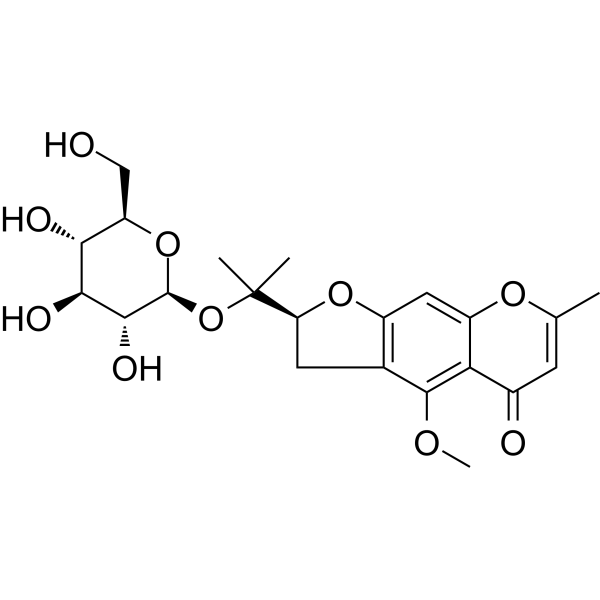
5-O-Methylvisammioside (4'-O-β-D-Glucosyl-5-O-methylvisamminol) is an orally active natural chromone glycoside and multiple biological activities. 5-O-Methylvisammioside inhibits ferroptosis by activating the Nrf2/HO-1 signaling axis. 5-O-Methylvisammioside alleviates intestinal barrier damage by inhibiting the ROS/NF-κB/NLRP3 pathway. 5-O-Methylvisammioside exerts a protective effect against acute liver injury by reducing ALT/AST, decreasing inflammatory infiltration, and inhibiting IκB-α phosphorylation and NF-κB nuclear translocation. 5-O-Methylvisammioside blocks the HMGB1/RAGE/MEK/ERK signaling axis to exert anti-tumor and anti-angiogenic effects. 5-O-Methylvisammioside improves depression-like behaviors by inhibiting Src kinase and the NF-κB pathway .
loading...
    loading...
Cat. No.: HY-P1189
CAS No.: 154303-05-6
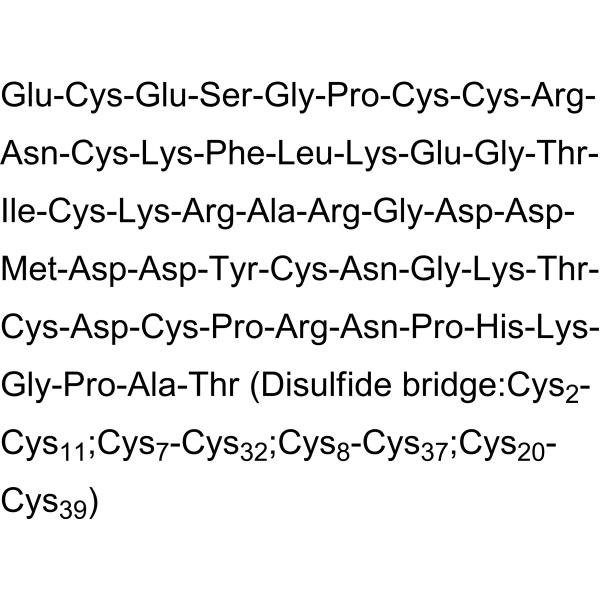
Echistatin is a naturally derived RGD-containing snake venom peptide. Echistatin exhibits an IC50 of 0.6 nM against mouse αvβ3 integrin, and acts as an antagonist against αvβ3, αIIbβ3, α5β1 integrins, pp125 FAK and paxillin. Echistatin reduces the phosphorylation of pp125 FAK and paxillin, inhibits the autophosphorylation and kinase activity of pp125 FAK, and weakens its binding to pp60src and paxillin. Echistatin disrupts the actin cytoskeleton and focal adhesions, induces melanoma cell detachment from fibronectin, and regulates cell adhesion and motility. Echistatin inhibits osteoclast maturation and migration, bone resorption, platelet aggregation, bone loss, as well as adhesion and metastasis of Lewis lung cancer cells; it also increases the number of osteoclasts and bone coverage area in mice with secondary hyperparathyroidism. Echistatin can be used in research related to melanoma, lung cancer and secondary hyperparathyroidism .
loading...
    loading...
Cat. No.: HY-P1189A
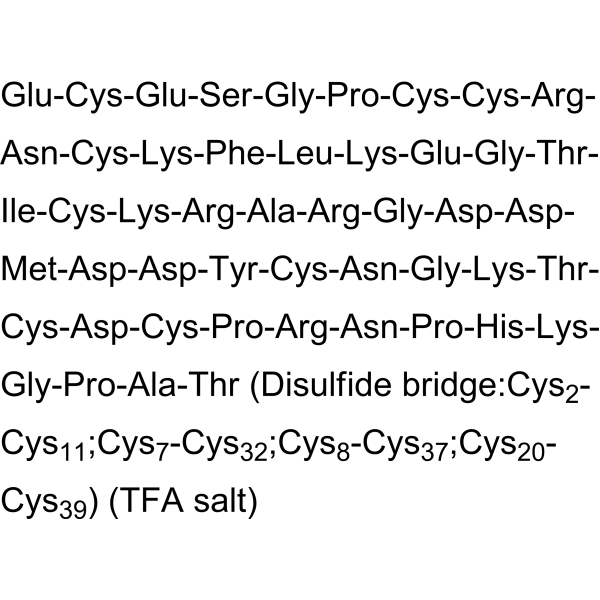
Echistatin TFA is a naturally derived RGD-containing snake venom peptide. Echistatin TFA exhibits an IC50 of 0.6 nM against mouse αvβ3 integrin, and acts as an antagonist against αvβ3, αIIbβ3, α5β1 integrins, pp125 FAK and paxillin. Echistatin TFA reduces the phosphorylation of pp125 FAK and paxillin, inhibits the autophosphorylation and kinase activity of pp125 FAK, and weakens its binding to pp60src and paxillin. Echistatin TFA disrupts the actin cytoskeleton and focal adhesions, induces melanoma cell detachment from fibronectin, and regulates cell adhesion and motility. Echistatin TFA inhibits osteoclast maturation and migration, bone resorption, platelet aggregation, bone loss, as well as adhesion and metastasis of Lewis lung cancer cells; it also increases the number of osteoclasts and bone coverage area in mice with secondary hyperparathyroidism. Echistatin TFA can be used in research related to melanoma, lung cancer and secondary hyperparathyroidism .
loading...
    loading...
Cat. No.: HY-N0442R
CAS No.: 84272-85-5
Synonyms: 4'-O-β-D-Glucosyl-5-O-methylvisamminol (Standard)
5-O-Methylvisammioside (4'-O-β-D-Glucosyl-5-O-methylvisamminol) (Standard) is the analytical standard of 5-O-Methylvisammioside. This product is intended for research and analytical applications. 5-O-Methylvisammioside is an orally active natural chromone glycoside and multiple biological activities. 5-O-Methylvisammioside inhibits ferroptosis by activating the Nrf2/HO-1 signaling axis. 5-O-Methylvisammioside alleviates intestinal barrier damage by inhibiting the ROS/NF-κB/NLRP3 pathway. 5-O-Methylvisammioside exerts a protective effect against acute liver injury by reducing ALT/AST, decreasing inflammatory infiltration, and inhibiting IκB-α phosphorylation and NF-κB nuclear translocation. 5-O-Methylvisammioside blocks the HMGB1/RAGE/MEK/ERK signaling axis to exert anti-tumor and anti-angiogenic effects. 5-O-Methylvisammioside improves depression-like behaviors by inhibiting Src kinase and the NF-κB pathway.
loading...
    loading...
Cat. No.: HY-N0819R
CAS No.: 89412-79-3
Raddeanin A (Standard) is the analytical standard of Raddeanin A (HY-N0819). This product is intended for research and analytical applications. Raddeanin A is an oleanane-type triterpenoid saponin with oral activity. Raddeanin A inhibits SRC, mTOR, JNK, VEGFR2, NLRP3 inflammasome, Wnt/β-catenin, Wee1, PI3K/AKT signaling pathway, MAPK/ERK signaling pathway, AR-FL, AR-Vs, and downregulates the expression of p-PI3K and p-AKT. Raddeanin A inhibits osteoclast formation, bone resorption, osteolysis, cancer cell invasion, migration, proliferation, angiogenesis and epithelial-mesenchymal transition, while induces apoptosis, cell cycle arrest, ROS production, immunogenic cell death and dendritic cell maturation. Raddeanin A improves blood-retinal barrier function, alleviates inflammation, regulates the tumor microenvironment, and enhances the activity of anti-PD-1 antibody. Raddeanin A is applicable to the research of breast cancer-associated osteolysis, human osteosarcoma, colorectal cancer, glioblastoma, Alzheimer's disease, cholangiocarcinoma, melanoma, non-small cell lung cancer, castration-resistant prostate cancer and multiple myeloma.
loading...
    loading...
Cat. No.: HY-P85536
Synonyms: Abundant SRC homology; Adapter protein GRB2; ASH; Ash protein; EGFRBP GRB2; Epidermal growth factor receptor binding protein; Epidermal growth factor receptor binding protein GRB2; GRB 2; GRB2 adapter protein; Grb2; GRB2_HUMAN; Grb3 3; Growth factor receptor bound protein 2; Growth factor receptor bound protein 3; Growth factor receptor-bound protein 2; HT027; MST084; MSTP084; NCKAP2; OTTHUMP00000166096; OTTHUMP00000166097; OTTHUMP00000166098; Protein ASH; SEM5; SH2/SH3 adapter GRB2.

Host:  

Mouse

Application:  

WB

Reactivity:  

Human, Mouse, Rat

loading...
    loading...
Cat. No.: HY-P85555
Synonyms: LCK; Lck p56; LCK_HUMAN; Leukocyte C-terminal SRC kinase; LSK; Lymphocyte cell specific protein tyrosine kinase; Lymphocyte cell-specific protein-tyrosine kinase; Lymphocyte Specific Protein Tyrosine Kinase; Membrane associated protein tyrosine kinase; Oncogene lck; P56 LCK; p56; LSTRA; protein tyrosine kinase; p56-LCK; p56lck; pp58 lck; pp58lck; Protein YT16; Proto oncogene tyrosine protein kinase LCK; Proto-oncogene Lck; Protooncogene tyrosine protein kinase LCK; T cell specific protein tyrosine kinase; T cell-specific protein-tyrosine kinase; T lymphocyte specific protein tyrosine kinase p56lck; Tyrosine-protein kinase Lck; YT 16; YT16.

Host:  

Mouse

Application:  

WB

Reactivity:  

Human

loading...
    loading...

