485 Results for "

insect morphogenesis

" in MedChemExpress (MCE) Product Catalog:
Products (485)

485 Results for "insect morphogenesis" in MCE Product Catalog:

Cat. No.: HY-W587689
CAS No.: 120293-93-8
Synonyms: Juvenile hormone III bisepoxide; Juvenile hormone bisepoxide; JHB3
Target:  

c-Met/HGFR

Research Areas:  

Others

Juvenile hormone B 3 (Juvenile hormone III bisepoxide)(mixture of diastereomers) is a sesquiterpenoid hormone. Juvenile hormone B 3 can be isolated from corpus allatum (CA) of high dipterans like the fruitfly and Drosophila melanogaster. JHB3 has anti-metamorphic activity and induces Kr-h1 expression by directly interacting with juvenile hormone (JH) receptors (Met and Gce). Juvenile hormone B 3 can be used for insect lethality research .
loading...
    loading...
Cat. No.: HY-110381R
CAS No.: 1962931-71-0
Research Areas:  

Metabolic Disease

JNJ-DGAT2-A (Standard) is the analytical standard of JNJ-DGAT2-A (HY-110381). This product is intended for research and analytical applications. JNJ-DGAT2-A is a selective diacylglycerol acyltransferase 2 (DGAT2) inhibitor with an IC50 value of 0.14 μM in human DGAT2-expressing Sf9 insect cell membranes. JNJ-DGAT2-A can be used for the research of triglyceride (TG) synthesis .
loading...
    loading...
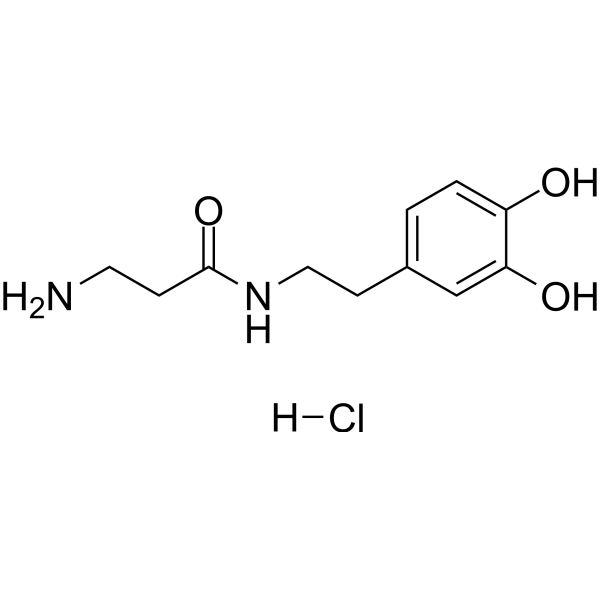
Cat. No.: HY-136537A
CAS No.: 58077-93-3
Purity:  99.94%
Synonyms: NBAD hydrochloride
N-β-alanyldopamine hydrochloride (NBAD hydrochloride) is a tyrosine metabolite, Antibacterial agent and Antifungal agent. N-β-alanyldopamine hydrochloride exists in the hemolymph and cuticle during pupal cuticle tanning of the tobacco hornworm (Manduca sexta). N-β-alanyldopamine hydrochloride is the preferred substrate for pupal cuticular o-Diphenol oxidase during insect pupal cuticle tanning. N-β-alanyldopamine hydrochloride inhibits the growth of Escherichia coli, Bacillus megaterium and Saccharomyces cerevisiae in vitro. N-β-alanyldopamine hydrochloride can be used in studies related to microbial infections .
loading...
    loading...
Cat. No.: HY-180460
CAS No.: 339231-67-3
Target:  

Insecticide

Research Areas:  

Others

SCPI-1 is a potent and competitive mosquito sterol carrier protein-2 (SCP-2) inhibitor (AeSCP-2 IC50 = 0.347 µM; AeSCP-x IC50 = 0.527 µM). SCPI-1 exhibits physiological effects on cholesterol metabolism in cultured insect cells (IC50 of 5.53 µM in Aag-2 cells). SCPI-1 shows insecticidal activity against Aedes aegypti with a LD50 of 4.8 µM .
loading...
    loading...
Cat. No.: HY-180500
CAS No.: 349561-46-2
Target:  

Insecticide

Research Areas:  

Others

SCPI-3 is a potent and competitive mosquito sterol carrier protein-2 (SCP-2) inhibitor (AeSCP-2 IC50 = 0.159 µM; AeSCP-x IC50 = 0.285 µM). SCPI-3 exhibits physiological effects on cholesterol metabolism in cultured insect cells (IC50 of 3.09 µM in Aag-2 cells). SCPI-3 shows insecticidal activity against Aedes aegypti with a LD50 of 12.3 µM .
loading...
    loading...
Cat. No.: HY-B1970
CAS No.: 789-02-6
Synonyms: 2,4'-DDT
Research Areas:  

Endocrinology

o,p'-DDT (2,4'-DDT) is a chlorinated organic pesticide with estrogenic activity. o,p'-DDT is persistent in the environment, can accumulate in organisms and disrupt the endocrine system. o,p'-DDT is used in agriculture as a pesticide, especially for controlling insect pests. The use of o,p'-DDT has led to toxic effects in organisms, raising widespread concern about its environmental and health effects. o,p'-DDT has also led to research into its long-term effects in ecosystems .
loading...
    loading...
Cat. No.: HY-E72096
Target:  

Cytochrome P450

Research Areas:  

Others

Human CYP2B6, Reductase+b5 refers to a near-physiological recombinant microsomal system co-expressed in insect cells, consisting of human cytochrome P450 2B6, NADPH-P450 oxidoreductase (CPR) and cytochrome b5. Human CYP2B6 is a human cytochrome P450 subtype belonging to the CYP2 family, and also serves as a minor but highly polymorphic hepatic metabolic enzyme that metabolizes various prodrugs or xenobiotics .
loading...
    loading...
Cat. No.: HY-E72099
Target:  

Cytochrome P450

Research Areas:  

Others

Human CYP2C19, Reductase+b5 is a near-physiological recombinant microsomal system co-expressed in insect cells, consisting of human cytochrome P450 2C19, NADPH-P450 oxidoreductase (CPR) and cytochrome b5. Human CYP2C19 is a human cytochrome P450 subtype belonging to the CYP2 family, as well as a major metabolic enzyme. It is predominantly expressed in the human liver and metabolizes various psychoactive compounds .
loading...
    loading...
Cat. No.: HY-N13069
CAS No.: 86577-96-0
Target:  

Drug Intermediate

2-Deoxy-20-hydroxyecdysone-22-phosphate is an inactive storage form of insect ecdysteroids. 2-Deoxy-20-hydroxyecdysone-22-phosphate exists in newly laid eggs of the desert locust Schistocerca gregaria. 2-Deoxy-20-hydroxyecdysone-22-phosphate can be enzymatically hydrolyzed by embryonic tissues to release the ecdysteroid 2-deoxy-20-hydroxyecdysone (HY-N17267) .
loading...
    loading...
Cat. No.: HY-N7058R
CAS No.: 488-10-8
cis-Jasmone (Standard) is the analytical standard of cis-Jasmone. This product is intended for research and analytical applications. Cis-Jasmone is a plant-derived natural product. Cis-Jasmone is a plant-derived natural product. Cis-Jasmone is constitutively released by many flowers and sometimes by leaves as an attractant for pollinators or as a chemical cue for host location by insect flower herbivores. Cis-Jasmone treatment of crop plants not only induces direct defense against herbivores, but also induces indirect defense by releasing VOCs that attract natural enemies .
loading...
    loading...
Cat. No.: HY-W004303S
CAS No.: 1809273-36-6
Synonyms: Tetradecyl Aldehyde-d27
Tetradecanal-d27 (Tetradecyl Aldehyde-d27) is the deuterium labeled Tetradecanal. Tetradecanal is a compound belonging to the class of fatty aldehydes. It is an aldehyde with a 14-carbon chain that occurs naturally in certain plant and animal sources, such as coconut oil and butter. Due to its unique properties, Tetradecanal has several uses in industry, such as a flavoring agent in certain foods and as a precursor for the production of perfumes and other cosmetics. It is also used as an insecticide and insecticide due to its ability to repel certain types of insects.
loading...
    loading...
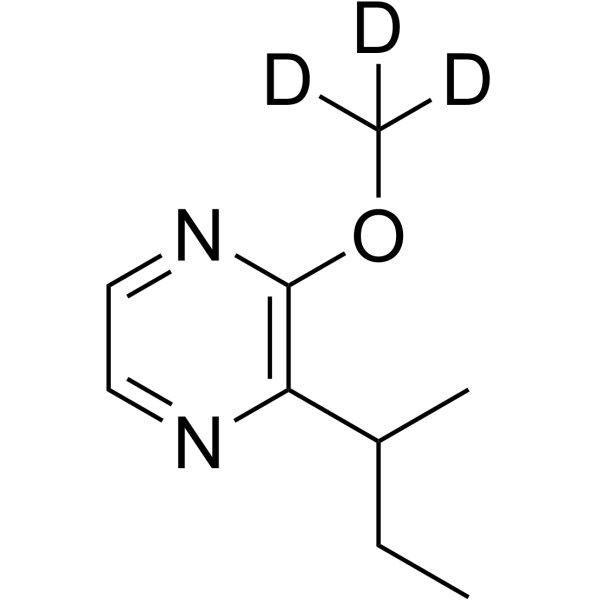
Cat. No.: HY-W017140S
CAS No.: 1335436-01-5
Synonyms: SBMP-d3
2-Sec-butyl-3-methoxypyrazine-d3 is deuterated labeled cis-?Jasmone (HY-N7058). Cis-Jasmone is a plant-derived natural product. Cis-Jasmone is constitutively released by many flowers and sometimes by leaves as an attractant for pollinators or as a chemical cue for host location by insect flower herbivores. Cis-Jasmone treatment of crop plants not only induces direct defense against herbivores, but also induces indirect defense by releasing VOCs that attract natural enemies .
loading...
    loading...
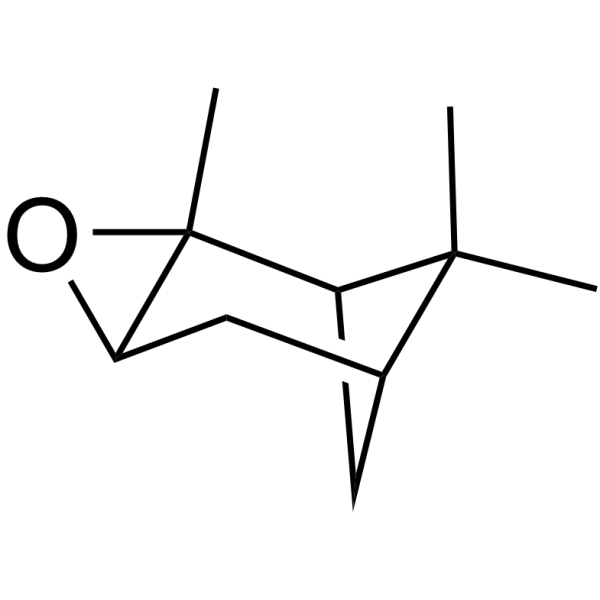
Cat. No.: HY-W130074
CAS No.: 1686-14-2
α-Pinene oxide is a type of monoterpene epoxidation intermediate. α-Pinene oxide is produced via the cytochrome P-450-mediated oxidation pathway in Dendroctonus terebrans body microsomes and rat liver microsomes, and can be further converted into alcohols, ketones and insect pheromone derivatives. α-Pinene oxide can generate the perfume intermediate myrtenal. α-Pinene oxide is used in studies related to terpenoid metabolism and perfume synthesis .
loading...
    loading...
Cat. No.: HY-B0633I
CAS No.: 9067-32-7
Hyaluronic acid sodium (MW 800kDa) is a biopolymer composed of repeating units of disaccharides with various applications. Hyaluronic acid sodium is a major component of the extracellular matrix (ECM). Hyaluronic acid sodium is synthesized at the plasma membrane. Increased hyaluronic acid sodium levels are associated with tumor cell growth, adhesion, migration, invasion and angiogenesis in digestive cancers. Hyaluronic acid sodium participates in tissue remodeling and rapid cell proliferation in some physiological processes including embryonic morphogenesis and wound-healing. Hyaluronic acid sodium activates the PI3K-Akt signaling. Hyaluronic acid sodium acts as a regulator of cancer-associated lymphangiogenesis. Hyaluronic acid sodium also enhances cell invasion and angiogenesis by promoting proteolytic MMP-9 binding to cell surface or stimulating MMP-9 binding to cell surface. Hyaluronic acid sodium can be used as drug delivery for sodium butyrate to improve the anti-proliferative activity on breast cancer cell line. Hyaluronic acid sodium can be studied in joint diseases, wound healing and cancer .
loading...
    loading...
Cat. No.: HY-133204R
CAS No.: 71422-67-8
Synonyms: IKI-7899 (Standard)
Research Areas:  

Metabolic Disease

Chlorfluazuron (Standard) (IKI-7899 (Standard)) is the analytical standard of Chlorfluazuron (HY-133204). This product is intended for research and analytical applications. Chlorfluazuron (IKI-7899) is a benzoylurea chitin synthesis inhibitor and a PPARγ agonist ligand that blocks the polymerization of UDP-N-acetylglucosamine by inhibiting chitin synthase, disrupting cuticle formation, molting, and embryonic development, thereby exerting ovicidal, larvicidal, and fecundity-reducing effects in insects. Chlorfluazuron is used in hepatotoxicity research .
loading...
    loading...
Cat. No.: HY-B0828S
CAS No.: 1773496-62-0
Synonyms: Hostathion 40EC-d5; Hostathion-d5; Hostation-d5
Triazophos-d5 (Hostathion 40EC-d5) is the deuterium labeled Triazophos(HY-B0828) . Triazophos, a non-systemic insecticide and acaricide that acts as an acetylcholinesterase (AChE) inhibitor, covalently and irreversibly binds to the acetylcholine binding site, thus blocking the hydrolysis of acetylcholine and leading to hyperexcitability; it is effective against a variety of soil insects and mites, including aphids, thrips, midges, beetles, Lepidoptera larvae, cutworms, and spider mites in crops such as ornamentals, cotton, rice, maize, soybeans, oil palms, olives, and coffee.
loading...
    loading...
Cat. No.: HY-E72094
Target:  

Cytochrome P450

Research Areas:  

Others

Human CYP1A2, Reductase+b5 refers to a near-physiological recombinant microsomal system co-expressed in insect cells, consisting of human cytochrome P450 1A2, NADPH-P450 oxidoreductase (CPR) and cytochrome b5. Human CYP1A2 is a human cytochrome P450 subtype belonging to the CYP1 family, as well as a major metabolic enzyme. Its expression is centered in the human liver, and it can activate procarcinogens including aromatic heterocyclic amines and polycyclic aromatic hydrocarbons .
loading...
    loading...
Cat. No.: HY-E72097
Target:  

Cytochrome P450

Research Areas:  

Others

Human CYP2C8, Reductase+b5 refers to a near-physiological recombinant microsomal system co-expressed in insect cells, which consists of human cytochrome P450 2C8, NADPH-P450 oxidoreductase (CPR) and cytochrome b5. Human CYP2C8 is a human cytochrome P450 subtype belonging to the CYP2 family, and also serves as a major metabolic enzyme. It is predominantly expressed in human liver and is capable of metabolizing a variety of active compounds .
loading...
    loading...
Cat. No.: HY-E72098
Target:  

Cytochrome P450

Research Areas:  

Others

Human CYP2C9, Reductase+b5 refers to a near-physiological recombinant microsomal system co-expressed in insect cells, which consists of human cytochrome P450 2C9, NADPH-P450 oxidoreductase (CPR) and cytochrome b5. Human CYP2C9 is a human cytochrome P450 subtype belonging to the CYP2 family, and also a major metabolic enzyme. It is predominantly expressed in human liver and can metabolize a variety of active compounds .
loading...
    loading...
Cat. No.: HY-E72102
Target:  

Cytochrome P450

Research Areas:  

Others

Human CYP3A4, Reductase+b5 refers to a near-physiological recombinant microsomal system co-expressed in insect cells, consisting of human cytochrome P450 3A4, NADPH-P450 oxidoreductase (CPR) and cytochrome b5. Human CYP3A4 is a human cytochrome P450 subtype belonging to the CYP3 family, as well as a major metabolic enzyme. It is predominantly expressed in human liver and intestine, metabolizes a variety of active compounds, and activates multiple procarcinogens .
loading...
    loading...

