



Hyaluronic acid sodium (MW 800kDa)

Based on 1 Customer Validation
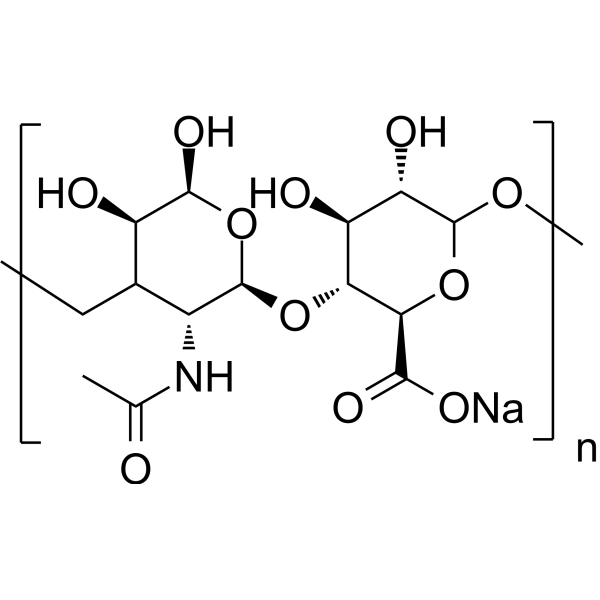
Hyaluronic acid sodium (MW 800kDa) is a biopolymer composed of repeating units of disaccharides with various applications. Hyaluronic acid sodium is a major component of the extracellular matrix (ECM). Hyaluronic acid sodium is synthesized at the plasma membrane. Increased hyaluronic acid sodium levels are associated with tumor cell growth, adhesion, migration, invasion and angiogenesis in digestive cancers. Hyaluronic acid sodium participates in tissue remodeling and rapid cell proliferation in some physiological processes including embryonic morphogenesis and wound-healing. Hyaluronic acid sodium activates the PI3K-Akt signaling. Hyaluronic acid sodium acts as a regulator of cancer-associated lymphangiogenesis. Hyaluronic acid sodium also enhances cell invasion and angiogenesis by promoting proteolytic MMP-9 binding to cell surface or stimulating MMP-9 binding to cell surface. Hyaluronic acid sodium can be used as drug delivery for sodium butyrate to improve the anti-proliferative activity on breast cancer cell line. Hyaluronic acid sodium can be studied in joint diseases, wound healing and cancer.
For research use only. We do not sell to patients.
- CAS No.: 9067-32-7
-
Storage:
-20°C, sealed storage, away from moisture
* In solvent : -80°C, 6 months; -20°C, 1 month (sealed storage, away from moisture)


To place orders, for customer services and technical support, please contact: MedChemExpress USA
Tel: 609-228-6898 E-mail: [email protected] [email protected]


-
 Biological Activity
-
Chemical Information
-
Solvent & Solubility
- Purity & Documentation
- References
-
 Help & FAQs


-

HY-B0633D
Hyaluronic acid sodium (MW 200-1560) -

HY-B0633O
Hyaluronic acid sodium (MW 5000) -
HY-B0633
Hyaluronic acid sodium -

HY-B0633P
Hyaluronic acid sodium (MW 0.9M-1.0Mda) -
HY-B0633A
Hyaluronic acid -

HY-B0633B
Hyaluronic acid (MW 50000-100000) -

HY-B0633C
Hyaluronic acid (Mw:1000-2000Da) -

HY-B0633E
Hyaluronic acid, low endotoxin -
HY-113511
Glycogen, Mussel -

HY-113511C
Glycogen, from bovine liver, ≥85% -
HY-113511A
Glycogen, Oysters -
HY-113511B
Glycogen, from rabbit liver, ≥85%
All Endogenous Metabolite Isoforms
More

Biological Activity
Description
In Vitro
Hyaluronic acid (HA) is widely used in aesthetic medicine due to its binding ability with a large number of water molecules. It improves tissue hydration and their resistance to mechanical damage. HA plays an important role in wound healing, ovulation, fertilization, signal transduction, and tumor physiology. HA is used in joint diseases such as osteoarthritis or rheumatoid arthritis. HA of a high molecular mass reduces the chemotaxis and migration of inflammatory cells which acts as a good barrier to the inflammatory process and protects against the effects of free radicals. HA is used in ophthalmology due to its lubricating properties for the corneal endothelium, and improves tissue hydration and cellular resistance to mechanical damage in aesthetic dermatology, and has marginal adverse effects. Several trials indicate its role in tumor markers, liver diseases, and in pharmaceuticals[1].
MedChemExpress (MCE) has not independently confirmed the accuracy of these methods. They are for reference only.


Chemical Information
-
CAS No. 9067-32-7
-
Appearance Solid
-
Color White to off-white
-
SMILES
CO[C@H]1[C@H](O)[C@@H](CO)O[C@@H](O[C@H]2[C@@H]([C@H]([C@@H](O[C@H]2C(O[Na])=O)OC)O)O)[C@@H]1NC(C)=O.[n]
-
Shipping
Room temperature in continental US; may vary elsewhere.
-
Storage
-20°C, sealed storage, away from moisture
* In solvent : -80°C, 6 months; -20°C, 1 month (sealed storage, away from moisture)


Solvent & Solubility
In Vitro:
H2O : 5 mg/mL (Need ultrasonic)


Purity & Documentation
-
Data Sheet (276 KB)
-
SDS (252 KB)
- English - EN (252 KB)
- Français - FR (252 KB)
- Deutsch - DE (252 KB)
- Norwegian - NO (252 KB)
- Español - ES (252 KB)
- Swedish - SV (252 KB)
- Italian - IT (252 KB)
- Korean - KR (252 KB)
- Portuguese - PT (252 KB)
-
Handling Instructions (2659 KB)
References
[1]. Salwowska NM, et al. Physiochemical properties and application of hyaluronic acid: a systematic review. J Cosmet Dermatol. 2016 Dec;15(4):520-526. [Content Brief]
[2]. Wu RL, et al. Hyaluronic acid in digestive cancers. J Cancer Res Clin Oncol. 2017 Jan;143(1):1-16. [Content Brief]
[3]. Kogan G, et al. Hyaluronic acid: a natural biopolymer with a broad range of biomedical and industrial applications. Biotechnol Lett. 2007 Jan;29(1):17-25. [Content Brief]
[4]. Coradini, D., et al., (1999). Hyaluronic acid as drug delivery for sodium butyrate: improvement of the anti-proliferative activity on a breast-cancer cell line. International journal of cancer, 81(3), 411-416. [Content Brief]
[5]. Goa, K. L., & Benfield, P. (1994). Hyaluronic acid. A review of its pharmacology and use as a surgical aid in ophthalmology, and its therapeutic potential in joint disease and wound healing. Drugs, 47(3), 536-566. [Content Brief]

Calculators
Concentration (start) × Volume (start) = Concentration (final) × Volume (final)


Hyaluronic acid sodium (MW 800kDa) Related Classifications
HY-B0633I Related Classifications
 Powered by Bioz