

66 Results for "

base modification

" in MedChemExpress (MCE) Product Catalog:
Products (66)

66 Results for "base modification" in MCE Product Catalog:

Cat. No.: HY-P1191
CAS No.: 438567-88-5
Synonyms: TI-JIP; JIP-1 peptide; JIPtide
Target:  

JNK

Research Areas:  

Others

JIP-1(153-163) (TI-JIP) is a peptide inhibitor of c-JNK, based on residues 153-163 of JNK-interacting protein-1 (JIP-1) (Modifications: Phe-11 = C-terminal amide) .
loading...
    loading...
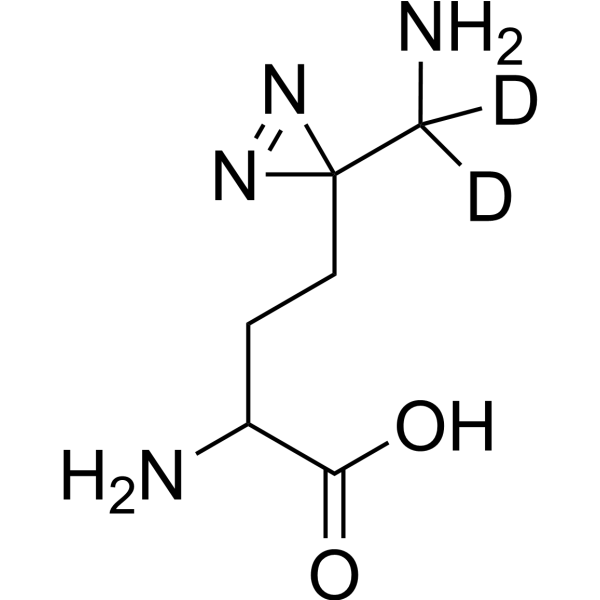
Cat. No.: HY-D2283S
Photo-DL-lysine-d2 is the deuterium labeled Photo-DL-lysine (HY-D2283). Photo-DL-lysine is a DL-lysine-based photo-reactive amino acid, captures proteins that bind lysine post-translational modifications .
loading...
    loading...
Cat. No.: HY-P1191A
Synonyms: TI-JIP TFA; JIP-1 peptide TFA; JIPtide TFA
Target:  

JNK

Research Areas:  

Others

JIP-1(153-163) TFA (TI-JIP TFA) is a peptide inhibitor of c-JNK, based on residues 153-163 of JNK-interacting protein-1 (JIP-1) (Modifications: Phe-11 = C-terminal amide) .
loading...
    loading...
Cat. No.: HY-101422A
CAS No.: 1380342-00-6
Target:  

Potassium Channel

Research Areas:  

Inflammation/Immunology

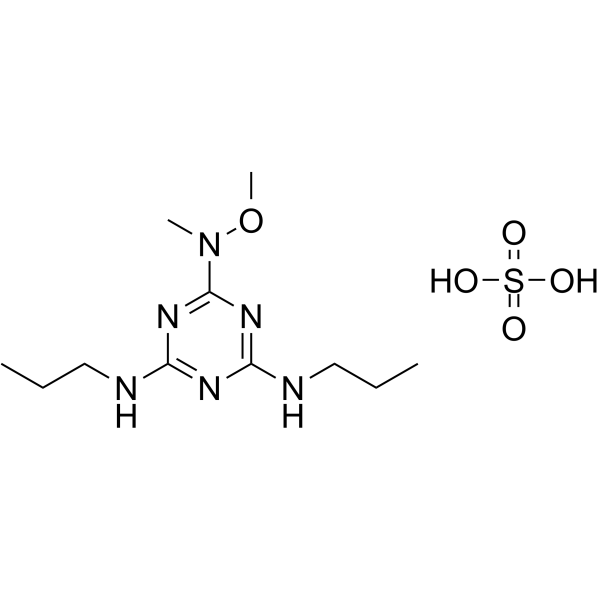
GAL-021 sulfate is a potent BKCa-channel blocker. GAL-021 sulfate inhibits KCa1.1 in GH3 cells. GAL-021 sulfate is a novel breathing control modulator that is based on selective modification of the almitrine pharmacophore. GAL-021 sulfate increases minute ventilation in rats and non-human primates .
loading...
    loading...
Cat. No.: HY-106994
CAS No.: 403604-85-3
Synonyms: YM598 free base
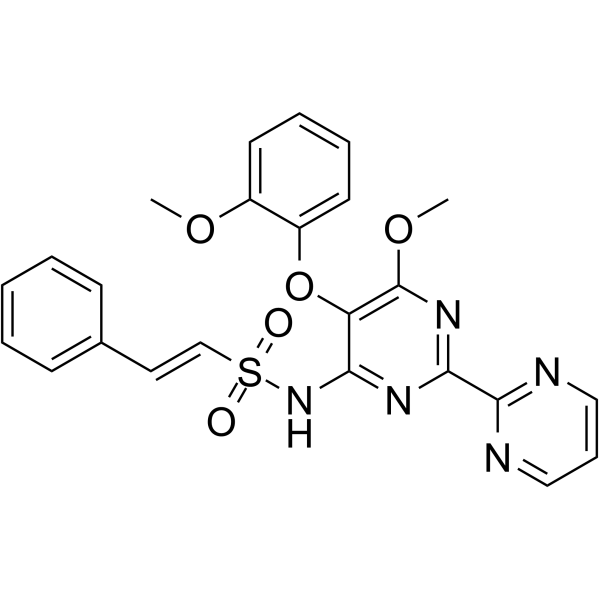
Nebentan (YM598 free base) is a potent, selective and orally active non-peptide endothelin ETA receptor antagonist through the modification of Bosentan (HY-A0013). Nebentan inhibits [ 125I] endothelin-1 binding to cloned human endothelin ETA and ETB receptor, with Ki of 0.697 nM and 569 nM, respectively . YM598 can ameliorate the progression of cor pulmonale and myocardial infarction in vivo .
loading...
    loading...
Cat. No.: HY-172150
Research Areas:  

Cancer

XH02 is a compound based on L6 modification. XH02 ( 177Lu labeled) displays exceptional tumor growth inhibition in BxPC-3 tumors .
loading...
    loading...
Cat. No.: HY-K3040

MEM-α is a synthetic cell culture medium developed through modifications of Eagle's Basal Medium (BME), which Harry Eagle formulated in the 1950s. It is now among the most widely used media for mammalian cell culture.

loading...
    loading...
Cat. No.: HY-K3041

MEM-α is a synthetic cell culture medium developed through modifications of Eagle's Basal Medium (BME), which Harry Eagle formulated in the 1950s. It is now among the most widely used media for mammalian cell culture.

loading...
    loading...
Cat. No.: HY-P12260
CAS No.: 3027489-02-4
Research Areas:  

Cancer

AJICAP reagent 1b is a thiophenyl ester-based site-specific conjugation reagent for antibody modification applications. AJICAP reagent 1b is used in HER2-positive gastric cancer-related research .
loading...
    loading...
Cat. No.: HY-185907
CAS No.: 1772522-17-4
Research Areas:  

Others

5'-Octyltocopherol C8 CE Phosphoramidite is a tocopherol-based phosphoramidite modification monomer for solid-phase oligonucleotide synthesis, which can introduce an octyltocopherol modification group with a C8 spacer arm at the 5'-end of oligonucleotides. 5'-Octyltocopherol C8 CE Phosphoramidite can be used to prepare DNA or RNA with hydrophobic tocopherol terminal modifications. 5'-Octyltocopherol C8 CE Phosphoramidite is applicable to studies related to oligonucleotide chemical synthesis, nucleic acid hydrophobic modification, and nucleic acid conjugate construction.
loading...
    loading...
Cat. No.: HY-K3027

Minimum Essential Medium (MEM), also known as Minimal Essential Medium, was developed by Harry Eagle based on Eagle’s Basal Medium (BME). It is a basic cell culture medium with a simple formulation and broad applicability, and is one of the most commonly used media in animal cell culture. MEM contains only 12 essential amino acids, L-glutamine, and 8 vitamins. It is primarily used for the culture of adherent cells. With appropriate formulation modifications, it can also be used for other types of cell culture.

loading...
    loading...
Cat. No.: HY-138830B
CAS No.: 1818252-52-6
Target:  

Histone Demethylase

Research Areas:  

Neurological Disease

TAK-418 free base is an orally active, blood-brain barrier-penetrant LSD1 inhibitor with a human IC50 of 2.9 nM. TAK-418 free base irreversibly inhibits LSD1 by forming a compact flavin-FAD adduct with the catalytic domain FAD, blocking the demethylation of H3K4me1/2 and H3K9me1/2 without disrupting the LSD1-GFI1B interaction. TAK-418 free base restores normally dysregulated brain gene expression and DNA methylation, increases H3K4me1/2/3 and H3K9me2 at the Ucp2 locus, and induces Ucp2 mRNA expression. TAK-418 free base rescues defective H3K4 histone modifications, normalizes adult neurogenesis, and improves recognition memory, social behavior, and cognition in rodent models. TAK-418 free base can be used in research related to neurodevelopmental disorders, Alzheimer's disease, and autism spectrum disorders .
loading...
    loading...
Cat. No.: HY-101422R
CAS No.: 1380341-99-0
GAL-021 (Standard) is the analytical standard of GAL-021 (HY-101422). This product is intended for research and analytical applications. GAL-021 is a potent BKCa-channel blocker. GAL-021 inhibits KCa1.1 in GH3 cells. GAL-021 is a novel breathing control modulator that is based on selective modification of the almitrine pharmacophore. GAL-021 increases minute ventilation in rats and non-human primates .
loading...
    loading...
Cat. No.: HY-113138R
CAS No.: 2140-69-4
Synonyms: N3-Methyluridine (Standard)
3-Methyluridine (Standard) is the analytical standard of 3-Methyluridine. This product is intended for research and analytical applications. 3-Methyluridine (m3U; N3-Methyluridine) is a methylated nucleotide present in ribosomal RNA (rRNA), mainly targeting specific base sites of RNA molecules such as 23S rRNA. 3-Methyluridine can introduce a methyl group at the N3 position of uracil, affecting the secondary structure stability and base pairing ability of RNA, and regulating ribosome function. For example, it affects ribosomal subunit binding and tRNA interaction. 3-Methyluridine is often used as a key raw material for the synthesis of modified nucleotides, and is used to construct RNA oligonucleotides containing methylation modifications to study the effects of RNA methylation on gene expression and drug resistance .
loading...
    loading...
Cat. No.: HY-W017382R
CAS No.: 619-67-0
Synonyms: p-Hydrazinobenzoic acid (Standard)
4-Hydrazinobenzoic acid (Standard) (p-Hydrazinobenzoic acid (Standard)) is the analytical standard of 4-Hydrazinobenzoic acid (HY-W017382). This product is intended for research and analytical applications. 4-Hydrazinobenzoic acid (p-Hydrazinobenzoic acid) is a DNA-damaging agent. 4-Hydrazinobenzoic acid induces copper-dependent oxidative damage, accompanied by strand breaks and base modifications; autoxidation generates hydrogen peroxide and cuprous ion-derived ROS. 4-Hydrazinobenzoic acid is cytotoxic to cancer cells and normal cells. 4-Hydrazinobenzoic acid can be used in cancer research .
loading...
    loading...
Cat. No.: HY-161032
CAS No.: 2926679-10-7
Target:  

IPK Superfamily

Research Areas:  

Inflammation/Immunology

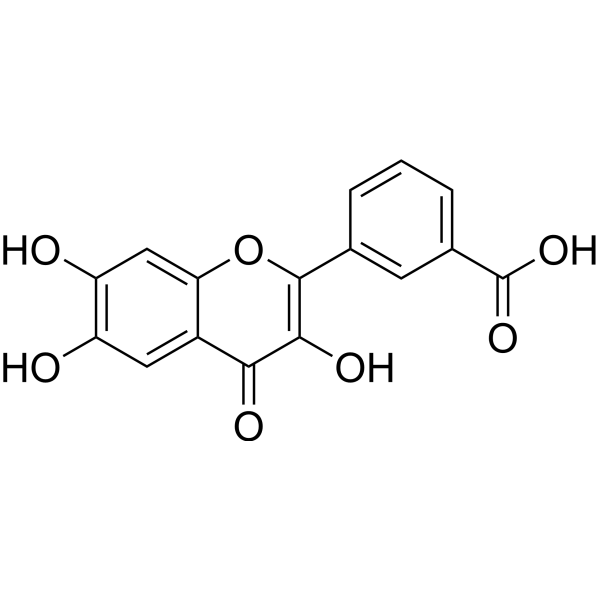
IP6K2-IN-1 is a selective flavonoid-based IP6K2 inhibitor with an IC50 value of 0.55 μM . IP6K2-IN-1 shows higher inhibitory potency against IP6K2 than IP6K1 and IP6K3. IP6K2-IN-1 can be utilised as a hit compound for further structural modifications of IP6K2 inhibitors .
loading...
    loading...
Cat. No.: HY-134902A
Synonyms: UDP-α-6N3-glucose disodium; 6-Azidoglucose-UDP disodium
UDP-6-azido-6-Deoxy-D-Glc disodium (UDP-α-6N3-glucose; 6-Azidoglucose-UDP disodium) is a UDP-sugar donor . UDP-6-azido-6-Deoxy-D-Glc disodium is used for the selective labeling of 5-hmC in genomic DNA. UDP-6-azido-6-Deoxy-D-Glc disodium enables glyco-diversification modification of saponin intermediates and click chemistry-based derivatization .
loading...
    loading...
Cat. No.: HY-L105S
867 compounds

Peptides, composed of amino acids, serve as crucial building blocks for proteins and have gained significant attention in drug development over the past decade. The advancements in production, modification, and analytical technologies have led to a surge in the potential applications of peptides in medicine. Peptides offer a number of advantages over small molecule drugs, including: greater target specificity and efficacy, more predictable metabolic profiles, easier delivery to where they are needed in the body, and fewer side effects. Peptides are increasingly appearing in all branches of medicine as components of innovative drugs, imaging agents, diagnostic agents, and other complex drugs such as peptide-drug conjugates. To date, more than 80 peptide drugs have been approved to treat a variety of diseases, including microbial infections, obesity, anti-diabetes, and cancer, as well as to develop cell targeting platforms and improve cell penetration properties.

MCE designs a unique collection of 867 peptide compounds. HY-L105S is a peptide compound library that can be provided with solution form based on HY-L105, and can be applied to peptides-based drug development.

Cat. No.: HY-L901
50,000 compounds

MCE 50K Diversity Library consists of 50,000 lead-like compounds with multiple characteristics such as calculated good solubility (-3.2 < logP < 5), oral bioavailability (RotB <= 10), drug transportability (PSA < 120). These compounds were selected by dissimilarity search with an average Tanimoto Coefficient of 0.52. There are 36,857 unique scaffolds and each scaffold 1 to 7 compounds. What’s more, compounds with the same scaffold have as many functional groups as possible, which make abundant chemical spaces. This exceptionally diverse library is highly recommended for random screening against new as well as popular targets based its novel, diverse scaffolds, abundant chemical spaces and the convenience for subsequent modification.

Cat. No.: HY-112817A
Synonyms: 8-Oxo-Deoxyguanosine triphosphate trisodium
Target:  

Apoptosis

Research Areas:  

Others

8-Oxo-dGTP (8-Oxo-Deoxyguanosine triphosphate) trisodium solution (100mM) is an oxidized guanine nucleotide formed by ROS-mediated oxidative modification of dGTP, and it also serves as a key substrate for 8-oxo-dGTP pyrophosphohydrolases (such as hMTH1 and E. coli MutT). 8-Oxo-dGTP trisodium solution (100mM) acts as a DNA mutagen, inserts into nascent DNA and pairs with adenine and cytosine, inducing A:T to C:G transversion mutations. Furthermore, 8-Oxo-dGTP trisodium solution (100mM) causes oxidative DNA base modification, strand breakage and S-phase arrest, and ultimately triggers AIF-mediated apoptosis and promotes spontaneous carcinogenesis in mth1-deficient mice. Accumulation of 8-Oxo-dGTP trisodium solution (100mM) in cells induces genomic instability, but it exhibits a tumor-suppressive effect that reduces tumor incidence in mouse models instead. 8-Oxo-dGTP trisodium solution (100mM) is widely used in studies related to spontaneous carcinogenesis, Parkinson's disease, Alzheimer's disease, heart failure and tumor mechanisms .
loading...
    loading...

