
1041 Results for "

detection

" in MedChemExpress (MCE) Product Catalog:
Products (1041)

1041 Results for "detection" in MCE Product Catalog:

Cat. No.: HY-D3124
Target:  

Fluorescent Dye

Research Areas:  

Others

Gol-SiRhoNox is a Golgi apparatus-targeted fluorescent probe with high selectivity for Fe (II), with a limit of detection of 50 nM. Gol-SiRhoNox integrates a myristoyl motif for Golgi apparatus targeting and a silicon-fused rhodamine N-oxide as the Fe (II)-sensitive moiety. Gol-SiRhoNox is non-fluorescent in its native state; Fe (II)-mediated deoxygenation of the N-oxide triggers fluorescence recovery. Its fluorescent product, Gol-SiR, has excitation/emission wavelengths of 630/665 nm and a maximum absorption wavelength of 655 nm .
loading...
    loading...
Cat. No.: HY-D3136
Target:  

Fluorescent Dye

Research Areas:  

Cancer

MC-PSE is a fluorescent probe that can be used for glutathione (GSH) detection, NIR-II fluorescence imaging and ratiometric photoacoustic imaging. MC-PSE spontaneously forms J-aggregates in aqueous solution through π-π stacking, and its phenylselenyl group acts as a fluorescence quencher and GSH recognition receptor, thereby eliminating intrinsic fluorescence and generating a maximum absorption peak at 1000 nm. The excitation/emission wavelengths of MC-PSE are Ex = 808 nm and Em = 940 nm. MC-PSE can be applied in tumor-related research .
loading...
    loading...
Cat. No.: HY-D3269
CAS No.: 2088127-60-8
Mito-Cu (II) is a mitochondria-targeted fluorescent probe (Ex/Em = 370/450 nM). Mito-Cu (II) specifically accumulates in mitochondria of living cells and enables real-time detection of exogenous Cu 2+ within mitochondria of living cells. Mito-Cu (II) achieves "on-off-on" fluorescence switching through sequential exposure to Cu 2+ and ethylenediaminetetraacetic acid (EDTA) (HY-Y0682). Its fluorescence is quenched after forming a 1:1 complex with Cu 2+, and the fluorescence recovers when Cu 2+ is chelated by EDTA .
loading...
    loading...
Cat. No.: HY-D3405
CAS No.: 173357-16-9
BO-TAP-3 is an orange fluorescent carbocyanine monomer dye, and it is also a cell impermeable nucleic acid staining agent. When there is no nucleic acid present, BO-TAP-3 shows a non-fluorescent state. However, when it binds to double-stranded DNA, it exhibits multiple fluorescence enhancement effects. BO-TAP-3 can be used for cell nucleus and cytoplasm imaging, bacterial and sperm labeling, and can also be applied in nucleic acid detection and amplification research. It can also be used as a temperature sensor (Ex/Em = 564/600 nM).
loading...
    loading...
Cat. No.: HY-DY1019
CAS No.: 186689-07-6
2-NBDG (solution) is a fluorescently-labeled deoxyglucose analog that is used primarily to directly monitor glucose uptake by living cells and tissues. It is also used as a topical contrast reagent for the detection of neoplasia. 2-NBDG can be used in real-time confocal, high-resolution, or wide-field fluorescence microscopy as well as in flow cytometry. The probe can be excited by the Argon laser at 488 nm to give the environment-sensitive fluorescence. It has lower photostability than the rhodamine-based fluorescent probes.
Solvent and Concentration: Sterile PBS: 5 mM
loading...
    loading...
Cat. No.: HY-DY1053
CAS No.: 5471-63-6
1,3-Diphenylisobenzofuran (DPBF) (solution) has been developed as a selective probe for the detection and quantitative determination of hydrogen peroxide in samples containing different reactive nitrogen and oxygen species (RNOS). DPBF is a fluorescent probe which, for almost 20 years, was believed to react in a highly specific manner toward some reactive oxygen species such as singlet oxygen and hydroxy, alkyloxy or alkylperoxy radicals .
Solvent and concentration: DMSO: 10 mM
The 1 mL volume is defined as the base specification. All larger sizes correspond to incremental volumes of this base.
loading...
    loading...
Cat. No.: HY-N22000
CAS No.: 14379-32-9
N-Stearoyl valine is an N-acyl derivative of valine. N-Stearoyl valine antagonizes intracellular calcium mobilization by binding to the TRPV3 channel as a bioactive endogenous ligand of transient receptor potential (TRP) channels. N-Stearoyl valine participates in physiological processes such as lipid metabolism and cell signal transduction as an endogenous metabolite. N-Stearoyl valine is also a flavor compound. N-Stearoyl valine can be used in research on biomarker detection, animal nutrition and amino acid metabolism, and the development of the food and beverage industry .
loading...
    loading...
Cat. No.: HY-P3818
CAS No.: 813416-46-5
Target:  

PKC

Research Areas:  

Others

PKCδ Peptide Substrate is a highly selective peptide substrate targeting PKCδ. PKCδ Peptide Substrate can only be efficiently catalyzed for phosphorylation modification by PKCδ, and Thr431 is the sole phosphorylation site. PKCδ Peptide Substrate binds to the catalytic pocket of PKC in a competitive manner, but exhibits no PKC agonistic or inhibitory activity. PKCδ Peptide Substrate is a dedicated biochemical probe for the quantitative detection of PKCδ in vitro, and can be used for studies on PKCδ-related pathways .
loading...
    loading...
Cat. No.: HY-P3818A
Target:  

PKC

Research Areas:  

Others

PKCδ Peptide Substrate acetate is a highly selective peptide substrate targeting PKCδ. PKCδ Peptide Substrate acetate can only be efficiently catalyzed for phosphorylation modification by PKCδ, and Thr431 is the sole phosphorylation site. PKCδ Peptide Substrate acetate binds to the catalytic pocket of PKC in a competitive manner, but exhibits no PKC agonistic or inhibitory activity. PKCδ Peptide Substrate acetate is a dedicated biochemical probe for the quantitative detection of PKCδ in vitro, and can be used for studies on PKCδ-related pathways .
loading...
    loading...
Cat. No.: HY-P990274

Research Areas:  

Others

Anti-Canine CD34 Antibody (1H6) is a mouse-derived IgG1 κ type antibody inhibitor, targeting to canine CD34. Anti-Canine CD34 Antibody (1H6) reacts with canine CD34. Anti-Canine CD34 Antibody (1H6) can be used for the separation and identification of CD34 + cells. Anti-Canine CD34 Antibody (1H6) can be used for detections of western blot, immunohistochemistry and flow cytometry .
loading...
    loading...
Cat. No.: HY-P990303

Research Areas:  

Others

Anti-Mouse 2C TCR Antibody (1B2) is a mouse-derived IgG1 type antibody inhibitor, targeting to mouse 2C TCR. Anti-Mouse 2C TCR Antibody (1B2) recognizes determinants on the variable regions of both the α and β subunits of the TCR (T cell receptor) expressed by the mouse cytotoxic T lymphocyte clone 2C. Anti-Mouse 2C TCR Antibody (1B2) can be used for the detections of immunofluorescence and flow cytometry .
loading...
    loading...
Cat. No.: HY-W127711
CAS No.: 14263-94-6
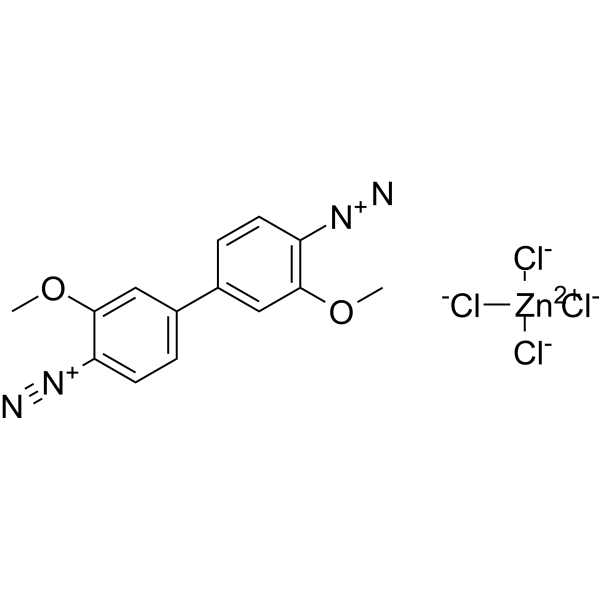
Fast Blue B Salt, Dye content ~95% is a diazo dye, primarily used as a chromogenic substrate in biochemical analysis. Fast Blue B Salt, Dye content ~95% is the coupling agent for the histochemical demonstration of proteases. Fast Blue B Salt, Dye content ~95% can be used for the detection of acid phosphatase in Clostridium perfringens, and also for the determination of lipase activity. Fast Blue B Salt, Dye content ~95% reacts directly with the active hydroxyl groups in phenolic compounds to determine the content of phenolic substances .
loading...
    loading...
Cat. No.: HY-W150770
CAS No.: 1740-57-4
Synonyms: Isophthalic acid diamide
Target:  

Drug Intermediate

Research Areas:  

Others

Isophthalamide (Isophthalic acid diamide) is a widely used chemical scaffold for the design of high-performance fluorescent chemosensors.Isophthalamide, with its inherent hydrogen-bond-donating properties and tunable chelating cavity, enables highly selective recognition and detection of various analytes ranging from inorganic ions to complex organic molecules.Isophthalamide can be incorporated with various fluorophores to develop sensors displaying “turn-on” or “turn-off” signal responses.Isophthalamide-based sensors are thus capable of detecting diverse analytes including metal ions, anions, neutral molecules, pharmaceuticals, and explosives .
loading...
    loading...
Cat. No.: HY-W612175
CAS No.: 1668-13-9
Target:  

Leukotriene Receptor

Research Areas:  

Others

H-Ala-pNA is an L-amino acid p-nitroaniline (pNA) derivative and a specific substrate for leukotriene A4 hydrolase. The D-enantiomer of H-Ala-pNA shows no activity toward leukotriene A4 hydrolase. H-Ala-pNA can be catalytically hydrolyzed by leukotriene A4 hydrolase, and the p-nitroaniline produced during the reaction is monitored spectrophotometrically at 405 nm to enable quantitative detection of enzyme activity. H-Ala-pNA is used to evaluate the potency of inhibitors targeting the amidase activity of leukotriene A4 hydrolase .
loading...
    loading...
Cat. No.: HY-W800694
CAS No.: 2006335-63-1
BP Fluor 405 alkyne triTEA is a blue-fluorescent dye that often used in multi-color applications, including flow cytometry and super-resolution microscopy using STORM. Its excitation is ideally suited for the 407 nm spectral line of the krypton laser or the 408 nm violet laser diode. BP Fluor 405 alkyne triTEA reacts with azides via a copper-catalyzed click reaction (CuAAC) to form a stable triazole linker. A probe for copper-less detection (BP Fluor 405 DBCO) is also available for application where the presence of copper is not acceptable.
loading...
    loading...
Cat. No.: HY-W800838
CAS No.: 1466419-80-6
BP Fluor 488 Tetrazine is a bright, green-fluorescent probe used for detection TCO-tagged biopolymers. BP Fluor 488 Tetrazine demonstrates exceptionally fast cycloaddition kinetics (up to 30 000 M-1 s-1) with trans-cyclooctenes (TCO) as the dienophile, the fastest kinetics ever reported for any bioorthogonal reaction. In applications such as in vivo cancer imaging or pre?targeted cell labeling studies where rapid reaction kinetics is a must BP Fluor 488 Tetrazine probe would of great value.
loading...
    loading...
Cat. No.: HY-Y1134R
CAS No.: 147-71-7
Synonyms: D-(-)-Tartaric acid (Standard)
D-Tartaric acid (Standard) is the analytical standard of D-Tartaric acid (HY-Y1134). This product is intended for research and analytical applications. D-Tartaric acid (D-(-)-Tartaric acid) serves as an additive in beverages and other food products. When combined with pyrrole, D-Tartaric acid is used to construct a D-TA/polypyrrole-based bacterial imprinted polymer sensor for the detection of Vibrio parahaemolyticus. D-Tartaric acid enhances the sensitivity of polypyrrole-based bacterial imprinted polymer sensors for detecting Vibrio parahaemolyticus. D-Tartaric acid is applicable to research on Vibrio parahaemolyticus infection .
loading...
    loading...
Cat. No.: HY-111391AR
CAS No.: 62758-13-8
Synonyms: Diazoresorcinol sodium, indicator (Standard)
Research Areas:  

Others

Resazurin (sodium), indicator (Standard) is the analytical standard of Resazurin (sodium), indicator (HY-111391A). This product is intended for research and analytical applications. Resazurin (Diazoresorcinol) sodium, indicator is a non-toxic, stable, membrane-permeable blue non-fluorescent dye (faintly fluorescent). Resazurin sodium, indicator is used as a redox indicator, can be reduced to pink, highly fluorescent Resorufin (Ex=530-560 nm, Em=590 nm) in living cells. Resazurin sodium, indicator can be used for the detection of cell viability, toxicity, proliferation, migration and invasion in cells (human, plant and animal, bacterial and fungal) .
loading...
    loading...
Cat. No.: HY-137557
CAS No.: 1565797-16-1
Synonyms: APN1607; PM-PBB3
Target:  

Tau Protein

Research Areas:  

Neurological Disease

Florzolotau (APN1607) is a positron emission tomography (PET) ligand that can be used for the detection of Alzheimer's disease (AD) and other tau proteinopathies. Its binding sites are located in the β-sheet of paired helical filaments (PHFs) and straight filaments (SFs) of tau protein, as well as in the C-shaped cavity of SFs. In addition, APN-1607 binds to intraneuronal inclusions in Alzheimer's disease (AD), primary age-related tauopathy (PART) and posterior cortical atrophy (PCA). Florzolotau shows promise for PET imaging studies of neurological disorders, particularly tau proteinopathies .
loading...
    loading...
Cat. No.: HY-141667
CAS No.: 33984-50-8
Purity:  98.93%
Synonyms: 7-(p-Methoxybenzylamino)-4-nitrobenz-2,1,3-oxadiazole
Target:  

Fluorescent Dye

Research Areas:  

Others

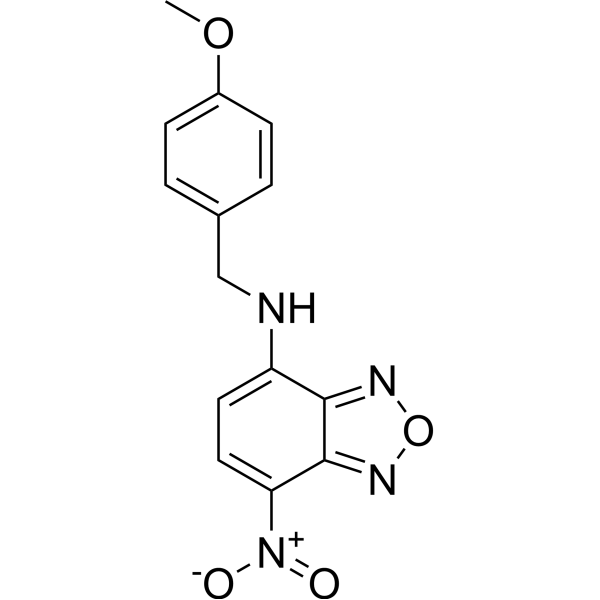
MBD (7-(p-Methoxybenzylamino)-4-nitrobenz-2,1,3-oxadiazole) is a hydrophobic fluorescent probe that is used to detect conformational changes of the complement subcomponent C1r during its autoactivation process. MBD acts by selectively binding to exposed hydrophobic regions on the C1r macromolecule. The detection wavelength of MBD in the free unbound state is Ex/Em = 490/560 nm, whereas the maximum emission wavelength of MBD upon binding to C1r exhibits a blue shift of approximately 20 nm relative to 560 nm .
loading...
    loading...

