1088 Results for "

staphylococcus

" in MedChemExpress (MCE) Product Catalog:
Products (1088)

1088 Results for "staphylococcus" in MCE Product Catalog:

Cat. No.: HY-N20707
CAS No.: 24312-00-3
Castalagin is an orally active natural product with multiple biological activities including antibacterial activity against bacteria and anti-leishmanial activity against Leishmania aethiopica. Castalagin exhibits inhibitory activity against PARP1 and DNA topoisomerase II, with an IC50 of 0.86 μM for bovine PARP1. Castalagin reduces poly (ADP-ribosyl) ation modification in cells. Castalagin binds to the cell envelope of Ruminococcus bromii, increases the ratio of CD8+/FOXP3+CD4+ T cells in the tumor microenvironment, and acts as a prebiotic to enhance the activity of anti-PD-1 therapy. Castalagin induces morphological changes in Leishmania aethiopica promastigotes and inhibits their proliferation. Castalagin inhibits PBP2a-mediated peptidoglycan layer stabilization, disrupts bacterial peptidoglycan assembly, and inhibits and disintegrates bacterial biofilms. Castalagin can be used in research related to diseases such as cancer, leishmaniasis, and bacterial infections .
loading...
    loading...
Cat. No.: HY-N8411
CAS No.: 489-39-4
Synonyms: (+)-Aromadendrene
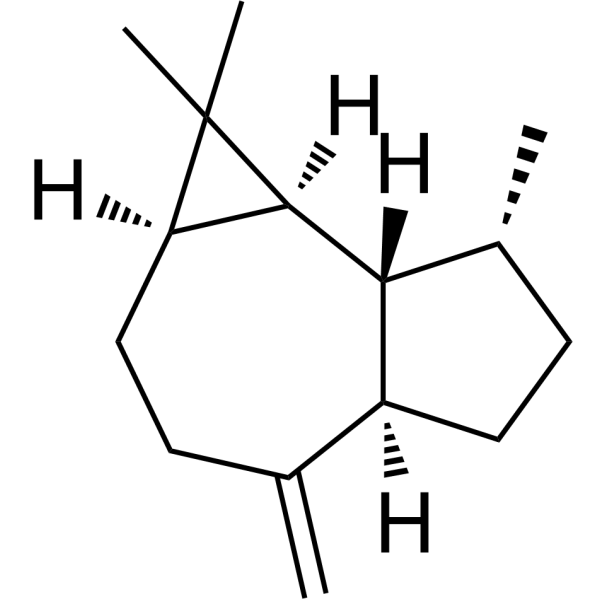
Aromadendrene ((+)-Aromadendrene) is a potent antibacterial agent. Aromadendrene can be isolated from Eucalyptus globulus. Aromadendrene disrupts cellular biofilms via high lipophilicity and interferes with protein conformation through protein alkylation. Aromadendrene is applicable to research related to multidrug-resistant bacterial infections .
loading...
    loading...
Cat. No.: HY-N8411R
CAS No.: 489-39-4
Synonyms: (+)-Aromadendrene (Standard)
Aromadendrene (Standard) ((+)-Aromadendrene (Standard)) is the analytical standard of Aromadendrene (HY-N8411). This product is intended for research and analytical applications. Aromadendrene ((+)-Aromadendrene) is a potent antibacterial agent. Aromadendrene can be isolated from Eucalyptus globulus. Aromadendrene disrupts cellular biofilms via high lipophilicity and interferes with protein conformation through protein alkylation. Aromadendrene is applicable to research related to multidrug-resistant bacterial infections .
loading...
    loading...
Cat. No.: HY-P10633
CAS No.: 1628913-44-9
Research Areas:  

Others

SmBiT Tag is an 11-amino-acid short peptide with extremely low natural affinity for LgBiT, with a Kd value of approximately 190 μM. It serves as a core component of the NanoLuc Binary Technology (NanoBiT) system. NanoBiT is a bioluminescent reporter system based on protein fragment complementation technology, which is used to monitor dynamic protein-protein interactions in live cells and in vitro .
loading...
    loading...
Cat. No.: HY-W001963
CAS No.: 634-97-9
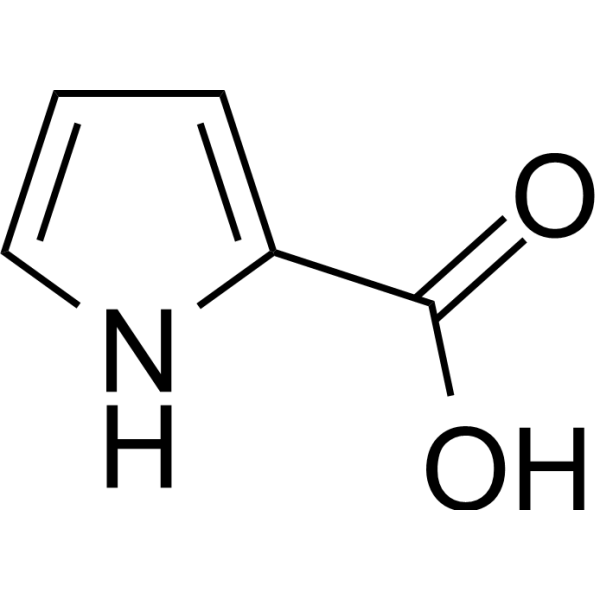
Pyrrole-2-carboxylic acid is a natural alkaloid foumd in the marine bacterium Pelomonas puraquae sp. Nov. Pyrrole-2-carboxylic acid shows antibacterial activity and inhibits biofilm formation. Pyrrole-2-carboxylic acid serves as a precursor for various pyrrole derivatives like Clorobiocin (HY-123515), Coumermycin A1 (HY-N7452) in biosynthetic processes .
loading...
    loading...
Cat. No.: HY-W010989
CAS No.: 72957-37-0
Gly-His-Lys acetate is a natural, circulating regulatory and antimicrobial tripeptide derived from extracellular matrix proteins. Gly-His-Lys acetate binds Cu 2+ to support copper enzyme activation, antioxidant processes, cellular bioenergetics, and the synthesis of elastin, collagen and catecholamines. Gly-His-Lys acetate regulates cell growth, differentiation and tissue repair, and exerts regenerative, anxiolytic, anti-inflammatory, analgesic and immunosuppressive activities. Gly-His-Lys acetate induces liver degenerative changes. Gly-His-Lys acetate can be used for the research of infections, anxiety, pain-related behaviors and immune-associated liver diseases .
loading...
    loading...
Cat. No.: HY-W014141
CAS No.: 15042-01-0
Synonyms: L-Ascorbic acid 5,6-acetonide
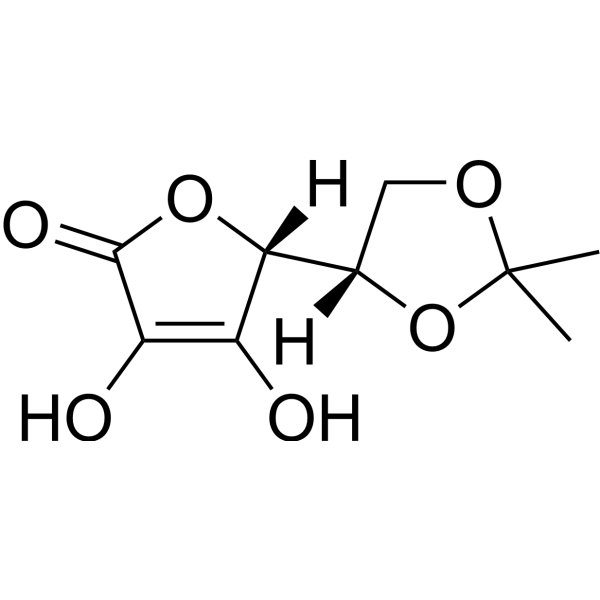
5,6-O-Isopropylidene-L-ascorbic acid (L-Ascorbic acid 5,6-acetonide) is an organic compound and a derivative of L-ascorbic acid (vitamin C). 5,6-O-Isopropylidene-L-ascorbic acid inhibits biofilm formation by pathogenic bacteria. 5,6-O-Isopropylidene-L-ascorbic acid is applicable to studies related to bacterial infections .
loading...
    loading...
Cat. No.: HY-W047709
CAS No.: 140-07-8
Synonyms: THEED; THEEN
Research Areas:  

Infection Cancer

N,N,N',N'-Tetrakis(2-hydroxyethyl)ethylenediamine (THEED; THEEN) is a tetrapodal pentadentate chelating ligand that functions as a chelator to form stable complexes with metal ions. N,N,N',N'-Tetrakis(2-hydroxyethyl)ethylenediamine serves as a versatile building block for organic synthesis, a reagent for metal extraction, and an auxiliary for catalytic reactions. N,N,N',N'-Tetrakis(2-hydroxyethyl)ethylenediamine-derived metal complexes exhibit antibacterial, antifungal, and anticancer activities. N,N,N',N'-Tetrakis(2-hydroxyethyl)ethylenediamine and its metal complexes can be used for research related to breast cancer, leukemia, various bacterial and fungal infections .
loading...
    loading...
Cat. No.: HY-W237019
CAS No.: 55836-69-6
Target:  

Bacterial

Research Areas:  

Infection

3-Ethoxybenzamide is an alkoxybenzamide compound with antibacterial activity and a FtsZ inhibitor that can cross the blood-brain barrier. 3-Ethoxybenzamide distributes widely and rapidly in vivo, rapidly reaches equilibrium between various tissues and blood, and is linearly taken up by hepatocytes. 3-Ethoxybenzamide is completely dependent on hepatic microsomal oxidation for clearance, with salicylamide as its major metabolite. 3-Ethoxybenzamide can be used for the study of bacterial infections .
loading...
    loading...
Cat. No.: HY-W243303C
CAS No.: 9003-01-4
Poly (acrylic acid) (MW 4000000) is an anionic polyacrylic acid. Poly (acrylic acid) (MW 4000000) acts as a corrosion inhibitor and surface stabilizer. Poly (acrylic acid) (MW 4000000) serves as a biomaterial or organic compound for life science research .
loading...
    loading...
Cat. No.: HY-117150
CAS No.: 22868-35-5
Target:  

Bacterial Fungal

Research Areas:  

Infection

2-(3-Chlorophenyl)-1H-benzo[d]imidazole is an antibacterial agent. 2-(3-Chlorophenyl)-1H-benzo[d]imidazole can be used in the research of bacterial infections and fungal infections .
loading...
    loading...
Cat. No.: HY-118773
CAS No.: 22816-60-0
Purity:  99.3%
Synonyms: A22 hydrochloride
Target:  

Bacterial

Research Areas:  

Infection

MreB Perturbing Compound A22 hydrochloride (A22 hydrochloride) is a reversible MreB inhibitor and antimicrobial agent that exhibits bacteriostatic activity against Escherichia coli, with low activity against Gram-positive bacteria. MreB Perturbing Compound A22 hydrochloride rapidly and reversally delocalizes MreB from the helical/circular structures in cells, impairs MreB function, and reduces the binding of MreB to the chromosomal region proximal to the replication origin. MreB Perturbing Compound A22 hydrochloride alters the cell morphology of caulobacters to round/lemon-shaped, slows caulobacter growth, blocks their cell division, and induces the formation of spherical morphology, asymmetric division, and anucleate cells in Escherichia coli. MreB Perturbing Compound A22 hydrochloride is used for studies related to bacterial rod-shaped morphology determination, chromosome segregation, and cell division mechanisms .
loading...
    loading...
Cat. No.: HY-126926
CAS No.: 36408-16-9
Synonyms: 5-Deazaflavin mononucleotide
Research Areas:  

Others

5-Deaza-FMN (5-Deazaflavin mononucleotide) is a binder of type II isopentenyl diphosphate: dimethylallyl diphosphate isomerase (IDI-2) with a Kd value of 16 μM. 5-Deaza-FMN acts as a radical generator, forming radicals through photoinduced single-electron transfer of tryptophan. 5-Deaza-FMN finds applications in biocatalysis and photocatalysis .
loading...
    loading...
Cat. No.: HY-141633
CAS No.: 25339-99-5
Purity:  ≥97.0%
Sucrose monolaurate is a glycolipid surfactant . Sucrose monolaurate interacts with bacterial DNA, disrupts cell membrane permeability, and exerts excellent inhibitory and bactericidal effects against a variety of foodborne pathogens (especially Gram-positive bacteria). Sucrose monolaurate significantly reduces liquid surface tension, and acts as a synergist for chlorine-based disinfectants in food cleaning and disinfection to improve the removal efficiency of pathogens on the surface of agricultural products .
loading...
    loading...
Cat. No.: HY-160821A
CAS No.: 335275-62-2
Synonyms: ManNAc-6P sodium salt
Target:  

Endogenous Metabolite

Research Areas:  

Others

N-Acetylmannosamine 6-phosphate sodium salt is a NanR modulator and an intermediate in the sialic acid pathway. N-Acetylmannosamine 6-phosphate sodium salt disrupts the binding of NanR to the promoter regions of nanAT and nanE, and prevents NanR-mediated transcriptional repression of these loci. N-Acetylmannosamine 6-phosphate sodium salt acts as a key precursor for sialic acid biosynthesis, participating in this process via Neu5Ac-9-P synthase. N-Acetylmannosamine 6-phosphate sodium salt can be used in research related to GNE myopathy .
loading...
    loading...
Cat. No.: HY-184081
CAS No.: 5118-17-2
Target:  

Bacterial

Research Areas:  

Infection

Furazolium hydrochloride is a broad-spectrum antibacterial agent with inhibitory activity against a variety of Gram-positive and Gram-negative Bacterial strains. In a gelatin-acacia complex coacervate system, Furazolium hydrochloride exhibits protein-binding properties, where protein binding dominates at low concentrations, while micellization occurs at high concentrations. Furazolium hydrochloride does not alter the water permeability of cellulose membranes, and it can induce delayed-type hypersensitivity reactions in guinea pigs, with cross-reactivity observed in animals sensitized with aflatoxin B1. Furazolium hydrochloride can be used in studies related to bacterial infections and local wound infections .
loading...
    loading...
Cat. No.: HY-B1387
CAS No.: 80-35-3
Target:  

Antibiotic Bacterial

Research Areas:  

Inflammation/Immunology

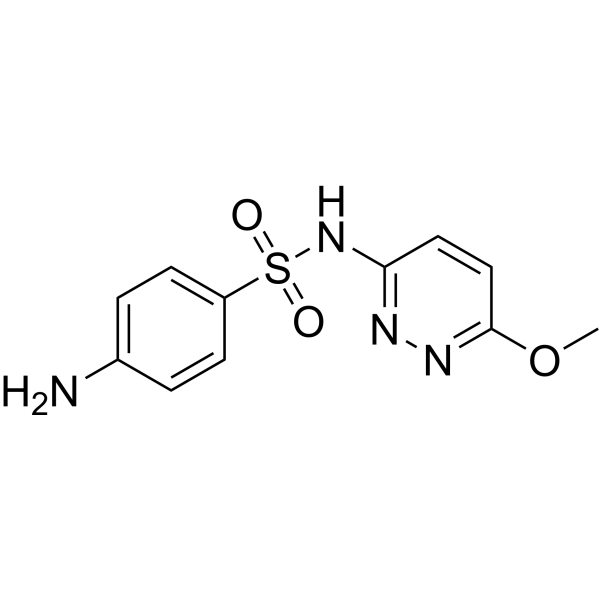
Sulfamethoxypyridazine is an orally active and brain-penetrant sulfonamide antibiotic. Sulfamethoxypyridazine exhibits antibacterial activity and inhibits growth of susceptible bacterial strains. Sulfamethoxypyridazine can be used for the research of pyelonephritis, urinary tract infections, and dermatitis herpetiformis .
loading...
    loading...
Cat. No.: HY-B1387R
CAS No.: 80-35-3
Research Areas:  

Infection

Sulfamethoxypyridazine (Standard) is the analytical standard of Sulfamethoxypyridazine. This product is intended for research and analytical applications. Sulfamethoxypyridazine is an orally active and brain-penetrant sulfonamide antibiotic. Sulfamethoxypyridazine exhibits antibacterial activity and inhibits growth of susceptible bacterial strains. Sulfamethoxypyridazine can be used for the research of pyelonephritis, urinary tract infections, and dermatitis herpetiformis .
loading...
    loading...
Cat. No.: HY-B1387S1
CAS No.: 1172846-03-5
Research Areas:  

Infection

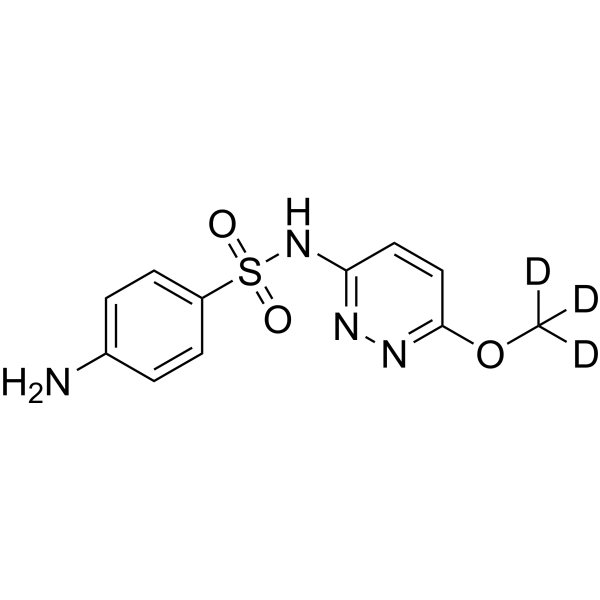
Sulfamethoxypyridazine-d3 is the deuterium-labeled Sulfamethoxypyridazine (HY-B1387) . Sulfamethoxypyridazine is an orally active and brain-penetrant sulfonamide antibiotic. Sulfamethoxypyridazine exhibits antibacterial activity and inhibits growth of susceptible bacterial strains. Sulfamethoxypyridazine can be used for the research of pyelonephritis, urinary tract infections, and dermatitis herpetiformis .
loading...
    loading...
Cat. No.: HY-N19666
CAS No.: 1820968-26-0
2-Hexylglutaconic acid is a 2-Pentenedioic acid (HY-W073501A) derivative found in the soil-derived fungus Gongronella butleri. 2-Pentenedioic acid is a chemical building block in synthesis, with research applications focusing on metabolic studies .
loading...
    loading...