130 Results for "

kinetics

" in MedChemExpress (MCE) Product Catalog:
Products (130)

130 Results for "kinetics" in MCE Product Catalog:

Cat. No.: HY-P11855
CAS No.: 557064-55-8
Target:  

Inhibitory Antibodies

Research Areas:  

Others

AG3 is an inorganic-binding polypeptide that specifically recognizes Ag/Au surfaces . In silver systems, AG3 induces the reduction of Ag + and regulates microcrystal morphology . In gold systems, AG3 acts as a non-reducing, high-affinity inhibitor that modulates nucleation-growth kinetics through interactions with metal clusters/surfaces to achieve size/morphology control . AG3 can be immobilized on polymer films, phages or nanosubstrates for applications in biomimetic mineralization, biosensors, precious metal recovery and patterned graphite templates .
loading...
    loading...
Cat. No.: HY-136995
CAS No.: 99465-44-8
Target:  

Sodium Channel

Research Areas:  

Cardiovascular Disease

AFD-21 maleate is a drug with antiarrhythmic activity. AFD-21 maleate inhibits sodium channels by binding to sodium channels in an inactive state, with both use-dependent and voltage-dependent effects. The unbinding rate of AFD-21 maleate is similar to that of Class I antiarrhythmic drugs with moderate kinetics. AFD-21 maleate can cause a slight prolongation of the action potential duration and significantly reduce the maximum rise rate of the action potential at certain concentrations. AFD-21 maleate also showed use-dependent blocking effects as stimulation frequency increased .
loading...
    loading...
Cat. No.: HY-131691
CAS No.: 76991-05-4
Target:  

iGluR Calcium Channel

Research Areas:  

Neurological Disease

NMDAR blocker 1 is an NMDA receptor channel blocker with an IC50 of 5.0 μM. NMDAR blocker 1 exhibits fast on-off blockade kinetics and strong voltage dependence, and does not compete with glutamate or glycine. NMDAR blocker 1 prevents glutamate/NMDA-induced intracellular Ca 2+ overload, modulates the glutamate-nitric oxide-cGMP pathway. NMDAR blocker 1 prevents in vitro excitotoxic neurodegeneration of cultured cerebellar and hippocampal neurons. NMDAR blocker 1 attenuates excitotoxic insult in an mouse model of hyperammonemia-induced excitotoxicity. NMDAR blocker 1 can be used for the research of neurodegenerative diseases .
loading...
    loading...
Cat. No.: HY-D3480
BeRST voltage sensitive dye is a silicon-rhodamine-based voltage-sensitive dye that serves as a membrane potential indicator, featuring fast response kinetics, high sensitivity, photostability, and excellent signal-to-noise ratio. BeRST voltage sensitive dye relies on the photoinduced electron transfer (PeT) mechanism to report changes in neuronal membrane potential via fluorescent signals. BeRST voltage sensitive dye localizes to the extracellular surface of neuronal plasma membranes, including cell bodies and neurites. BeRST voltage sensitive dye can be used in studies related to Alzheimer's disease (Ex/Em = 658/683 nm) .
loading...
    loading...
Cat. No.: HY-106432A
CAS No.: 159912-58-0
Purity:  99.86%
Synonyms: SB-202026 hydrochloride; Memric hydrochloride
Target:  

mAChR Dopamine Receptor

Research Areas:  

Neurological Disease

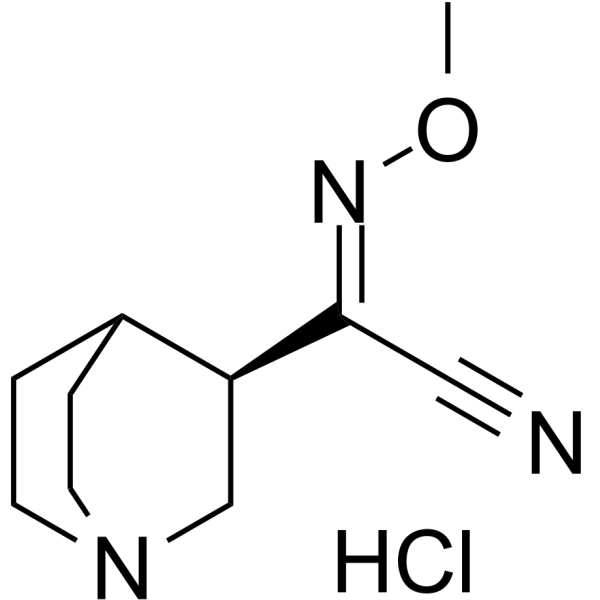
Sabcomeline (SB-202026; Memric) hydrochloride is a muscarinic receptor agonist capable of crossing the blood-brain barrier. Sabcomeline hydrochloride exhibits affinity for all hM1 to hM5 subtypes (pKi=6.72-7.23), and shows near-full agonism at the hM3 receptor, inducing extracellular acidification. Sabcomeline hydrochloride alters the binding kinetics of dopamine D2 receptors through neural network regulation. Sabcomeline hydrochloride also causes minimal cardiovascular changes, effectively reverses spatial memory deficits in rodents and induces conditioned taste aversion. Sabcomeline hydrochloride is an important tool compound in studies of Alzheimer's disease and related neurodegenerative diseases .
loading...
    loading...
Cat. No.: HY-113841
CAS No.: 107707-38-0
RS-87337 is an orally active piperazine-amidine hybrid class Ia (inhibiting Vmax, IC50 = 17 μM)/class III (prolonging ADP90, EC15 = 2 μM) antiarrhythmic agent with selectivity for ventricular conduction . RS-87337 inhibits cardiac sodium channel, thereby reducing the maximum depolarization rate of action potential, with moderate onset and recovery kinetics. RS-87337 reduces cardiac outward potassium conductance (I_K), thus prolonging action potential duration. RS-87337 is applicable to research related to arrhythmia, ventricular arrhythmia, ventricular fibrillation, and myocardial ischemia-reperfusion injury .
loading...
    loading...
Cat. No.: HY-115736
CAS No.: 6253-56-1
Synonyms: 5'-XTP
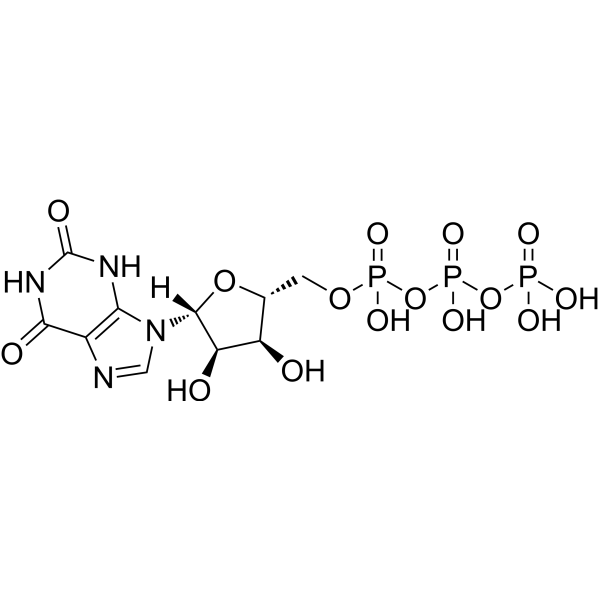
Xanthosine-5'-triphosphate (5'-XTP) is a purine nucleotide that stimulates Adenylate Cyclase to induce Cyclic AMP (cAMP) (HY-B1511) biosynthesis, binds to the AL1 allosteric site of the D137N-SAMHD1 mutant to activate dNTP triphosphohydrolase activity, and stimulates P2Y/P2U purinergic receptor-coupled phosphoinositide-specific phospholipase C with Michaelis-Menten kinetics. Xanthosine-5'-triphosphate can be used for HIV-1 research .
loading...
    loading...
Cat. No.: HY-126061
CAS No.: 33868-03-0
Purity:  99.82%
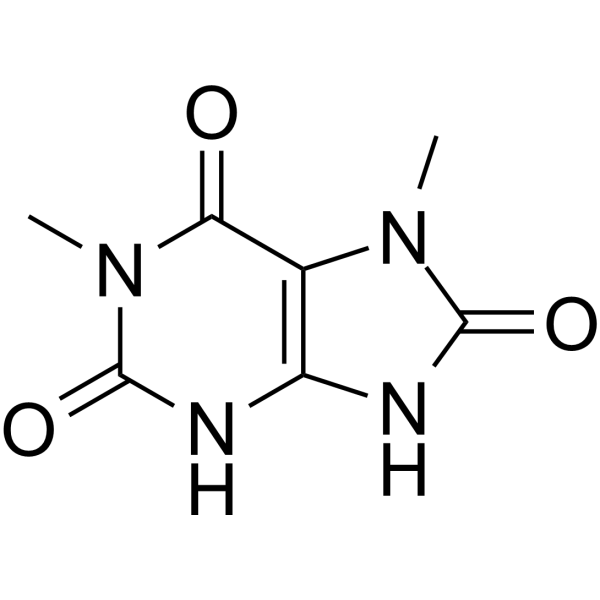
1,7-Dimethyluric acid is an N-methylated uric acid and purine derivative, as well as a caffeine metabolite. When 1,7-Dimethyluric acid is acted upon by peroxidase in the presence of H2O2, it follows the same oxidation pathway to generate a UV-absorbing intermediate, which decays via first-order kinetics. 1,7-Dimethyluric acid can adsorb onto pyrolytic graphite electrodes, but not onto glassy carbon electrodes or platinum electrodes. The N-methylation modification of its pyrimidine ring prevents ring contraction of the diol intermediate, and no NMR evidence of O-alkylation is observed during propylation under the test conditions .
loading...
    loading...
Cat. No.: HY-135541
CAS No.: 365462-24-4
Synonyms: YM150 maleate
Target:  

Endogenous Metabolite

Research Areas:  

Cardiovascular Disease

Darexaban maleate (YM150 maleate) is a direct factor Xa inhibitor with activity in preventing venous thromboembolism. The major metabolite of Darexaban maleate in humans is Darexaban glucitol, which acts pharmacologically. The glucitolation reaction of Darexaban maleate is mainly catalyzed by UGT1A9 and UGT1A10 in the human liver and intestine. The K(m) value of Darexaban maleate glucitolation in the liver is greater than 250 μM, while in the intestine it exhibits substrate inhibition kinetics with a K(m) value of 27.3 μM. The unbound K(m) value of Darexaban maleate is significantly reduced by the influence of fatty acid-free bovine serum albumin in both HLM and UGT1A9 .
loading...
    loading...
Cat. No.: HY-P1218B
Target:  

Sodium Channel

Research Areas:  

Neurological Disease

Phrixotoxin 3-NH2 TFA is a derivative of Phrixotoxin 3 TFA (HY-P1218A). Phrixotoxin 3 TFA is a potent blocker of voltage-gated sodium channels, with IC50s of 0.6, 42, 72, 288, 610 nM for NaV1.2, NaV1.3, NaV1.4, NaV1.1 and NaV1.5, respectively. Phrixotoxin 3 TFA modulates voltage-gated sodium channels with properties similar to those of typical gating-modifier toxins, both by causing a depolarizing shift in gating kinetics and by blocking the inward component of the sodium current .
loading...
    loading...
Cat. No.: HY-W011654
CAS No.: 5094-33-7
Synonyms: 4-Aminophenyl-beta-D-galactopyranoside, 98%
4-Aminophenyl-β-D-galactopyranoside, 98% is a highly efficient substrate for β-galactosidase. It is specifically hydrolyzed by this enzyme to release galactose and electroactive p-aminophenol. 4-Aminophenyl-β-D-galactopyranoside, 98% is widely used in colorimetric and electrochemical assays for detecting β-galactosidase activity and determining enzyme kinetics, such as in biosensing fields including cellular senescence, pathogen and contaminant detection. In addition, since β-galactosidase is often overexpressed in primary ovarian cancer, 4-Aminophenyl-β-D-galactopyranoside, 98% can also be applied to related research on primary ovarian cancer .
loading...
    loading...
Cat. No.: HY-100034R
CAS No.: 383907-43-5
Synonyms: DA-3003-1 (Standard)
NSC 663284 (Standard) is the analytical standard of NSC 663284 (HY-100034). This product is intended for research and analytical applications. NSC 663284 (DA-3003-1) is a potent, cell-permeable, and irreversible Cdc25 dual specificity phosphatase inhibitor, has an IC50 for Cdc25B2 of 0.21 μM. NSC 663284 exhibits mixed competitive kinetics against Cdc25A, Cdc25B(2), and Cdc25C with Ki values of 29, 95, and 89 nM, respectively . NSC 663284 inhibits NSD2 (IC50 of 170 nM) through a direct interaction with the catalytic SET domain (Kd of 370 nM) .
loading...
    loading...
Cat. No.: HY-100903R
CAS No.: 113158-34-2
Synonyms: nor-Binaltorphimine dihydrochloride (Standard); nor-BNI dihydrochloride (Standard)
Research Areas:  

Neurological Disease

Norbinaltorphimine dihydrochloride (Standard) is the analytical standard of Norbinaltorphimine dihydrochloride (HY-100903). This product is intended for research and analytical applications. Norbinaltorphimine dihydrochloride (nor-Binaltorphimine dihydrochloride; nor-BNI dihydrochloride) is a selective, long-acting competitive antagonist of the κ-opioid receptor. Norbinaltorphimine dihydrochloride blocks κ-opioid receptor-mediated analgesic effects, and inhibits butorphanol-induced changes in κ-opioid receptor binding kinetics, desensitization and down-regulation. Norbinaltorphimine dihydrochloride suppresses specific opioid withdrawal symptoms, precipitates withdrawal behaviors in butorphanol-dependent rats, and serves as a molecular probe for studying κ-opioid receptor-agonist interactions. Norbinaltorphimine dihydrochloride is applicable to research related to neurological disorders such as pain .
loading...
    loading...
Cat. No.: HY-115736B
CAS No.: 3056945-74-2
Synonyms: 5'-XTP lithium
Target:  

Adenylate Cyclase

Research Areas:  

Infection

Xanthosine-5'-triphosphate (5'-XTP) lithium is a purine nucleotide that stimulates Adenylate Cyclase to induce Cyclic AMP (cAMP) (HY-B1511) biosynthesis, binds to the AL1 allosteric site of the D137N-SAMHD1 mutant to activate dNTP triphosphohydrolase activity, and stimulates P2Y/P2U purinergic receptor-coupled phosphoinositide-specific phospholipase C with Michaelis-Menten kinetics. Xanthosine-5'-triphosphate lithium can be used for HIV-1 research .
loading...
    loading...
Cat. No.: HY-125533
CAS No.: 1404289-52-6
Target:  

Bacterial

Research Areas:  

Infection

TXA497 is a potent local topical bactericide. TXA497 exerts its bactericidal effect by interfering with the polymerization kinetics of the bacterial cell division protein FtsZ, rather than inhibiting it. TXA497 shows strong activity against various Staphylococcus aureus strains, including MRSA and MSSA, with an MIC value ranging from 1.0 to 2.0 μg/mL. TXA497 skin deposition is concentration-dependent in its formulation, consistent with Fick's first law. TXA497 has limited systemic permeability through the lipid pathway of the stratum corneum and is easily absorbed through this route. TXA497 can be used for research on topical bactericidal agents .
loading...
    loading...
Cat. No.: HY-173390
CAS No.: 2059099-03-3
Research Areas:  

Others

BCN-E-BCN is a strained cycloalkyne-based probe designed for detecting protein sulfenylation, the primary intermediate in protein oxidation. This structurally constrained cycloalkyne compound specifically recognizes sulfenic acid groups formed during thiol oxidation, while remaining completely unreactive toward other oxidative states (such as free thiols, sulfinic, or sulfonic acid groups). Researchers can leverage its efficient conjugation with azide-bearing tags through copper-free click chemistry to amplify detection signals. Compared to conventional detection methods, BCN-E-BCN demonstrates superior reaction kinetics and enhanced sensitivity. With these advantages, BCN-E-BCN shows great promise as an effective tool for protein oxidation research .
loading...
    loading...
Cat. No.: HY-181085
Target:  

DYRK

RD0448 is a potent inhibitor of DYRK1A, DYRK1B, and DYRK2. RD0448 selectively targets the non-native (folded intermediate) state of DYRK1A and DYRK1B. The binding site of RD0448 is hidden in the native state of DYRK1A and DYRK1B, and as a stabilizing binder, it binds tightly to both DYRK1A and DYRK1B, forming a stable complex with slow dissociation kinetics. In contrast, RD0448 targets the native state of DYRK2 without selectivity between its native and non-native states, acting as a weak binder with weaker binding affinity to DYRK2 and forming a rapidly dissociating complex .
loading...
    loading...
Cat. No.: HY-W099504S
CAS No.: 194793-95-8
Synonyms: n-Heptyl alcohol-d15
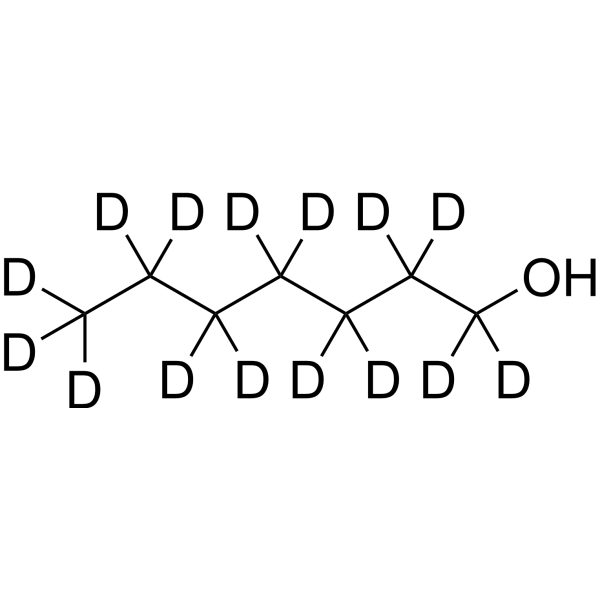
n-Heptyl Alcohol-d15 is the deuterium labeled 1-Heptanol. 1-Heptanol (n-Heptyl alcohol) is a linear primary fatty alcohol. 1-Heptanol selectively inhibits the activating phosphorylation of SAPK/JNK and reduces the phosphorylation level of IκB-α. 1-Heptanol increases plasma membrane fluidity, decreases membrane thermal stability, alters the coupling kinetics of STIM1-ORAI1, inhibits the production of ROS and LTC4, and induces the expression of HSP70. 1-Heptanol is used in the fragrance industry due to its pleasant odor .
loading...
    loading...
Cat. No.: HY-W099504S1
CAS No.: 1219804-99-5
Synonyms: n-Heptyl alcohol-d7
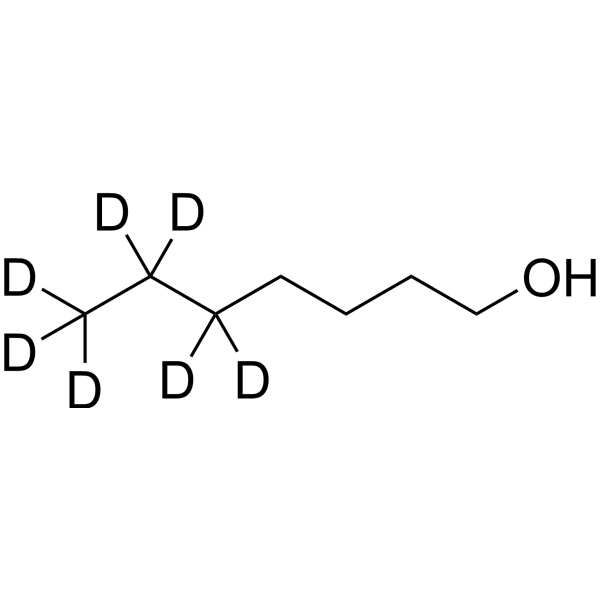
1-Heptanol-d7 is the deuterium labeled 1-Heptanol. 1-Heptanol (n-Heptyl alcohol) is a linear primary fatty alcohol. 1-Heptanol selectively inhibits the activating phosphorylation of SAPK/JNK and reduces the phosphorylation level of IκB-α. 1-Heptanol increases plasma membrane fluidity, decreases membrane thermal stability, alters the coupling kinetics of STIM1-ORAI1, inhibits the production of ROS and LTC4, and induces the expression of HSP70. 1-Heptanol is used in the fragrance industry due to its pleasant odor .
loading...
    loading...
Cat. No.: HY-W099504S2
CAS No.: 38007-42-0
Synonyms: n-Heptyl alcohol-d1
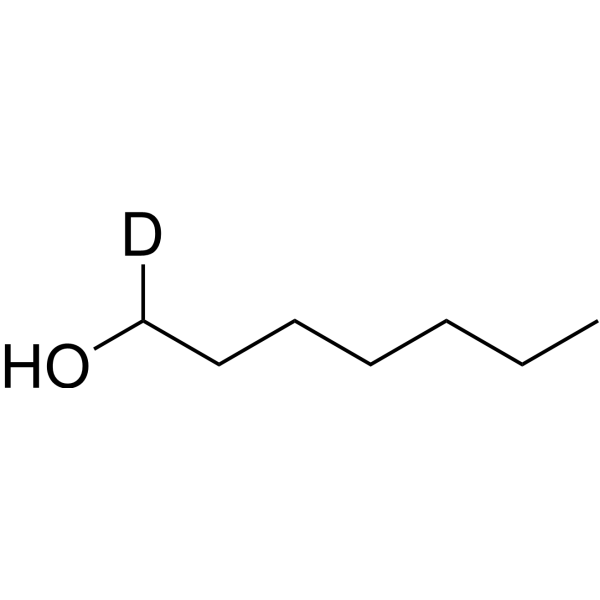
1-Heptanol-d1 is the deuterium labeled 1-Heptanol. 1-Heptanol (n-Heptyl alcohol) is a linear primary fatty alcohol. 1-Heptanol selectively inhibits the activating phosphorylation of SAPK/JNK and reduces the phosphorylation level of IκB-α. 1-Heptanol increases plasma membrane fluidity, decreases membrane thermal stability, alters the coupling kinetics of STIM1-ORAI1, inhibits the production of ROS and LTC4, and induces the expression of HSP70. 1-Heptanol is used in the fragrance industry due to its pleasant odor .
loading...
    loading...

