
237 Results for "

Ionizing

" in MedChemExpress (MCE) Product Catalog:
Products (237)

237 Results for "Ionizing" in MCE Product Catalog:

Cat. No.: HY-170896
CAS No.: 3063868-70-9
Target:  

Liposome

Research Areas:  

Inflammation/Immunology

Iso-A11B5C1 is an ionizable lipid that can be used in the synthesis of lipid nanoparticles (LNP). Iso-A11B5C1 is particularly suitable for muscle-specific mRNA delivery .
loading...
    loading...
Cat. No.: HY-176027
Target:  

Liposome

Research Areas:  

Others

CP-LC-1422 is a homocysteine-derived ionizable amino lipid with high RNA delivery capability and can mediate high-level protein expression in vivo. CP-LC-1422 exhibits significant spleen targeting via intravenous injection in a lipid nanoparticle (LNP) formulation with no significant toxicity observed .
loading...
    loading...
Cat. No.: HY-12364C
CAS No.: 1234694-20-2
Synonyms: (+)-C75
(+)-trans-C75 ((+)-C75) is an enantiomer of C75 (HY-12364) (a fatty acid synthase inhibitor). (+)-trans-C75 is less potent than the racemic mixture or the (-) enantiomer in enhancing the cancer-killing ability of ionizing radiation. (+)-trans-C75 inhibits CPT1 and is an anorectic agent .
loading...
    loading...
Cat. No.: HY-145798
CAS No.: 2922283-38-1
Purity:  ≥98.0%
Target:  

Liposome

Research Areas:  

Others

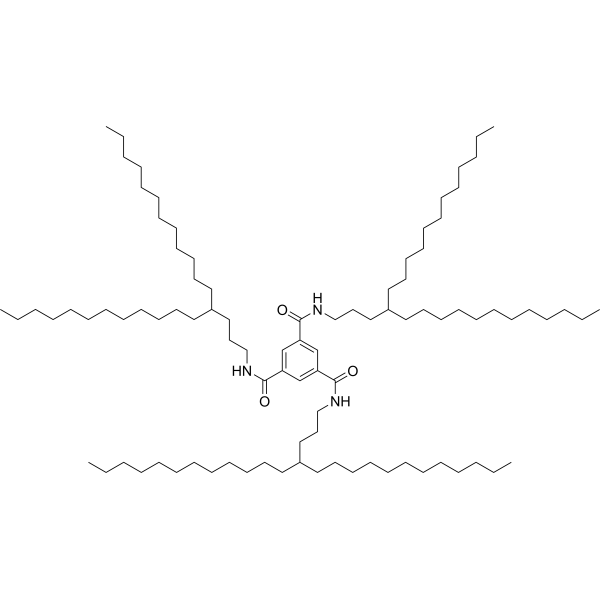
N1,N3,N5-Tris(4-dodecylhexadecyl)benzene-1,3,5-tricarboxamide is an analogue of TT3 (HY-148049). TT3 is an ionizable lipid-like materials for mRNA delivery .
loading...
    loading...
Cat. No.: HY-147332
CAS No.: 2361162-70-9
Purity:  99.92%
Target:  

Liposome

Research Areas:  

Neurological Disease

TCL053 is an ionizable lipid carrier and used to introduce active components, in particular nucleic acids, into cells with excellent efriciency. TCL053, together with DPPC (Dipalmitoylphosphatidylcholine), PEG-DMG (Polyethylene glycoldimyristoyl glycerol), and cholesterol, forms lipid nanoparticle (LNP) which is able to deliver Cas9 mRNA and sgRNA into skeletal muscle .
loading...
    loading...
Cat. No.: HY-171954
Target:  

Liposome

Research Areas:  

Cancer

9C-SCC-10 is a crown-like biodegradable ionizable lipid. 9C-SCC-10 an be used to prepare lipid nanoparticles for delivering mRNA and targeting lung tissue. 9C-SCC-10 can be used for early detection and diagnosis of lung cancer .
loading...
    loading...
Cat. No.: HY-176754
CAS No.: 1872269-57-2
Target:  

Liposome

TCL065 is an ionizable lipid with a pKa of 6.3. TCL065 can be used to generate lipid nanoparticles (LNPs) for the delivery of mRNA as well as single-guide RNA (sgRNA) both in vitro and in vivo. TCL065-containing LNPs can studied in research for Duchenne muscular dystrophy and gene-editing technologies .
loading...
    loading...
Cat. No.: HY-W1130450
CAS No.: 3096665-79-8
Target:  

Liposome

Research Areas:  

Inflammation/Immunology

Lipid ND-O1 is an ether-containing ionizable cationic lipid pKa of 6.6. Lipid ND-O1 can be used to generate lipid nanoparticles (LNPs) for siRNA delivery in vitro and in vivo. Lipid ND-O1 LNPs can be studied in research on hepatic fibrosis .
loading...
    loading...
Cat. No.: HY-W1130452
CAS No.: 2639634-86-7
Target:  

Liposome

Research Areas:  

Cancer

Lipid C16-C is an ionizable cationic lipid that can be used to prepare lipid nanoparticles (LNPs) for mRNA delivery. Lipid C16-C mediates ApoE-independent macropinocytosis-based mRNA delivery to macrophages, with endosomal acidification enabling endosomal escape and release of mRNA cargo into the cytosol .
loading...
    loading...
Cat. No.: HY-171897
CAS No.: 3031773-77-7
Target:  

Liposome

Research Areas:  

Inflammation/Immunology Cancer

E10i-494 is an ionizable cationic branched endosomal disruptor (BEND) lipid. E10i-494 can be used to generate lipid nanoparticles (LNPs) for mRNA delivery in vitro. E10i-494 can enhance transfection efficiency .
loading...
    loading...
Cat. No.: HY-171898
CAS No.: 3046404-81-0
Target:  

Liposome

Research Areas:  

Inflammation/Immunology Cancer

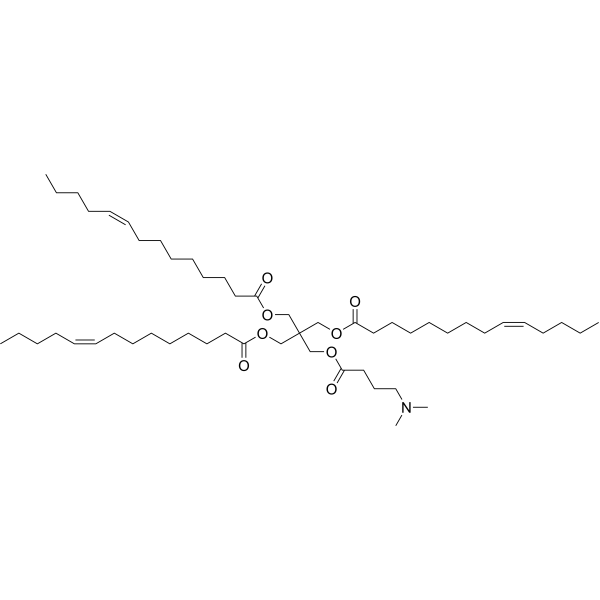
Lipid I97 is an ionizable lipid derived from vitamin B5 (pKa = 6.23). Lipid I97 can be used to generate lipid nanoparticles (LNPs) for mRNA delivery in vivo. Lipid I97 can be studied in research for enhancing mRNA transfection efficiency and long-term stability as well as formulation of mRNA vaccines .
loading...
    loading...
Cat. No.: HY-172535
Target:  

Lipase

Research Areas:  

Inflammation/Immunology Cancer

Lipid OA2 dihydrochloride is an ionizable cationic lipid that can be used to prepare single-component lipid nanoparticles for siRNA delivery. Lipid OA2 dihydrochloride can effectively deliver SOCS1-siRNA to dendritic cells, silence the SOCS1 gene, and enhance their antigen-presenting ability and pro-inflammatory factor secretion capacity .
loading...
    loading...
Cat. No.: HY-113266S
CAS No.: 2847775-89-5
Synonyms: C5:0 L-carnitine-d9
Valerylcarnitine-d9 (C5:0 L-carnitine-d9) is the deuterium labeled Valerylcarnitine (HY-113266). Valerylcarnitine is an endogenous metabolite, belonging to the short-chain acylcarnitines. Valerylcarnitine acts as a metabolomic biomarker for ionizing radiation exposure in nonhuman primates. Valerylcarnitine can be used for the research of type 1 diabetes .
loading...
    loading...
Cat. No.: HY-148842
CAS No.: 2639634-80-1
Purity:  98.13%
Synonyms: C14-494
Target:  

Liposome

Research Areas:  

Inflammation/Immunology

C14-4 is an ionizable lipid utilized for the synthesis of lipid nanoparticles (LNPs). C14-4 enhances mRNA delivery, enabling the effective transport of mRNA to primary human T cells, which in turn induces functional protein expression. C14-4 demonstrates high transfection efficiency while maintaining low cytotoxicity .
loading...
    loading...
Cat. No.: HY-165095
CAS No.: 74257-22-0
Synonyms: 1,2-Palmitolein-3-palmitin; TG(16:1/16:1/16:0)
Target:  

Others

Research Areas:  

Others

1,2-Dipalmitoleoyl-3-palmitoyl-rac-glycerol (1,2-Palmitolein-3-palmitin) is a triglyceride used for serum lipidomics analysis by liquid chromatography-mass spectrometry. This method can effectively separate and detect lipids in positive and negative ionization modes and has certain performance in the identification and characterization of serum triglycerides.
loading...
    loading...
Cat. No.: HY-171953
CAS No.: 3097638-13-3
Target:  

Liposome

Research Areas:  

Others

THP1 Lipid is an ionizable lipidoid. THP1 Lipid can be used to synthesize lipid nanoparticles (LNPs) for delivering mRNA to muscles with minimal toxicity and editing genes in specific liver tissues in tdTomato transgenic mice model. THP1 Lipid can be used for vaccine delivery and CRISPR/Cas9-mediated gene editing research .
loading...
    loading...
Cat. No.: HY-185284
Target:  

Liposome

Research Areas:  

Others

MeDZ lipid is a zwitterion-type ionizable endosomal membrane destabilizer and anti-inflammatory agent that promotes endosomal escape. When incorporated into LNP formulations, MeDZ lipid enhances mRNA expression in lymph node antigen-presenting cells and promotes cytotoxic T cell activation. MeDZ lipid is compatible with existing targeted nanoparticle formulations to improve mRNA delivery efficiency .
loading...
    loading...
Cat. No.: HY-185983
CAS No.: 3113145-84-6
Target:  

Liposome

Research Areas:  

Others

Ale-a12K2 is a peptide-based ionizable lipid modified with bone-binding alendronate. Ale-a12K2 mediates targeted delivery of mRNA to bone tissues. Ale-a12K2 increases mRNA expression levels in the femur and tibia .
loading...
    loading...
Cat. No.: HY-112251GL
CAS No.: 1224606-06-7
D-Lin-MC3-DMA (GMP Like) is the GMP Like class D-Lin-MC3-DMA (HY-112251). GMP small molecules works appropriately as an auxiliary reagent for cell therapy manufacture. D-Lin-MC3-DMA, an ionizable cationic lipid, is a potent siRNA delivery vehicle.
loading...
    loading...
Cat. No.: HY-160552
CAS No.: 2956402-64-3
Target:  

Liposome

Research Areas:  

Others

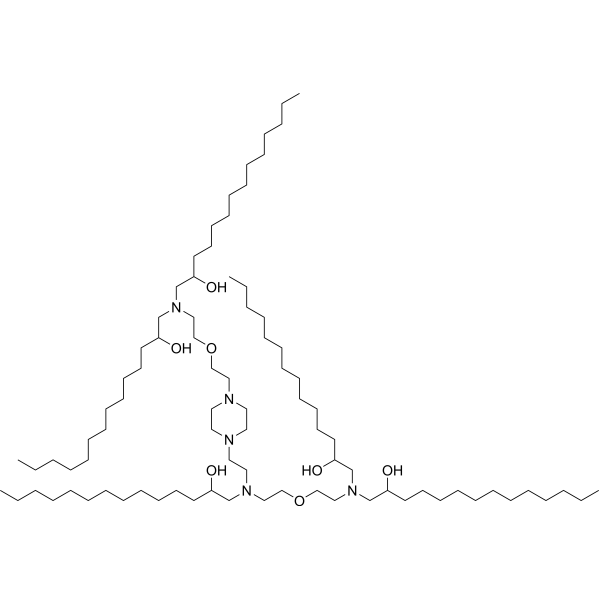
244cis, a piperazine-containing ionizable cationic lipid, has been used to generate lipid nanoparticles (LNPs). LNPs containing 244cis and coated with mRNA reporter gene were specifically accumulated in mouse lungs compared with LNPs containing SM-102. Induces a decrease in serum chemokine (C-C motif) ligand 2 (CCL2) levels .
loading...
    loading...

