2424 Results for "

decrease

" in MedChemExpress (MCE) Product Catalog:
Products (2424)

2424 Results for "decrease" in MCE Product Catalog:

Cat. No.: HY-158740
CAS No.: 2644636-20-2
Target:  

Ferroptosis

Research Areas:  

Neurological Disease

1(R)-(Trifluoromethyl)oleyl alcohol (compound (R)-24) is a trifluoromethyl alcohol derivative of Oleic acid (HY-N1446) with activity in multiple models of Friedreich ataxia (FRDA). 1(R)-(Trifluoromethyl)oleyl alcohol inhibits ferroptosis induced by Erastin (HY-15763) and decreases lipid peroxidation in NBT human myoblasts with frataxin (FXN) siRNA knockdown. 1(R)-(Trifluoromethyl)oleyl alcohol at 40 μM increases survival to 95% in a model of FRDA where a significant percentage of cell death is caused by FAC (HY-B1645) and BSO (HY-106376) .
loading...
    loading...
Cat. No.: HY-15947B
CAS No.: 1817728-45-2
Synonyms: GDC-0994 benzenesulfonate
Research Areas:  

Cancer

Ravoxertinib benzenesulfonate (GDC-0994 benzenesulfonate) is an orally active ERK1/2 inhibitor. Ravoxertinib benzenesulfonate inhibits the ERK1/2 MAPK signaling pathway and reduces the expression levels of c-Myc, HK2 and LDHA. Ravoxertinib benzenesulfonate decreases mammosphere formation, and exerts additive and/or superadditive cytotoxicity when combined with Ipatasertib (HY-15186) in 3D tumor sphere models. Ravoxertinib benzenesulfonate can be used in research related to various cancers including breast cancer, melanoma, head and neck cancer, non-small cell lung cancer, ovarian cancer and Merkel cell carcinoma .
loading...
    loading...
Cat. No.: HY-161874
Research Areas:  

Cancer

RPS6-IN-1 (Compound 22o) inhibits cell metastasis, induces cell apoptosis (increases the expression of Bax, p53, cleaved-caspase 3, and cleaved-PARP). RPS6-IN-1 decreases mitochondrial membrane potential. RPS6-IN-1 activates autophagy through the PI3K-Akt-mTOR signaling pathway, damages intracellular mitochondria and lysosomes, and cause ER stress. RPS6-IN-1 inhibits RPS6 phosphorylation. RPS6-IN-1 is an anticancer agent with low systemic toxicity .
loading...
    loading...
Cat. No.: HY-163511
Research Areas:  

Cancer

PI3K/Akt/mTOR-IN-4 (compound 4r) is a potent PI3K/Akt/mTOR and tubulin polymerization inhibitor. PI3K/Akt/mTOR-IN-4 induce apoptosis and cell cycle arrest at G2/M phase. PI3K/Akt/mTOR-IN-4 decreases the expression of p-PI3K, p-Akt, and p-mTOR, β-tubulin .
loading...
    loading...
Cat. No.: HY-169096
CAS No.: 2924883-83-8
Research Areas:  

Cancer

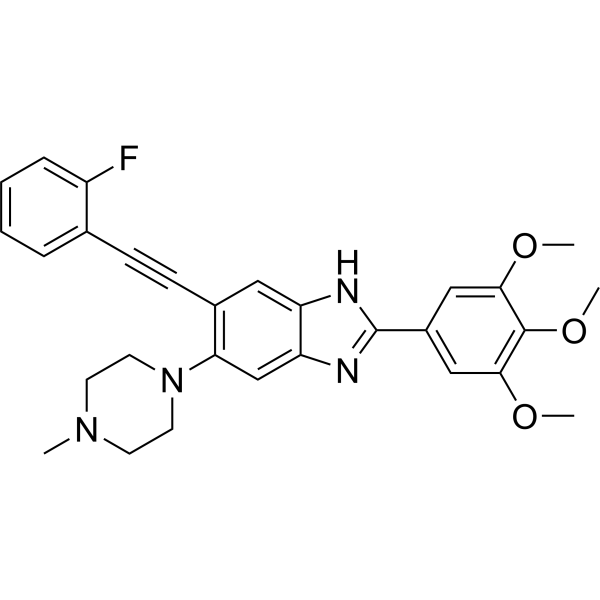
DPP-21 is an inhibitor of tubulin polymerization (IC50: 2.4 μM). DPP-21 shows anti-proliferative activity against cancer cell lines, with IC50s of 0.38 nM (HCT116), 11.69 nM (B16), 5.37 nM (HeLa), 9.53 nM (MCF7), 8.94 nM (H23) and 9.37 nM (HepG2) respectively. DPP-21 arrests the cell cycle in the G2/M phase of mitosis, subsequently inducing tumor cell apoptosis (decreases Bcl-2 but upregulates the pro-apoptotic protein Bax) .
loading...
    loading...
Cat. No.: HY-172804
Research Areas:  

Infection

SDH-IN-26 (Compound C3) is a succinate dehydrogenase (SDH) inhibitor. SDH-IN-26 exhibits significant inhibitory activity against multiple phytopathogenic fungi, such as Rhizoctonia solani and Botrytis cinerea, with an EC50 value of 0.270 μg/mL against Rhizoctonia solani. SDH-IN-26 damages the integrity of the fungal cell membrane, increases membrane permeability, disrupts cell structure, and reduces the number of mitochondria, thus affecting the normal growth of mycelia. SDH-IN-26 leads to a decrease in mitochondrial membrane potential, and induces cell apoptosis. SDH-IN-26 is promising for research of plant diseases caused by fungi .
loading...
    loading...
Cat. No.: HY-174137
CAS No.: 2290545-53-6
Target:  

Apoptosis FLT3

Research Areas:  

Cancer

FLT3-IN-31 (compound 10q) is a potent FLT3 inhibitor with IC50 values of 0.16, 2.4 nM for FLT3, FLT3-D835Y, resprctively. FLT3-IN-31 shows antiproliferation activity. FLT3-IN-31 decreases the protein expression of p-FLT3, P-STAT5, P-ERK. FLT3-IN-31 induces apoptosis and cell cycle arrest at G1 phase. FLT3-IN-31 shows antitumor activity .
loading...
    loading...
Cat. No.: HY-175637
Target:  

COX MyD88

COX-2-IN-57 is an orally active COX-2 inhibitor with an IC50 value of 0.02 μM. COX-2-IN-57 reduces MyD88 expression and decreases serum levels of COX-2, PGE2, and COX-1 in Cisplatin (HY-17394)/radiation-induced neuropathy rat model. COX-2-IN-57 demonstrates superior antinociceptive efficacy in hot plate, cold allodynia, and Randall-Selitto tests, along with hepato-/renal protection. COX-2-IN-57 can be used for the study of inflammation .
loading...
    loading...
Cat. No.: HY-178780
CAS No.: 2137977-29-6
Synonyms: MKP10241
Target:  

GPR119

Deziglipel (MKP10241) is an orally active GPR119 agonist (human EC50: 3.7 nM; IC50 > 7.2 μM). Deziglipel activates GPR119 to increase cAMP levels, promotes active GLP-1 release, reduces blood glucose and HbA1c, decreases body weight and feed intake, and resolves MASH via altered lipid, cytokine, and liver enzyme levels. Deziglipel shows low hERG channel inhibition, minimal CYP450 inhibition, no PXR activation, and no significant transporter inhibition. Deziglipel can be used for the research of type 2 diabetes mellitus, obesity, MASH/MASLD, and metabolic disorders .
loading...
    loading...
Cat. No.: HY-180142
Target:  

Vasopressin Receptor

Research Areas:  

Endocrinology

XYDC2050 (Compound 29) is a selective vasopressin V2 receptor (V2R) antagonist with an IC50 of 27 nM and a Ki of 2.8 nM. XYDC2050 shows a Ki of 420.7 nM (SI = 162 fold) for V1R. XYDC2050 can inhibit Vasopressin (HY-B1811)-induced intracellular cyclic adenosine monophosphate (cAMP) accumulation with an IC50 of 12 nM. XYDC2050 can inhibit the growth of renal cysts, reduce the ratio of kidney weight to body weight and decrease the area of cysts and the cystic index. XYDC2050 can be used for the research of autosomal dominant polycystic kidney disease (ADPKD) .
loading...
    loading...
Cat. No.: HY-181065
CAS No.: 3099617-79-2
Research Areas:  

Cancer

LS-170 is a YEATS2 YEATS domain inhibitor with an IC50 of 0.14 μM. LS-170 displays selectivity for the YEATS2 YEATS domain over other YEATS domain family members and other epigenetic 'reader' and 'eraser' proteins. LS-170 reduces chromatin occupancy of the Ada-two-A-containing (ATAC) complex, decreases ATAC-dependent histone acetylation levels, and downregulates expression of ATAC-governed genes. LS-170 suppresses tumor growth in a lung cancer mouse model. LS-170 can be used for the research of non-small cell lung cancer .
loading...
    loading...
Cat. No.: HY-182447
CAS No.: 69095-83-6
Synonyms: DL111-IT
Target:  

CDK Apoptosis

Research Areas:  

Endocrinology Cancer

Contragestazol (DL111-IT) is a non-hormonal antifertility agent. Contragestazol reduces the expression of Cyclin D1 and CDK4, increases the expression of total retinoblastoma protein (pRb), and decreases the level of hyperphosphorylated pRb. Contragestazol induces G0/G1 phase cell cycle arrest. Contragestazol inhibits embryonic development by inducing luteal cell apoptosis and reducing intrauterine polyamine levels. Contragestazol exhibits antitumor activity against prostate cancer, S180 tumor and H22 tumor. Contragestazol shows extremely potent activity in terminating early pregnancy in animals .
loading...
    loading...
Cat. No.: HY-183244
CAS No.: 121412-39-3
Research Areas:  

Neurological Disease

CGS 21595 is an orally active 5-lipoxygenase inhibitor that blocks the synthesis of 5-hydroxyeicosatetraenoic acid and leukotriene B4. CGS 21595 acts as a prodrug and metabolizes into CGS 19213. CGS 21595 induces lesions in the spinal nerve roots and sciatic nerves of rats, causing mild functional impairments including reduced grip strength, increased spread of the landing feet, and decreased motor activity. CGS 21595 exhibits dose-dependent neurotoxicity in rats, and induces reversible cytoplasmic hyaline droplets in the proximal renal tubules of both male and female rats. CGS 21595 can be used in studies of peripheral toxic neuropathy .
loading...
    loading...
Cat. No.: HY-183312
Antitumor agent-217 is a dual mitochondria-targeted anticancer agent. Antitumor agent-217 exhibits potent and selective antiproliferative activity against bladder cancer cell line J82 (IC50 = 6.3 μM), and inhibits colony formation and migration of J82 cells. Antitumor agent-217 accumulates in mitochondria, alters mitochondrial morphology, reduces ATP production, increases ROS generation and decreases mitochondrial membrane potential. Antitumor agent-217 induces apoptosis (Apoptosis) and ferroptosis (Ferroptosis) in bladder cancer cells. Antitumor agent-217 can be used for the research of bladder cancer .
loading...
    loading...
Cat. No.: HY-186096
Research Areas:  

Metabolic Disease

LP-856866 is an orally active ACSL5 inhibitor, with IC50 values of 8 nM and 4 nM against mouse and human ACSL5, respectively, and IC50 values of 6 nM and 17 nM against mouse and human ACSL1, respectively. LP-856866 induces delayed gastric emptying, promotes GLP-1 release, reduces food intake, decreases body weight and body fat mass, preserves lean body mass, improves glucose homeostasis, enhances insulin sensitivity, reduces hepatic lipid accumulation, and lowers serum triglyceride and total cholesterol levels. LP-856866 is applicable to research on diet-induced obesity .
loading...
    loading...
Cat. No.: HY-189271
CAS No.: 3113312-38-9
Anti-neuroinflammation agent-4 is a blood-brain barrier-penetrating inhibitor of IκBα, NLRP3, and NF-κB p65. Anti-neuroinflammation agent-4 exerts anti-neuroinflammatory effects by inhibiting IκBα phosphorylation, reducing NLRP3 and caspase-1 expression, and suppressing p65 phosphorylation and its nuclear translocation, thereby decreasing the release of inflammatory mediators such as ROS, NO, IL-1β, IL-6, TNF-α, and IL-18 in microglia. Anti-neuroinflammation agent-4 can be used for research on neuroinflammation .
loading...
    loading...
Cat. No.: HY-189292
Research Areas:  

Cancer

HK2-IN-5 is a selective hexokinase 2 (HK2) inhibitor with an IC50 of 1.17 μM against HK2 enzymatic activity. HK2-IN-5 shows weak inhibition against HK3 and GCK (HK4). By inhibiting HK2, HK2-IN-5 induces a decrease in mitochondrial membrane potential (ΔΨm) and accumulation of reactive oxygen species (ROS), leading to mitochondrial dysfunction and oxidative stress, and its antiproliferative effect is mainly dependent on HK2. HK2-IN-5 can be used in research related to triple-negative breast cancer .
loading...
    loading...
Cat. No.: HY-189477
CAS No.: 1557236-81-3
GNE-7056 is an orally active interleukin-2-inducible T-cell kinase (ITK) inhibitor with a Ki of 0.2 nM against human kinase, and exhibits high selectivity over LCK kinase. GNE-7056 inhibits PLCγ-1 phosphorylation, suppresses the production of IL-2, IL-4, IL-13 and TH2 cytokines, reduces CD4 + T-cell proliferation, and inhibits activation-induced cell death of CD4 + T cells by decreasing the abundance of FasL. GNE-7056 can be used in asthma-related research .
loading...
    loading...
Cat. No.: HY-189698
CAS No.: 2768833-33-4
Target:  

NF-κB IKK TNF Receptor

Research Areas:  

Cancer

NCTD-01 is an orally active NF-κB inhibitor. NCTD-01 inhibits TNF-α-induced NF-κB activation by preventing IκBα phosphorylation/degradation and nuclear translocation of NF-κB subunits, and inhibits LPS/IFN-γ-induced nitric oxide production in macrophages. NCTD-01 inhibits the differentiation of naive T cells into regulatory T cells, downregulates transcripts of pro-inflammatory and immunosuppressive mediators in colorectal tumor tissues, reduces serum pro-inflammatory cytokines, and decreases Treg-related inhibitory proteins in colorectal tissues. NCTD-01 can be used for research on colorectal cancer .
loading...
    loading...
Cat. No.: HY-A0069A
CAS No.: 469-21-6
Doxylamine is a first-generation antihistamine and acts as a histamine H1 receptor antagonist. Doxylamine is orally active, possessing analgesic and hypnotic activities. Doxylamine enhances the activities of CYP2B, CYP2A, CYP3A and thyroxine-glucuronosyltransferase via promoting substrate hydroxylation and thyroxine metabolic pathways. Doxylamine decreases serum thyroxine (T4) level and elevates serum thyroid-stimulating hormone (TSH) level. Doxylamine induces liver enlargement and increases the activities of hepatic microsomal cytochrome P450, cytochrome b5 and NADPH-cytochrome c reductase. Doxylamine can be used for the research of nausea, allergy, insomnia .
loading...
    loading...

