Search Result
Results for "
α1 adrenoceptors
" in MedChemExpress (MCE) Product Catalog:
21
Isotope-Labeled Compounds
| Cat. No. |
Product Name |
Target |
Research Areas |
Chemical Structure |
-
- HY-B0769
-
-
-
- HY-B0471
-
-
-
- HY-17034A
-
|
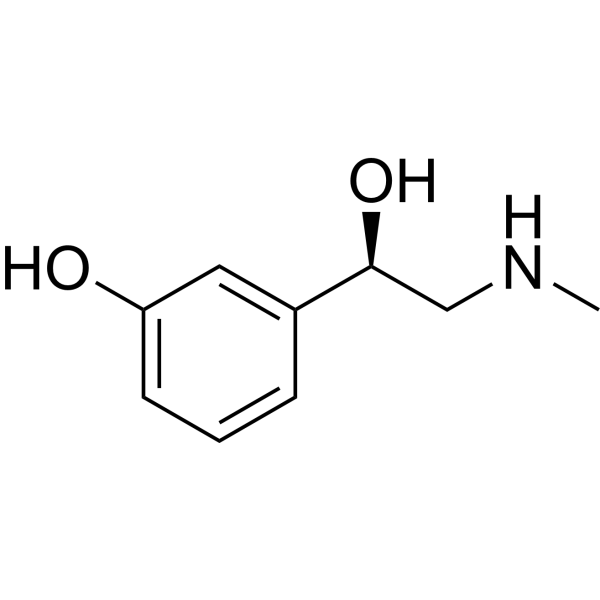
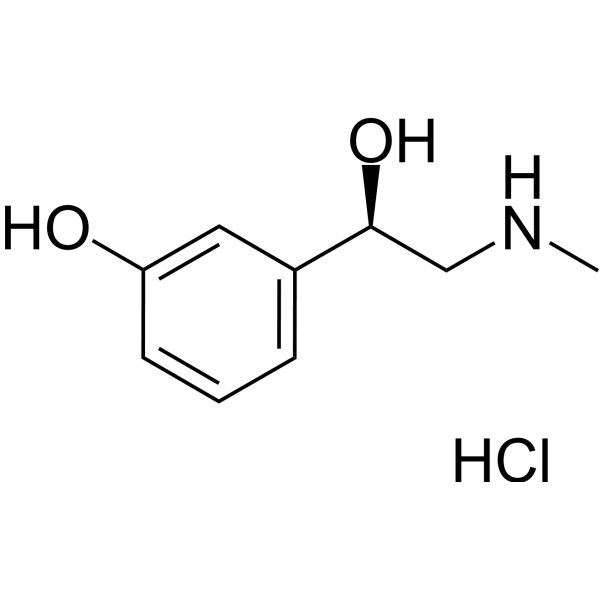
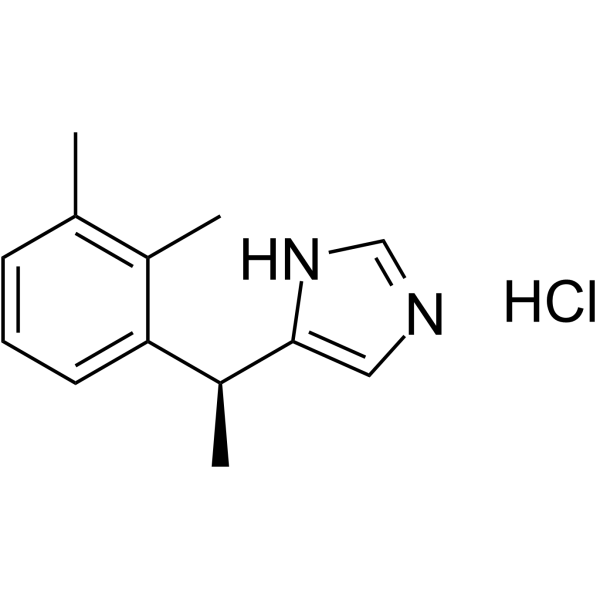
(+)-Medetomidine hydrochloride; (S)-Medetomidine hydrochloride
|
Adrenergic Receptor
|
Infection
Cancer
|
|
Dexmedetomidine hydrochloride ((+)-Medetomidine hydrochloride) is a potent, selective and orally active agonist of α2-adrenoceptor, with a Ki of 1.08 nM. Dexmedetomidine hydrochloride shows 1620-fold selectivity against α1-adrenoceptor. Dexmedetomidine hydrochloride exhibits anxiolysis, sedation, and modest analgesia effects .
|
-
-
- HY-12719
-
|
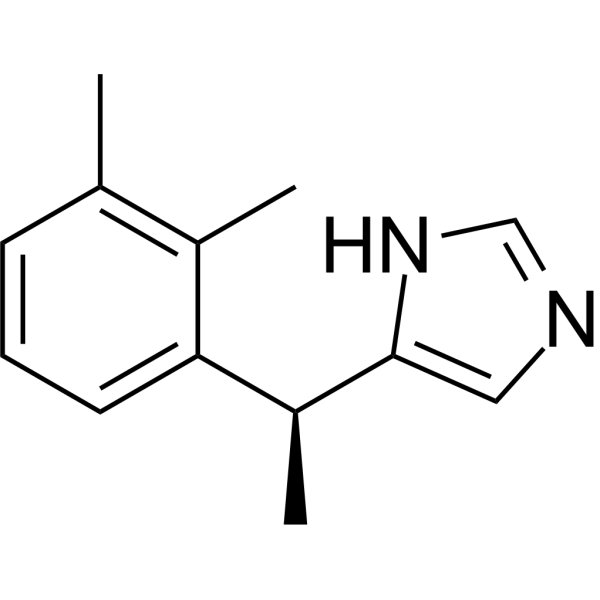
(+)-Medetomidine; (S)-Medetomidine
|
Adrenergic Receptor
|
Neurological Disease
Cancer
|
|
Dexmedetomidine ((+)-Medetomidine) is a potent, selective and orally active agonist of α2-adrenoceptor, with a Ki of 1.08 nM. Dexmedetomidine shows 1620-fold selectivity against α1-adrenoceptor. Dexmedetomidine exhibits anxiolysis, sedation, and modest analgesia effects .
|
-
-
- HY-12987
-
-
-
- HY-15746
-
|
|
Adrenergic Receptor
|
Cardiovascular Disease
Endocrinology
Cancer
|
|
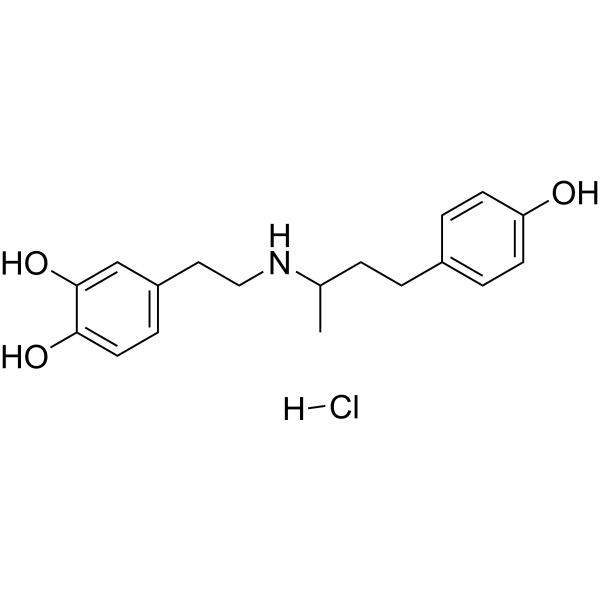
Dobutamine hydrochloride is a synthetic catecholamine that acts on α1-AR, β1-AR, β2-AR (α-1, β-1 andβ-2 adrenoceptors). Dobutamine hydrochloride is a selective β1-AR agonist, relatively weak activity at α1-AR and β2-AR. Dobutamine hydrochloride can increase cardiac output and correct hypoperfusion .
|
-
-
- HY-N1919
-
|
Raubasine
|
Adrenergic Receptor
Cholinesterase (ChE)
|
Neurological Disease
Endocrinology
|
|
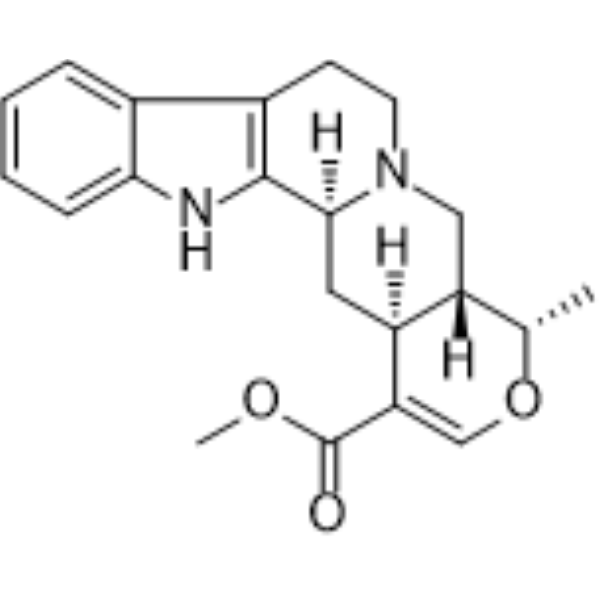
Ajmalicine (Raubasine) is a potent adrenolytic agent which preferentially blocks α1-adrenoceptor. Ajmalicine is an reversible but non-competitive nicotine receptor full inhibitor, with an IC50 of 72.3 μM. Ajmalicine also can be used as anti-hypertensive, and serpentine, with sedative activity .
|
-
-
- HY-B0371F
-
|
|
Adrenergic Receptor
|
Cardiovascular Disease
Metabolic Disease
Endocrinology
|
|
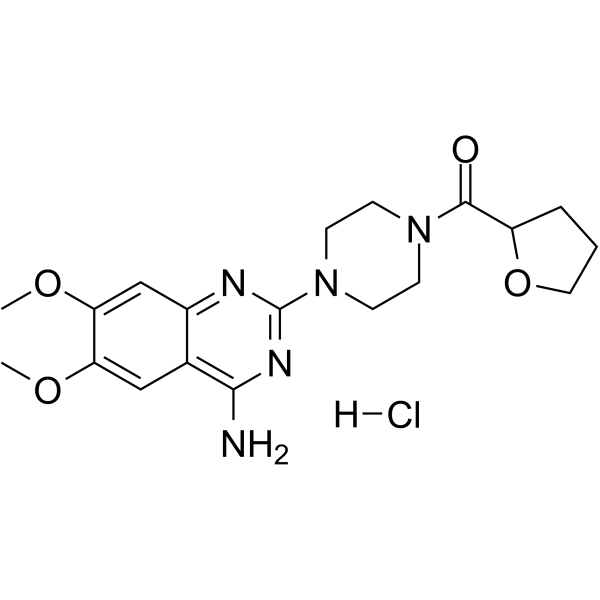
Terazosin hydrochloride is a quinazoline derivative and a competitive and orally active α1-adrenoceptor antagonist. Terazosin hydrochloride works by relaxing blood vessels and the opening of the bladder. Terazosin hydrochloride has the potential for benign prostatic hyperplasia (BPH) and high blood pressure treatment .
|
-
-
- HY-100672
-
-
-
- HY-B0192
-
|
SL 77499
|
Adrenergic Receptor
|
Endocrinology
|
|
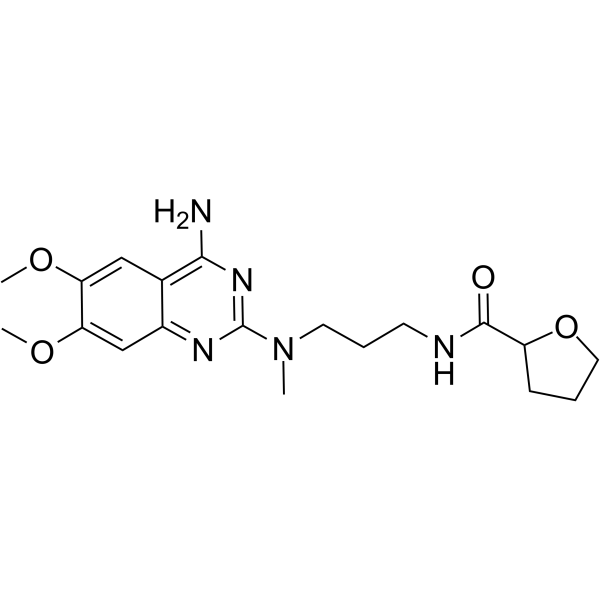
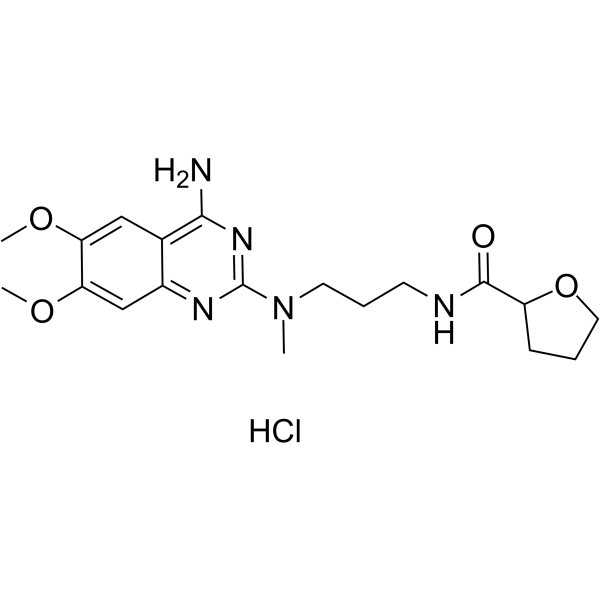
Alfuzosin (SL 77499-10) is an orally active, selective and competitive α1-adrenoceptor antagonist. Alfuzosin relaxes the muscles of the prostate and bladder neck, aiding in urination. Alfuzosin can be used in study of benign prostatic hyperplasia (BPH) .
|
-
-
- HY-103200
-
-
-
- HY-15746A
-
|
|
Adrenergic Receptor
|
Cardiovascular Disease
Endocrinology
Cancer
|
|
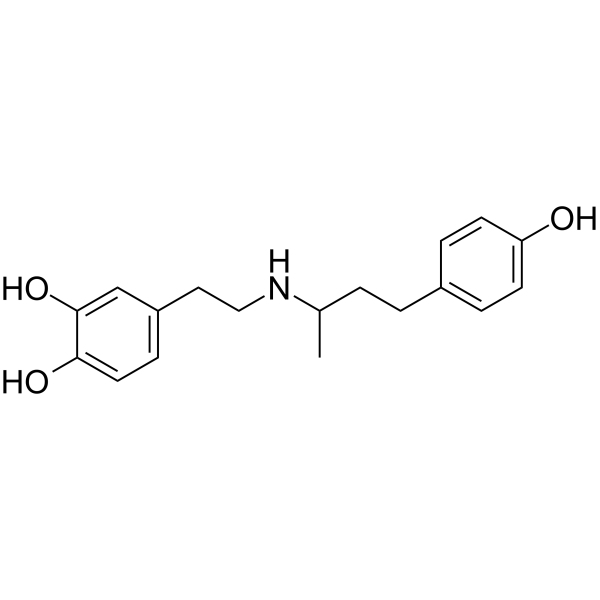
Dobutamine is a synthetic catecholamine that acts on α1-AR, β1-AR, β2-AR (α-1, β-1 andβ-2 adrenoceptors). Dobutamine is a selective β1-AR agonist, relatively weak activity at α1-AR and β2-AR. Dobutamine can increase cardiac output and correct hypoperfusion .
|
-
-
- HY-B0354A
-
-
-
- HY-114794
-
|
ST 1059
|
Adrenergic Receptor
Drug Metabolite
|
Cardiovascular Disease
|
|
Desglymidodrine (ST 1059), the active metabolite of Midodrine(HY-12749), is a selective α1-adrenoceptor agonist. Desglymidodrine is an effective arterial and venous vasoconstrictor and can be used to regulate blood pressure .
|
-
-
- HY-B0371
-
-
-
- HY-B0371A
-
|
|
Adrenergic Receptor
|
Cardiovascular Disease
Metabolic Disease
Endocrinology
|
|
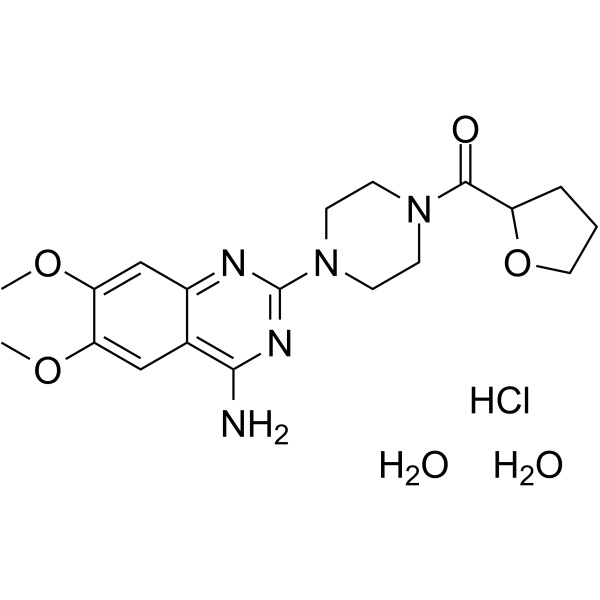
Terazosin hydrochloride dihydrate is a quinazoline derivative and a competitive and orally active α1-adrenoceptor antagonist. Terazosin hydrochloride dihydrate works by relaxing blood vessels and the opening of the bladder. Terazosin hydrochloride dihydrate has the potential for benign prostatic hyperplasia (BPH) and high blood pressure treatment .
|
-
-
- HY-B1658A
-
|
(R)-Frovatriptan succinate hydrate; SB 209509 succinate hydrate; VML 251 succinate hydrate
|
5-HT Receptor
|
Neurological Disease
|
|
Frovatriptan succinate hydrate ((R)-Frovatriptan succinate hydrate) is a potent, high affinity, selective and orally active 5-HT1B (pK50 of 8.2) and 5-HT1D receptor agonist. Frovatriptan succinate hydrate exhibits >10-fold selectivity for 5-HT1B and 5-HT1D over 5-HT1A, 5-HT1F, and 5-HT7 and >1000-fold selectivity over other 5-HT, dopamine, histamine H1, and α1-adrenoceptor. Frovatriptan succinate hydrate has the potential for migraine research .
|
-
-
- HY-B0192A
-
|
SL 77499-10
|
Adrenergic Receptor
|
Endocrinology
|
|
Alfuzosin (SL 77499-10) hydrochloride is an orally active, selective and competitive α1-adrenoceptor antagonist. Alfuzosin hydrochloride relaxes the muscles of the prostate and bladder neck, aiding in urination. Alfuzosin hydrochloride can be used in study of benign prostatic hyperplasia (BPH) .
|
-
-
- HY-14903
-
|
TZP-101
|
GHSR
Adrenergic Receptor
|
Metabolic Disease
|
|
Ulimorelin (TZP-101) is a ghrelin receptor (GRLN) agonist with an EC50 of 29 nM and a Ki of 16 nM. Ulimorelin is a prokinetic agent and causes vasorelaxation through competitive antagonist action at α1-adrenoceptors. Ulimorelin stimulates intestinal motility and is used for malnutrition .
|
-
-
- HY-100991
-
|
ZK 39106; LSU-65
|
GABA Receptor
|
Neurological Disease
|
|
FG 7142 (ZK 39106; LSU-65), a non-selectively benzodiazepine inverse agonist, has high affinity for the α1 subunit-containing GABAA receptor (Ki=91 nM). FG 7142 (ZK 39106; LSU-65) also modulates GABA-induced chloride flux at GABAA receptors expressing the α1 subunit (EC50= 137 nM). FG 7142 (ZK 39106; LSU-65) can increase tyrosine hydroxylation and cause upregulation of β-adrenoceptors in mouse cerebral cortex .
|
-
-
- HY-203894
-
|
Defekton
|
Dopamine Receptor
Adrenergic Receptor
5-HT Receptor
|
Neurological Disease
|
|
Carpipramine (Defekton) is an antipsychotic agent that belongs to the iminodibenzyl class. Carpipramine is a potent dopamine antagonist which blocks alpha 1- and alpha 2-adrenoceptors. Carpipramine also has antagonist properties with respect to serotonin (5-ΗΤ2) receptors. Carpipramine exhibits antipsychotic and anti-depressant effects. Carpipramine can be used for the research of neurological disease, such as post-traumatic stress disorder (PTSD) and depression .
|
-
-
- HY-N6969
-
|
|
Adrenergic Receptor
|
Endocrinology
|
|
Dicentrine is a natural product isolated from the plant Stephania epigaea Lo with antihypertensive effect. Dicentrine is an α1-adrenoceptor antagonist which has effective against human hyperplastic prostates .
|
-
-
- HY-D1606
-
|
|
Adrenergic Receptor
|
Metabolic Disease
|
|
BODIPY FL prazosin is a fluorescent α1-adrenergic antagonist with Ki values of 14.5, 43.3 nM for α1a-AR and α1b-AR, respectively. BODIPY FL prazosin also is a fluorescent ligand with the excitation and emission wavelengths are 485 and 535 nm, respectively. BODIPY FL prazosin can be used for study the differences in the subcellular localization of α1-adrenoceptor subtypes .
|
-
-
- HY-B0769R
-
-
-
- HY-106612
-
|
U-K52046; Albanoquil
|
Adrenergic Receptor
|
Cardiovascular Disease
|
|
Abanoquil (U-K52046), an potent and selective α-1 adrenoceptor antagonist, is an anti-arrhythmic agent. Abanoquil can be used for erectile dysfunction research .
|
-
-
- HY-17034AR
-
|
(+)-Medetomidine hydrochloride (Standard); (S)-Medetomidine hydrochloride (Standard)
|
Reference Standards
Adrenergic Receptor
|
Neurological Disease
Endocrinology
Cancer
|
|
Dexmedetomidine (hydrochloride) (Standard) is the analytical standard of Dexmedetomidine (hydrochloride). This product is intended for research and analytical applications. Dexmedetomidine hydrochloride ((+)-Medetomidine hydrochloride) is a potent, selective and orally active agonist of α2-adrenoceptor, with a Ki of 1.08 nM. Dexmedetomidine hydrochloride shows 1620-fold selectivity against α1-adrenoceptor. Dexmedetomidine hydrochloride exhibits anxiolysis, sedation, and modest analgesia effects .
|
-
-
- HY-12719R
-
|
(+)-Medetomidine (Standard); (S)-Medetomidine (Standard)
|
Reference Standards
Adrenergic Receptor
|
Neurological Disease
Cancer
|
|
Dexmedetomidine (Standard) is the analytical standard of Dexmedetomidine. This product is intended for research and analytical applications. Dexmedetomidine ((+)-Medetomidine) is a potent, selective and orally active agonist of α2-adrenoceptor, with a Ki of 1.08 nM. Dexmedetomidine shows 1620-fold selectivity against α1-adrenoceptor. Dexmedetomidine exhibits anxiolysis, sedation, and modest analgesia effects .
|
-
-
- HY-106954
-
|
Rec 15/2739; Recordati 15/2739; SB 216469
|
Adrenergic Receptor
|
Inflammation/Immunology
|
|
Upidosin (Rec 15/2739) is an α-1 adrenoceptor (α-1 AR) antagonist. Upidosin shows moderate selectivity for the α-1A AR subtype. Upidosin shows uroselectivity in urethra and prostate with a Kb value of 2-3 nM higher than in ear artery and aorta with a Kb value of 20-100 nM. Upidosin inhibits [3H]prazosin binding to cloned human α-1A adrenergic receptor. Upidosin can be used for the research of urethral obstruction .
|
-
-
- HY-U00399A
-
|
ABT 980
|
Adrenergic Receptor
|
Endocrinology
|
|
Fiduxosin hydrochloride (ABT 980) is a potent α1-adrenoceptor antagonist, with Ki of 0.160 nM, 24.9 nM, and 0.920 nM for α1a-, α1b-, and α1d-adrenoceptors, respectively .
|
-
-
- HY-B0371B
-
|
|
Adrenergic Receptor
|
Endocrinology
|
|
(R)-Terazosin is an active R-enantiomer of Terazosin. (R)-Terazosin is a potent α1-adrenoceptor antagonist with Ki values of 6.51 nM, 1.01 nM and 1.97 nM for α1a, α1b and α1d-adrenoceptor, respectively .
|
-
-
- HY-135552
-
-
-
- HY-B0471R
-
|
(R)-(-)-Phenylephrine hydrochloride (Standard); L-Phenylephrine hydrochloride (Standard)
|
Reference Standards
Adrenergic Receptor
Endogenous Metabolite
|
Cardiovascular Disease
Endocrinology
Cancer
|
|
Phenylephrine (hydrochloride) (Standard) is the analytical standard of Phenylephrine (hydrochloride). This product is intended for research and analytical applications. (R)-(-)-Phenylephrine hydrochloride is a selective α1-adrenoceptor agonist with pKis of 5.86, 4.87 and 4.70 for α1D, α1B and α1A receptors respectively.
|
-
-
- HY-118335
-
|
SZL 49
|
Adrenergic Receptor
|
Cardiovascular Disease
|
|
Prazobind (SZL 49), a prazosin analog, is an irreversible α1-adrenoceptor antagonist. Prazobind competes for alpha 1-adrenoceptor binding sites with a similar potency (IC50 of 1 nM) in tissues enriched in both the alpha 1A (hippocampus) and alpha 1B (liver) subtypes. Prazobind partially inhibits the contractions of circular muscles, longitudinal muscles and smooth muscles of the spleen. Prazobind can be used for the study of blood pressure .
|
-
-
- HY-12987R
-
-
-
- HY-100672B
-
|
|
Adrenergic Receptor
|
Cardiovascular Disease
Metabolic Disease
|
|
(2R)-SR59230A is the isomer of SR59230A (HY-100672), and can be used as an experimental control. SR59230A is a potent, selective, and blood-brain barrier penetrating β3-adrenergic receptor antagonist with IC50s of 40, 408, and 648 nM for β3, β1, and β2 receptors, respectively .
|
-
-
- HY-B0354AR
-
|
|
Reference Standards
5-HT Receptor
Adrenergic Receptor
|
Cardiovascular Disease
Endocrinology
|
|
Urapidil (hydrochloride) (Standard) is the analytical standard of Urapidil (hydrochloride). This product is intended for research and analytical applications. Urapidil hydrochloride is an orally active α1-adrenoceptor antagonist and 5-HT1A receptor agonist with a pIC50 of 6.13 and 4.38 against α1- and α2-adrenoceptor, respectively. Urapidil hydrochloride shows antihypertensive effect .
|
-
-
- HY-U00399
-
|
|
Adrenergic Receptor
|
Endocrinology
|
|
Fiduxosin is a potent α1-adrenoceptor antagonist, with Ki of 0.160 nM, 24.9 nM, and 0.920 nM for α1a-, α1b-, and α1d-adrenoceptors, respectively.
|
-
-
- HY-136935
-
|
|
Adrenergic Receptor
|
Endocrinology
|
|
Alloyohimbine, an alkaloid, is a selective α2-adrenoceptor antagonist with K Dα1, K Dα2 of 0.28 μM and 0.006 μM, respectively .
|
-
-
- HY-U00365
-
-
-
- HY-B0371S
-
|
|
Isotope-Labeled Compounds
Adrenergic Receptor
|
Metabolic Disease
Endocrinology
|
|
Terazosin-d8 is deuterium labeled Terazosin. Terazosin is a quinazoline derivative and a competitive and orally active α1-adrenoceptor antagonist. Terazosin works by relaxing blood vessels and the opening of the bladder. Terazosin has the potential for benign prostatic hyperplasia (BPH) and high blood pressure treatment .
|
-
-
- HY-19268
-
|
GW 1818
|
Adrenergic Receptor
|
Metabolic Disease
|
|
GG-818 (GW 1818) is a potent and selective α1 adrenoceptor antagonist, with pKi values of 9.7 for α1a, 7.8 for α1b, and 7.6 for α1d. GG-818 (GW 1818) can be used for benign prostatic hyperplasia research .
|
-
-
- HY-B0471S
-
|
(R)-(-)-Phenylephrine-d3 hydrochloride; L-Phenylephrine-d3 hydrochloride
|
Adrenergic Receptor
Endogenous Metabolite
|
Cardiovascular Disease
Endocrinology
|
|
Phenylephrine-d3 (hydrochloride) is the deuterium labeled Phenylephrine hydrochloride. (R)-(-)-Phenylephrine hydrochloride is a selective α1-adrenoceptor agonist with pKis of 5.86, 4.87 and 4.70 for α1D, α1B and α1A receptors respectively.
|
-
-
- HY-U00333
-
-
-
- HY-B0471S1
-
|
(R)-(-)-Phenylephrine-2,4,6-d3 hydrochloride; L-Phenylephrine-2,4,6-d3 hydrochloride
|
Adrenergic Receptor
Endogenous Metabolite
|
Cardiovascular Disease
Endocrinology
|
|
Phenylephrine-2,4,6-d3 (hydrochloride) is the deuterium labeled Phenylephrine hydrochloride. (R)-(-)-Phenylephrine hydrochloride is a selective α1-adrenoceptor agonist with pKis of 5.86, 4.87 and 4.70 for α1D, α1B and α1A receptors respectively.
|
-
-
- HY-17034AS
-
|
(+)-Medetomidine-13C,d3 hydrochloride; (S)-Medetomidine-13C,d3 hydrochloride
|
Isotope-Labeled Compounds
Adrenergic Receptor
|
Neurological Disease
Endocrinology
Cancer
|
|
Dexmedetomidine- 13C,d3 (hydrochloride) is the 13C- and deuterium labeled Dexmedetomidine (hydrochloride). Dexmedetomidine hydrochloride ((+)-Medetomidine hydrochloride) is a potent, selective and orally active agonist of α2-adrenoceptor, with a Ki of 1.08 nM. Dexmedetomidine hydrochloride shows 1620-fold selectivity against α1-adrenoceptor. Dexmedetomidine hydrochloride exhibits anxiolysis, sedation, and modest analgesia effects .
|
-
-
- HY-17019
-
|
|
Adrenergic Receptor
|
Inflammation/Immunology
|
|
SL-89.0591 is a uroselective α1-adrenoceptor antagonist. SL-89.0591 exhibits a more potent blocking effect on urethral receptors than on vascular receptors in anesthetized rabbits, with a lower risk of orthostatic hypotension. SL-89.0591 can be used in research related to benign prostatic hyperplasia .
|
-
-
- HY-B0192AR
-
|
SL 77499-10 (Standard)
|
Reference Standards
Adrenergic Receptor
|
Endocrinology
|
|
Alfuzosin (hydrochloride) (Standard) is the analytical standard of Alfuzosin (hydrochloride). This product is intended for research and analytical applications. Alfuzosin (SL 77499-10) hydrochloride is an orally active, selective and competitive α1-adrenoceptor antagonist. Alfuzosin hydrochloride relaxes the muscles of the prostate and bladder neck, aiding in urination. Alfuzosin hydrochloride can be used in study of benign prostatic hyperplasia (BPH) .
|
-
-
- HY-12987S
-
-
-
- HY-12987S1
-
-
-
- HY-N1919R
-
|
Raubasine (Standard)
|
Reference Standards
Adrenergic Receptor
Cholinesterase (ChE)
|
Neurological Disease
Endocrinology
|
|
Ajmalicine (Standard) is the analytical standard of Ajmalicine. This product is intended for research and analytical applications. Ajmalicine (Raubasine) is a potent adrenolytic agent which preferentially blocks α1-adrenoceptor. Ajmalicine is an reversible but non-competitive nicotine receptor full inhibitor, with an IC50 of 72.3 μM. Ajmalicine also can be used as anti-hypertensive, and serpentine, with sedative activity .
|
-
- HY-B1658B
-
|
(R)-Frovatriptan succinate; SB 209509 succinate; VML 251 succinate
|
5-HT Receptor
|
Neurological Disease
|
|
Frovatriptan succinate ((R)-Frovatriptan succinate) is a potent, high affinity, selective and orally active 5-HT1B (pK50 of 8.2) and 5-HT1D receptor agonist. Frovatriptan succinate exhibits >10-fold selectivity for 5-HT1B and 5-HT1D over 5-HT1A, 5-HT1F, and 5-HT7 and >1000-fold selectivity over other 5-HT, dopamine, histamine H1, and α1-adrenoceptor. Frovatriptan succinate has the potential for migraine research .
|
-
- HY-121312
-
|
ST-600
|
Adrenergic Receptor
|
Cardiovascular Disease
|
|
Flutonidine (ST-600) is a Clonidine (HY-12721) analogue that shows antihypertensive and sympatholytic effects. The initial hypertension produced by Flutonidine is due to stimulation of the peripheral α1, α2 adrenoceptors and the subsequent fall in blood pressure is due to the stimulation of central α2 adrenoceptors. Flutonidine reduces the arrhythmogenic and lethal effects of ouabain. Flutonidine is promising for research of ventricular arrhythmias caused by cardiac glycosides .
|
-
- HY-U00206
-
-
- HY-105798
-
-
- HY-107326
-
-
- HY-107326A
-
-
- HY-131449
-
|
|
Adrenergic Receptor
|
Others
|
|
Terazosin dimer impurity dihydrochloride, a dimer of Terazosin, is an impurity of Terazosin. Terazosin is a quinazoline derivative and a competitive and orally active α1-adrenoceptor antagonist .
|
-
- HY-106554
-
|
|
Adrenergic Receptor
|
Cardiovascular Disease
|
|
Trimazosin is an orally active, quinazoline derivative which is structurally related to prazosin. Trimazosin shows hypotensive effect by selectively block α1-adrenoceptors .
|
-
- HY-123563
-
-
- HY-U00165
-
-
- HY-B0098C
-
|
(S)-UK 33274
|
Adrenergic Receptor
|
Cardiovascular Disease
Neurological Disease
|
|
(S)-Doxazosin is a long-acting selective α1-adrenoceptor antagonist. (S)-Doxazosin exhibits antihypertensive activity through lowering total perioheral resistance by selective postsynaptic α1-blockade. (S)-Doxazosin reduces blood pressure in dog model with experimentally induced renal hypertension. (S)-Doxazosin can alleviate bladder outflow obstruction. (S)-Doxazosin can also be studied in mental health disorder-related research .
|
-
- HY-101061
-
|
|
Adrenergic Receptor
|
Cardiovascular Disease
|
|
2-MPMDQ is a potent and selective α1-adrenoceptor (Ki=0.37 nM) antagonist over α2-adrenoceptor (Ki=1740 nM). 2-MPMDQ is potent anti-hypertensive agent and has the potential for hypertension research .
|
-
- HY-B0471S3
-
-
- HY-B0471S2
-
-
- HY-N1919A
-
|
Raubasine hydrochloride
|
Adrenergic Receptor
Cholinesterase (ChE)
|
Neurological Disease
Endocrinology
|
|
Ajmalicine (Raubasine) hydrochloride is a potent adrenolytic agent which preferentially blocks α1-adrenoceptor. Ajmalicine hydrochloride is an reversible but non-competitive nicotine receptor full inhibitor, with an IC50 of 72.3 μM. Ajmalicine hydrochloride also can be used as anti-hypertensive, and serpentine, with sedative activity .
|
-
- HY-19036
-
|
|
Adrenergic Receptor
|
Neurological Disease
|
|
SDZ NVI 085 is a compound with CNS stimulatory effects, primarily through the α1-adrenoceptor subtype, with anti-cataplexy and anti-stroke activities. SDZ NVI 085 also has a significant alertness effect and can be used to study other types of excessive sleepiness .
|
-
- HY-19037
-
-
- HY-114794R
-
|
ST 1059 (Standard)
|
Reference Standards
Adrenergic Receptor
Drug Metabolite
|
Cardiovascular Disease
|
|
Desglymidodrine (Standard) is the analytical standard of Desglymidodrine. This product is intended for research and analytical applications. Desglymidodrine (ST 1059), the active metabolite of Midodrine(HY-12749), is a selective α1-adrenoceptor agonist. Desglymidodrine is an effective arterial and venous vasoconstrictor and can be used to regulate blood pressure .
|
-
- HY-101690
-
-
- HY-15746B
-
|
|
Adrenergic Receptor
|
Cardiovascular Disease
Endocrinology
Cancer
|
|
Dobutamine tartrate is a synthetic catecholamine that acts on α1-AR, β1-AR, β2-AR (α-1, β-1 andβ-2 adrenoceptors). Dobutamine tartrate is a selective β1-AR agonist, relatively weak activity at α1-AR and β2-AR. Dobutamine tartrate can increase cardiac output and correct hypoperfusion .
|
-
- HY-15746S
-
|
|
Isotope-Labeled Compounds
Adrenergic Receptor
|
Cardiovascular Disease
Endocrinology
|
|
(rac)-Dobutamine-d4 (hydrochloride) is a labelled racemic Dobutamine hydrochloride. Dobutamine hydrochloride is a synthetic catecholamine that acts on α1-AR, β1-AR, β2-AR (α-1, β-1 andβ-2 adrenoceptors). Dobutamine hydrochloride is a selective β1-AR agonist, relatively weak activity at α1-AR and β2-AR. Dobutamine hydrochloride can increase cardiac output and correct hypoperfusion .
|
-
- HY-15746S1
-
|
|
Isotope-Labeled Compounds
Adrenergic Receptor
|
Cardiovascular Disease
Endocrinology
|
|
(rac)-Dobutamine-d6 (hydrochloride) is a labelled racemic Dobutamine hydrochloride. Dobutamine hydrochloride is a synthetic catecholamine that acts on α1-AR, β1-AR, β2-AR (α-1, β-1 andβ-2 adrenoceptors). Dobutamine hydrochloride is a selective β1-AR agonist, relatively weak activity at α1-AR and β2-AR. Dobutamine hydrochloride can increase cardiac output and correct hypoperfusion .
|
-
- HY-B0192S
-
|
SL 77499-d7
|
Adrenergic Receptor
|
Endocrinology
|
|
Alfuzosin-d7 is the deuterium labeled Alfuzosin . Alfuzosin (SL 77499-10) is an orally active, selective and competitive α1-adrenoceptor antagonist. Alfuzosin relaxes the muscles of the prostate and bladder neck, aiding in urination. Alfuzosin can be used in study of benign prostatic hyperplasia (BPH) .
|
-
- HY-106874A
-
|
RS-15385-197 hydrochloride
|
Adrenergic Receptor
|
Neurological Disease
|
|
Delequamine (RS-15385-197) hydrochloride is an orally active and selective α2-adrenergic receptor antagonist with a pKi of 9.5 for α2-adrenoceptors in rat cortex. Delequamine hydrochloride shows >1000 fold selectivity against 5-HT1A receptors and α1-adrenoceptors. Delequamine hydrochloride can be used for the study of erectile dysfunction .
|
-
- HY-106874
-
|
RS-15385-197
|
Adrenergic Receptor
|
Neurological Disease
|
|
Delequamine (RS-15385-197) is an orally active and selective α2-adrenergic receptor antagonist with a pKi of 9.5 for α2-adrenoceptors in rat cortex. Delequamine shows >1000 fold selectivity against 5-HT1A receptors and α1-adrenoceptors. Delequamine can be used for the study of erectile dysfunction .
|
-
- HY-15746R
-
|
|
Reference Standards
Adrenergic Receptor
|
Cardiovascular Disease
Endocrinology
Cancer
|
|
Dobutamine (hydrochloride) (Standard) is the analytical standard of Dobutamine (hydrochloride). This product is intended for research and analytical applications. Dobutamine hydrochloride is a synthetic catecholamine that acts on α1-AR, β1-AR, β2-AR (α-1, β-1 andβ-2 adrenoceptors). Dobutamine hydrochloride is a selective β1-AR agonist, relatively weak activity at α1-AR and β2-AR. Dobutamine hydrochloride can increase cardiac output and correct hypoperfusion .
|
-
- HY-B0192R
-
|
SL 77499 (Standard)
|
Adrenergic Receptor
Reference Standards
|
Endocrinology
|
|
Alfuzosin (Standard) is the analytical standard of Alfuzosin. This product is intended for research and analytical applications. Alfuzosin (SL 77499-10) is an orally active, selective and competitive α1-adrenoceptor antagonist. Alfuzosin relaxes the muscles of the prostate and bladder neck, aiding in urination. Alfuzosin can be used in study of benign prostatic hyperplasia (BPH) .
|
-
- HY-B0371FR
-
|
|
Reference Standards
Adrenergic Receptor
|
Cardiovascular Disease
Metabolic Disease
Endocrinology
|
|
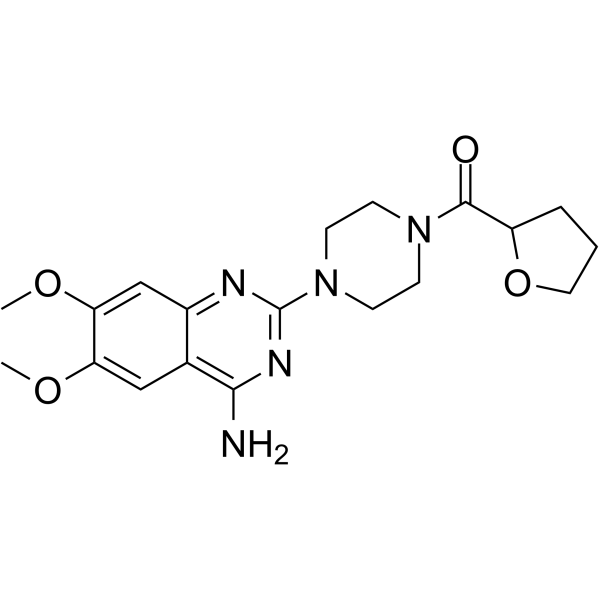
Terazosin (hydrochloride) (Standard) is the analytical standard of Terazosin (hydrochloride). This product is intended for research and analytical applications. Terazosin hydrochloride is a quinazoline derivative and a competitive and orally active α1-adrenoceptor antagonist. Terazosin hydrochloride works by relaxing blood vessels and the opening of the bladder. Terazosin hydrochloride has the potential for benign prostatic hyperplasia (BPH) and high blood pressure treatment .
|
-
- HY-118335S
-
|
SZL 49-d8
|
Isotope-Labeled Compounds
Adrenergic Receptor
|
Cardiovascular Disease
|
|
Prazobind-d8 (SZL 49-d8) is the deuterium labeled Prazobind (HY-118335). Prazobind, a prazosin analog, is an irreversible α1-adrenoceptor antagonist. Prazobind competes for alpha 1-adrenoceptor binding sites with a similar potency (IC50 of 1 nM) in tissues enriched in both the alpha 1A (hippocampus) and alpha 1B (liver) subtypes. Prazobind partially inhibits the contractions of circular muscles, longitudinal muscles and smooth muscles of the spleen. Prazobind can be used for the study of blood pressure.
|
-
- HY-12987S2
-
-
- HY-B0192S3
-
|
SL 77499-d6
|
Isotope-Labeled Compounds
Adrenergic Receptor
|
Endocrinology
|
|
Alfuzosin-d6 (SL 77499-d6) is deuterium labeled Alfuzosin. Alfuzosin (SL 77499-10) is an orally active, selective and competitive α1-adrenoceptor antagonist. Alfuzosin relaxes the muscles of the prostate and bladder neck, aiding in urination. Alfuzosin can be used in study of benign prostatic hyperplasia (BPH) .
|
-
- HY-B0192S3A
-
|
SL 77499-10-d6
|
Isotope-Labeled Compounds
Adrenergic Receptor
|
Endocrinology
|
|
Alfuzosin (hydrochloride)-d6 (SL 77499-10-d6) is deuterium labeled Alfuzosin (hydrochloride). Alfuzosin (SL 77499-10) hydrochloride is an orally active, selective and competitive α1-adrenoceptor antagonist. Alfuzosin hydrochloride relaxes the muscles of the prostate and bladder neck, aiding in urination. Alfuzosin hydrochloride can be used in study of benign prostatic hyperplasia (BPH) .
|
-
- HY-B0371AR
-
|
|
Reference Standards
Adrenergic Receptor
|
Metabolic Disease
Endocrinology
|
|
Terazosin (hydrochloride dihydrate) (Standard) is the analytical standard of Terazosin (hydrochloride dihydrate). This product is intended for research and analytical applications. Terazosin hydrochloride dihydrate is a quinazoline derivative and a competitive and orally active α1-adrenoceptor antagonist. Terazosin hydrochloride dihydrate works by relaxing blood vessels and the opening of the bladder. Terazosin hydrochloride dihydrate has the potential for benign prostatic hyperplasia (BPH) and high blood pressure treatment .
|
-
- HY-W704363
-
-
- HY-101641
-
-
- HY-100991R
-
|
ZK 39106 (Standard); LSU-65 (Standard)
|
Reference Standards
GABA Receptor
|
Neurological Disease
|
|
FG 7142 (Standard) is the analytical standard of FG 7142. This product is intended for research and analytical applications. FG 7142 (ZK 39106; LSU-65), a non-selectively benzodiazepine inverse agonist, has high affinity for the α1 subunit-containing GABAA receptor (Ki=91 nM). FG 7142 (ZK 39106; LSU-65) also modulates GABA-induced chloride flux at GABAA receptors expressing the α1 subunit (EC50= 137 nM). FG 7142 (ZK 39106; LSU-65) can increase tyrosine hydroxylation and cause upregulation of?β-adrenoceptors in mouse cerebral cortex .
|
-
- HY-103216
-
|
|
Adrenergic Receptor
|
Neurological Disease
|
|
RWJ52353 is a selective, orally active ligand for α2D adrenoceptor, which binds α2D, α2A, α2B and α1 receptors, with Kis of 1.5, 254, 621 and 443 nM. RWJ52353 exhibits analgesic efficacy in mouse abdominal irritation test (MAIT), with an ED50 of 15.1 mg/kg .
|
-
- HY-W753806
-
|
UK 33274 hydrochloride
|
Akt
|
Cardiovascular Disease
|
|
Doxazosin hydrochloride (UK 33274 hydrochloride) is a compound used to inhibit hypertension and prostate hyperplasia, with activity that inhibits postsynaptic α1-adrenoceptors on vascular smooth muscle. Doxazosin hydrochloride can cause vasodilation, thereby reducing peripheral vascular resistance. Doxazosin hydrochloride was found to inhibit the proliferation and migration of hepatic stellate cells in a mouse liver fibrosis model. Doxazosin hydrochloride regulates fibrosis, autophagy, and apoptosis of hepatic stellate cells by activating the PI3K/Akt/mTOR signaling pathway. Doxazosin hydrochloride also blocks autophagic flux and induces apoptosis of hepatic stellate cells .
|
-
- HY-B1658BS
-
|
(R)-Frovatriptan-d3 succinate; SB 209509-d3 succinate; VML 251-d3 succinate
|
Isotope-Labeled Compounds
5-HT Receptor
|
Neurological Disease
|
|
Frovatriptan-d3 (succinate) is deuterium labeled Frovatriptan (succinate). Frovatriptan succinate ((R)-Frovatriptan succinate) is a potent, high affinity, selective and orally active 5-HT1B (pK50 of 8.2) and 5-HT1D receptor agonist. Frovatriptan succinate exhibits >10-fold selectivity for 5-HT1B and 5-HT1D over 5-HT1A, 5-HT1F, and 5-HT7 and >1000-fold selectivity over other 5-HT, dopamine, histamine H1, and α1-adrenoceptor. Frovatriptan succinate has the potential for migraine research .
|
-
- HY-B1658AR
-
|
(R)-Frovatriptan succinate hydrate (Standard); SB 209509 succinate hydrate (Standard); VML 251 succinate hydrate (Standard)
|
Reference Standards
5-HT Receptor
|
Neurological Disease
|
|
Frovatriptan (succinate hydrate) (Standard) is the analytical standard of Frovatriptan (succinate hydrate). This product is intended for research and analytical applications. Frovatriptan succinate hydrate ((R)-Frovatriptan succinate hydrate) is a potent, high affinity, selective and orally active 5-HT1B (pK50 of 8.2) and 5-HT1D receptor agonist. Frovatriptan succinate hydrate exhibits >10-fold selectivity for 5-HT1B and 5-HT1D over 5-HT1A, 5-HT1F, and 5-HT7 and >1000-fold selectivity over other 5-HT, dopamine, histamine H1, and α1-adrenoceptor. Frovatriptan succinate hydrate has the potential for migraine research .
|
-
- HY-106416
-
-
- HY-W556123
-
|
|
Adrenergic Receptor
|
Neurological Disease
Metabolic Disease
|
|
Piperoxan is an α1-adrenergic receptor antagonist. Piperoxan exhibits a Ki value of 360 nM for inhibiting 3H-prazosin binding to rat brain α1-adrenoceptors. Piperoxan can be used for the research of adrenergic system-related diseases .
|
-
- HY-118390
-
|
|
Adrenergic Receptor
Drug Derivative
|
Cardiovascular Disease
|
|
Jingsongling is a Xylazine analog and anesthetic agent. Jingsongling causes bradycardia and hypertension by mediating α2-adrenoceptors. Jingsongling inhibits canine gastric motility through mediation of α1 and α2 adrenergic receptors .
|
-
- HY-106612R
-
|
U-K52046 (Standard); Albanoquil (Standard)
|
Reference Standards
Adrenergic Receptor
|
Cardiovascular Disease
|
|
Abanoquil (Standard) is the analytical standard of Abanoquil (HY-106612). This product is intended for research and analytical applications. Abanoquil (U-K52046), an potent and selective α-1 adrenoceptor antagonist, is an anti-arrhythmic agent. Abanoquil can be used for erectile dysfunction research .
|
-
- HY-106954R
-
|
Rec 15/2739 (Standard); Recordati 15/2739 (Standard); SB 216469 (Standard)
|
Reference Standards
Adrenergic Receptor
|
Inflammation/Immunology
|
|
Upidosin (Standard) (Rec 15/2739 (Standard)) is the analytical standard of Upidosin (HY-106954). This product is intended for research and analytical applications. Upidosin (Rec 15/2739) is an α-1 adrenoceptor (α-1 AR) antagonist. Upidosin shows moderate selectivity for the α-1A AR subtype. Upidosin shows uroselectivity in urethra and prostate with a Kb value of 2-3 nM higher than in ear artery and aorta with a Kb value of 20-100 nM. Upidosin inhibits [3H]prazosin binding to cloned human α-1A adrenergic receptor. Upidosin can be used for the research of urethral obstruction .
|
-
- HY-180372
-
-
- HY-182504
-
|
|
Dopamine Receptor
5-HT Receptor
Adrenergic Receptor
|
Neurological Disease
|
|
NRA‑0562 is a dopamine antagonist with high affinities for dopamine D1/D2/D3/D4, 5‑HT2A and α1‑adrenoceptors. NRA-0562 dose‑dependently reverses induced suppression of firing activity in rat A9 and A10 midbrain dopamine neurons, with preferential potency at A10 neurons (ED50 = 0.3 mg/kg). NRA-0562 elevates Fos-like immunoreactivity in rat nucleus accumbens and dorsolateral striatum. NRA-0562 can be used for preclinical research on schizophrenia . .
|
-
- HY-100672R
-
|
|
Adrenergic Receptor
Reference Standards
|
Cardiovascular Disease
Metabolic Disease
|
|
SR59230A (Standard) is the analytical standard of SR59230A (HY-100672). This product is intended for research and analytical applications. SR59230A is a potent, selective, and blood-brain barrier penetrating β3-adrenergic receptor antagonist with IC50s of 40, 408, and 648 nM for β3, β1, and β2 receptors, respectively .
|
-
- HY-100672BR
-
|
|
Others
Reference Standards
|
Cardiovascular Disease
Metabolic Disease
|
|
(2R)-SR59230A (Standard) is the analytical standard of (2R)-SR59230A (HY-100672B). This product is intended for research and analytical applications. (2R)-SR59230A is the isomer of SR59230A (HY-100672), and can be used as an experimental control. SR59230A is a potent, selective, and blood-brain barrier penetrating β3-adrenergic receptor antagonist with IC50s of 40, 408, and 648 nM for β3, β1, and β2 receptors, respectively .
|
-
- HY-103200R
-
|
|
Reference Standards
Adrenergic Receptor
|
Cardiovascular Disease
Metabolic Disease
|
|
SR59230A hydrochloride (Standard) is the analytical standard of SR59230A hydrochloride (HY-103200). This product is intended for research and analytical applications. SR59230A hydrochloride is a potent, selective, and blood-brain barrier penetrating β3-adrenergic receptor antagonist with IC50s of 40, 408, and 648 nM for β3, β1, and β2 receptors, respectively .
|
-
- HY-123368
-
|
|
Adrenergic Receptor
|
Cardiovascular Disease
|
|
Zolertine hydrochloride is an α-adrenoceptor antagonist with a pKi of 6.81 in rat liver (α1B-adrenoceptors) and 6.35 in rabbit liver (α1A-adrenoceptors) membranes .
|
-
- HY-180815
-
|
|
Adrenergic Receptor
|
Endocrinology
|
|
α1A/1D-Adrenoceptor antagonist-1 (Compound 15) is a selective α1A/1D-adrenoceptor dual antagonist with IC50 values of 20.26 and 164.9 nM. α1A/1D-Adrenoceptor antagonist-1 shows an IC50 of 1912 nM for α1B-adrenoceptor.α1A/1D-Adrenoceptor antagonist-1 can be used for research of benign prostatic hyperplasia .
|
-
- HY-183179
-
|
|
Adrenergic Receptor
|
Endocrinology
|
|
α1A Adrenoceptor antagonist-1 is a selective α1A adrenoceptor antagonist with a human Ki <20 nM. α1A Adrenoceptor antagonist-1 exhibits activity against benign prostatic hyperplasia (BPH) to enable less hindered urine flow. α1A Adrenoceptor antagonist-1 relaxes α1a receptor-enriched urethral smooth muscle tissue without inducing hypotension. α1A Adrenoceptor antagonist-1 can be used for the research of benign prostatic hyperplasia (BPH) .
|
-
- HY-101345
-
-
- HY-B0391B
-
|
KT-611 hydrochloride; BM-15275 hydrochloride
|
Adrenergic Receptor
|
Cancer
|
|
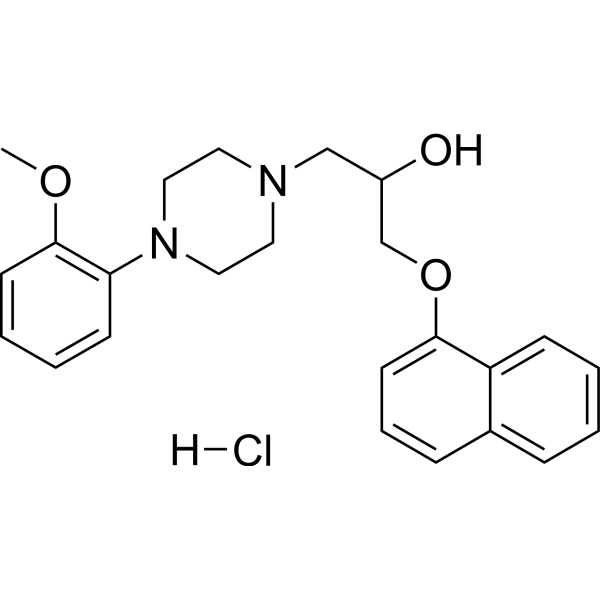
Naftopidil hydrochloride (KT-611 hydrochloride) is a selective alpha1-adrenoceptor antagonist, with Kis of 3.7 nM, 20 nM and 1.2 nM for the cloned human α1a-, α1b- and α1d-adrenoceptor subtypes, respectively. Naftopidil hydrochloride has antiproliferative effects. Naftopidil hydrochloride can be used for the research of prostate hyperplasia .
|
-
- HY-B0391A
-
|
KT-611 dihydrochloride; BM-15275 dihydrochloride
|
Adrenergic Receptor
|
Cancer
|
|
Naftopidil dihydrochloride (KT-611 dihydrochloride) is a selective alpha1-adrenoceptor antagonist, with Kis of 3.7 nM, 20 nM and 1.2 nM for the cloned human α1a-, α1b- and α1d-adrenoceptor subtypes, respectively. Naftopidil dihydrochloride has antiproliferative effects. Naftopidil dihydrochloride can be used for the research of prostate hyperplasia .
|
-
- HY-B0391
-
|
KT-611; BM-15275
|
Adrenergic Receptor
|
Cardiovascular Disease
Endocrinology
|
|
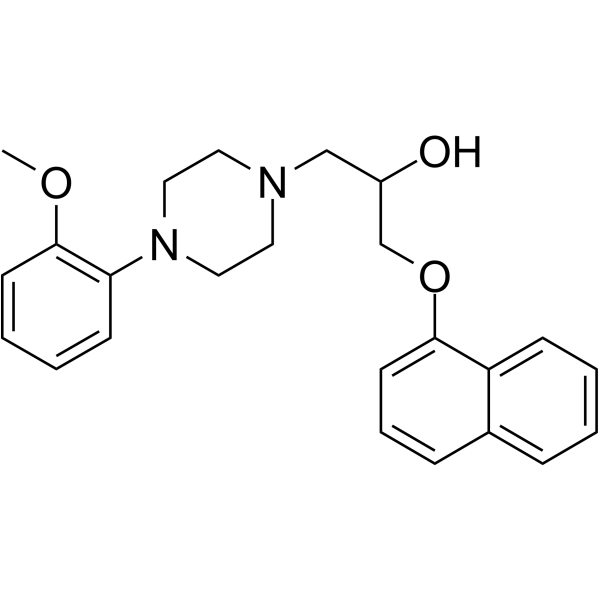
Naftopidil (KT-611) is is a selective alpha1-adrenoceptor antagonist, with Kis of 3.7 nM, 20 nM and 1.2 nM for the cloned human α1a-, α1b- and α1d-adrenoceptor subtypes, respectively. Naftopidil has antiproliferative effects. Naftopidil can be used for the research of prostate hyperplasia .
|
-
- HY-B0391S1
-
|
KT-611-d5; BM-15275-d5
|
Isotope-Labeled Compounds
Adrenergic Receptor
|
Cardiovascular Disease
Endocrinology
|
|
Naftopidil-d5 is deuterium labeled Naftopidil. Naftopidil (KT-611) is is a selective alpha1-adrenoceptor antagonist, with Kis of 3.7 nM, 20 nM and 1.2 nM for the cloned human α1a-, α1b- and α1d-adrenoceptor subtypes, respectively. Naftopidil has antiproliferative effects. Naftopidil can be used for the research of prostate hyperplasia .
|
-
- HY-B0391R
-
|
KT-611 (Standard); BM-15275 (Standard)
|
Reference Standards
Adrenergic Receptor
|
Cardiovascular Disease
Endocrinology
|
|
Naftopidil (Standard) is the analytical standard of Naftopidil. This product is intended for research and analytical applications. Naftopidil (KT-611) is is a selective alpha1-adrenoceptor antagonist, with Kis of 3.7 nM, 20 nM and 1.2 nM for the cloned human α1a-, α1b- and α1d-adrenoceptor subtypes, respectively. Naftopidil has antiproliferative effects. Naftopidil can be used for the research of prostate hyperplasia .
|
-
- HY-B0391S2
-
|
KT-611-d7; BM-15275-d7
|
Isotope-Labeled Compounds
Adrenergic Receptor
|
Cardiovascular Disease
Endocrinology
|
|
Naftopidil-d7 (KT-611-d7 ) is deuterium labeled Naftopidil. Naftopidil (KT-611) is is a selective alpha1-adrenoceptor antagonist, with Kis of 3.7 nM, 20 nM and 1.2 nM for the cloned human α1a-, α1b- and α1d-adrenoceptor subtypes, respectively. Naftopidil has antiproliferative effects. Naftopidil can be used for the research of prostate hyperplasia .
|
-
- HY-136474
-
|
(±)-Amidephrine
|
Adrenergic Receptor
|
Endocrinology
|
|
Amidephrine is a selective agonist of alpha 1-adrenoceptor. Amidephrine inhibits inhibits monopulse field contraction of the vas deferens epithelium and prostate gland .
|
-
- HY-19279A
-
|
|
Adrenergic Receptor
|
Endocrinology
|
|
JTH-601 Free base is a novel alpha1-adrenoceptor antagonist that exhibits potent activity in inhibiting phenylephrine-induced contractions in lower urinary tract tissues. JTH-601 Free base competitively antagonizes alpha1-adrenoceptor-mediated contractile responses, demonstrating greater potency than prazosin or tamsulosin. JTH-601 Free base is anticipated to be effective in treating urinary outlet obstruction associated with benign prostatic hyperplasia.
|
-
- HY-W009027
-
-
- HY-B0371D
-
|
|
Adrenergic Receptor
|
Endocrinology
|
|
(S)-Terazosin is an active S-enantiomer of Terazosin. (S)-Terazosin is a potent and high-affinity α-adrenoceptor antagonist with Ki values of 3.91 nM, 0.79 nM and 1.16 nM for α1a, α1b and α1d-adrenoceptor, respectively. (S)-Terazosin also has high-affinity for α2a, α2B and α2c-adrenoceptor with Ki values of 729 nM, 3.5 nM and 46.4 nM, respectively .
|
-
- HY-12760
-
-
- HY-U00237
-
-
- HY-134632
-
|
KMD-3241
|
Adrenergic Receptor
|
Cancer
|
|
Dehydro silodosin (KMD-3241) is a selective α1A-adrenoceptor antagonist used in the study of benign prostatic hyperplasia .
|
-
- HY-106465
-
-
- HY-P1442
-
|
|
Adrenergic Receptor
|
Cancer
|
|
AdTx1 is a selective α1A-adrenoceptor antagonist (Ki: 0.35 nM). AdTx1 can be used for research of benign prostatic hyperplasia .
|
-
- HY-W724254
-
|
|
Adrenergic Receptor
|
Endocrinology
|
|
SNAP-6201 is a selective α1a adrenoceptor antagonist with a Ki of 0.2 nM. SNAP-6201 exhibits >1400-fold selectivity over α1b and α1d adrenoceptors. SNAP-6201 exhibits excellent selectively to inhibit intraurethral pressure (IUP) in the anesthetized dog model. SNAP-6201 can be used for benign prostatic hyperplasia (BPH) research .
|
-
- HY-120296
-
-
- HY-105537
-
|
RS-100975
|
Adrenergic Receptor
|
Endocrinology
|
|
Ro 70-0004 (RS-100975) is a selective alpha1A-adrenoceptor antagonist with a pKi of 8.9. Ro 70‐0004 can be used in the study of prostatic hyperplasia .
|
-
- HY-12760R
-
-
- HY-137388A
-
|
p-Fluorohexahydrosiladifenidol hydrochloride
|
mAChR
Adrenergic Receptor
|
Cardiovascular Disease
Neurological Disease
Metabolic Disease
Cancer
|
|
p-F-HHSiD (p-Fluorohexahydrosiladifenidol) hydrochloride is a potent and selective M3 mAChR antagonist. p-F-HHSiD hydrochloride has antagonistic effects on other subtypes of the M receptor and the alpha1-adrenoceptor. p-F-HHSiD hydrochloride can be used for the researches of cancer, metabolic, neurological and cardiovascular disease such as, colon cancer, Alzheimer’s disease and diabetes .
|
-
- HY-137388
-
|
p-Fluorohexahydrosiladifenidol
|
mAChR
Adrenergic Receptor
|
Cardiovascular Disease
Neurological Disease
Metabolic Disease
Cancer
|
|
p-F-HHSiD (p-Fluorohexahydrosiladifenidol) is a potent and selective M3 mAChR antagonist. p-F-HHSiD has antagonistic effects on other subtypes of the M receptor and the alpha1-adrenoceptor. p-F-HHSiD can be used for the researches of cancer, metabolic, neurological and cardiovascular disease such as, colon cancer, Alzheimer’s disease and diabetes .
|
-
- HY-A0142
-
|
|
Adrenergic Receptor
|
Endocrinology
|
|
Dapiprazole is a potent, selective and orally active alpha-1 adrenoceptor antagonist. Dapiprazole suppresses the opioid withdrawal symptoms. Dapiprazole is also used as eye drops for reversing mydriasis .
|
-
- HY-A0142A
-
|
|
Adrenergic Receptor
|
Endocrinology
|
|
Dapiprazole hydrochloride is a potent, selective and orally active alpha-1 adrenoceptor antagonist. Dapiprazole hydrochloride suppresses the opioid withdrawal symptoms. Dapiprazole hydrochloride is also used as eye drops for reversing mydriasis .
|
-
- HY-119262
-
|
|
Adrenergic Receptor
|
Cardiovascular Disease
Endocrinology
|
|
ABT-866 is an α1A-adrenoceptor agonist and an antagonist at the α1B- and α1D-adrenoceptor subtypes. ABT-866 has an EC50 of 0.60 μM for the α1A in the rabbit urethra. ABT-866 has a pA2 value of 5.4 for the α1B in the rat spleen. ABT-866 has a pA2 value of 6.2 for the α1D in the rat aorta. ABT-866 exhibits good urethral selectivity and lower cardiovascular side effects in stress urinary incontinence models. ABT-866 can be used for the research of diseases such as stress urinary incontinence .
|
-
- HY-B0484
-
|
|
Adrenergic Receptor
|
Cardiovascular Disease
|
|
Buflomedil hydrochloride, a vasodilator agent, is an orally active α1A-adrenoceptor antagonist with Kis of 4.06 µM and 6.84 µM for α1A-AR and α1B-AR, respectively. Buflomedil hydrochloride can be used for the study of peripheral circulatory disorders .
|
-
- HY-B0484A
-
|
|
Adrenergic Receptor
|
Cardiovascular Disease
|
|
Buflomedil, a vasodilator agent, is an orally active α1A-adrenoceptor antagonist with Kis of 4.06 µM and 6.84 µM for α1A-AR and α1B-AR, respectively. Buflomedil can be used for the study of peripheral circulatory disorders .
|
-
- HY-135270
-
-
- HY-P5846
-
|
MT3
|
mAChR
Adrenergic Receptor
|
Neurological Disease
|
|
Muscarinic toxin 3 (MT3) is a potent and non-competitive mAChR and adrenoceptors antagonist with pIC50s of 6.71, 8.79, 8.86, 7.57, 8.13, 8.49, <6.5, 7.29 against M1, M4, α1A, α1B, α1D,α2A,α2B and α2C receptors, respectively. Muscarinic toxin 3 displays prominent adrenoceptor activity .
|
-
- HY-106418A
-
|
|
Adrenergic Receptor
5-HT Receptor
|
Cardiovascular Disease
|
|
SGB-1534 hydrochloride is an orally active, selective and competitive antagonist of the alpha 1-adrenoceptor and the 5-HT2 receptor. SGB-1534 hydrochloride can inhibit vasoconstriction and lower blood pressure. SGB-1534 hydrochloride can be used for the research of cardiovascular disease, such as hypertension .
|
-
- HY-103209
-
|
|
Adrenergic Receptor
|
Cardiovascular Disease
Endocrinology
|
|
Rec 15/2615 hydrochloride is a potent and selective α-1B adrenoceptor antagonist with Ki values of 1.9 nM, 0.3 nM, 2.6 nM for α1A, α1B, α1D, respectively. Rec 15/2615 hydrochloride modulates vaginal smooth muscle contractility and genital engorgement .
|
-
- HY-129427
-
|
|
Adrenergic Receptor
|
Cardiovascular Disease
|
|
DC-015 is a selective and orally active alpha 1-adrenoceptor antagonist on plasma lipid and vascular reactivity in hyperlipidaemic rodent model. DC-015 is a synthesized quinazoline derivative. DC-015 decreases mean arterial pressure in rats. DC-015 has antihypertensive activity .
|
-
- HY-123514
-
|
|
Adrenergic Receptor
Dopamine Receptor
5-HT Receptor
|
Others
|
|
SNAP8719 free base is a selective α1D-adrenoceptor antagonist (pKi = 8.89). SNAP8719 free base shows affinity for the dopamine D2-, 5-HT1A-, and the human clonal α2a-adrenoceptor, with pKi values of 5.98, 6.47, and <5.0, respectively. SNAP8719 free base causes a concentration-dependent increase in the twitch response .
|
-
- HY-103204
-
|
|
Adrenergic Receptor
|
Endocrinology
|
|
RS100329 hydrochloride is a potent and selective α1A-adrenoceptor antagonist with pKi values of 9.6, 7.9 and 7.5 for α1A, α1D, and α1B, respectively. RS100329 hydrochloride inhibits reflex urethral contractions. RS100329 hydrochloride can be used in research of benign prostatic hyperplasia .
|
-
- HY-101336
-
-
- HY-B0702
-
|
|
Adrenergic Receptor
|
Cardiovascular Disease
Neurological Disease
|
|
Nicergoline, an ergoline derivative ester of bromonicotinic acid, is a potent, selective and orally active antagonist of α1A-adrenoceptor. Nicergoline has vasodilator effects. Nicergoline also has ameliorative effects on cognitive function in mouse models of Alzheimer's disease .
|
-
- HY-135488
-
|
|
Adrenergic Receptor
|
Cardiovascular Disease
|
|
A 131701 is a selective α1a- (Ki: 0.22 nM for human α1a) and α1d-adrenoceptor antagonist. A 131701 antagonizes epinephrine-induced increases in intraurethral pressure (IUP). A 131701 causes transient decreases in mean arterial blood pressure (MABP) and transient tachycardia. A 131701 can be used in the research of spontaneous hypertension .
|
-
- HY-44667
-
|
|
Adrenergic Receptor
Drug Metabolite
|
Others
|
|
Deacetylmoxisylyte is an orally active metabolite in plasma of the prodrug Moxisylyte. Deacetylmoxisylyte exhibits similar affinity and selectivity for rabbit corpus cavernosum and urethra. Deacetylmoxisylyte has IC50 values of 400 and 1200 nM for alpha-1 and alpha-2 adrenoceptors .
|
-
- HY-A0142AR
-
|
|
Adrenergic Receptor
Reference Standards
|
Endocrinology
|
|
Dapiprazole (hydrochloride) (Standard) is the analytical standard of Dapiprazole (hydrochloride). This product is intended for research and analytical applications. Dapiprazole hydrochloride is a potent, selective and orally active alpha-1 adrenoceptor antagonist. Dapiprazole hydrochloride suppresses the opioid withdrawal symptoms. Dapiprazole hydrochloride is also used as eye drops for reversing mydriasis .
|
-
- HY-120296R
-
|
|
Adrenergic Receptor
Reference Standards
|
Cardiovascular Disease
|
|
5-Methylurapidil (Standard) is the analytical standard of 5-Methylurapidil. This product is intended for research and analytical applications. 5-Methylurapidil isα1A‐adrenoceptor antagonist. 5-Methylurapidil can be used for the research of cardiovascular diseases such as hypertension and heart failure .
|
-
- HY-B0484R
-
|
|
Reference Standards
Adrenergic Receptor
|
Cardiovascular Disease
|
|
Buflomedil hydrochloride (Standard) is the analytical standard of Buflomedil hydrochloride (HY-B0484). This product is intended for research and analytical applications. Buflomedil hydrochloride (Standard), a vasodilator agent, is an orally active α1A-adrenoceptor antagonist with Kis of 4.06 µM and 6.84 µM for α1A-AR and α1B-AR, respectively. Buflomedil hydrochloride can be used for the study of peripheral circulatory disorders .
|
-
- HY-103204R
-
|
|
Reference Standards
Adrenergic Receptor
|
Endocrinology
|
|
RS100329 hydrochloride (Standard) is the analytical standard of RS100329 hydrochloride (HY-103204). This product is intended for research and analytical applications. RS100329 hydrochloride is a potent and selective α1A-adrenoceptor antagonist with pKi values of 9.6, 7.9 and 7.5 for α1A, α1D, and α1B, respectively. RS100329 hydrochloride inhibits reflex urethral contractions. RS100329 hydrochloride can be used in research of benign prostatic hyperplasia .
|
-
- HY-B0702R
-
|
|
Reference Standards
Adrenergic Receptor
|
Cardiovascular Disease
Neurological Disease
|
|
Nicergoline (Standard) is the analytical standard of Nicergoline. This product is intended for research and analytical applications. Nicergoline, an ergoline derivative ester of bromonicotinic acid, is a potent, selective and orally active antagonist of α1A-adrenoceptor. Nicergoline has vasodilator effects. Nicergoline also has ameliorative effects on cognitive function in mouse models of Alzheimer's disease .
|
-
- HY-100554
-
|
|
Adrenergic Receptor
5-HT Receptor
|
Cardiovascular Disease
|
|
BMY 7378 is a selective antagonist of α1D-adrenoceptor (α1D-AR). BMY 7378 binds to membranes expressing the cloned rat α1D-AR with a >100-fold higher affinity (Ki=2 nM) than binding to either the cloned rat α1A-AR (Ki=800 nM) or the hamster α1B-AR (Ki=600 nM). BMY 7378 is a 5-HT1A receptor partial agonist .
|
-
- HY-B0702S
-
|
|
Isotope-Labeled Compounds
Adrenergic Receptor
|
Cardiovascular Disease
Neurological Disease
|
|
Nicergoline- 13C,d3 is the 13C- and deuterium labeled Nicergoline. Nicergoline, an ergoline derivative ester of bromonicotinic acid, is a potent, selective and orally active antagonist of α1A-adrenoceptor. Nicergoline has vasodilator effects. Nicergoline also has ameliorative effects on cognitive function in mouse models of Alzheimer's disease .
|
-
- HY-W743952
-
|
|
Isotope-Labeled Compounds
Adrenergic Receptor
|
Neurological Disease
|
|
Nicergoline-d3 is the deuterium labeled Nicergoline (HY-B0702). Nicergoline, an ergoline derivative ester of bromonicotinic acid, is a potent, selective and orally active antagonist of α1A-adrenoceptor. Nicergoline has vasodilator effects. Nicergoline also has ameliorative effects on cognitive function in mouse models of Alzheimer's disease .
|
-
- HY-103202A
-
|
|
Adrenergic Receptor
|
Cardiovascular Disease
|
|
SNAP5089 is a selective α1A-adrenoceptor antagonist with over 1700-fold selectivity for the α1A subtype, which may have implications for the treatment of hypertension and benign prostatic hypertrophy. SNAP5089 demonstrates significant receptor affinity compared to other clinical drugs, emphasizing its potential therapeutic advantages. SNAP5089's high affinity aligns with its suitability for conditions where precise α1A modulation is desirable.
|
-
- HY-116982
-
|
|
Adrenergic Receptor
5-HT Receptor
|
|
|
BMY 7378 (free base) is a selective antagonist of α1D-adrenoceptor (α1D-AR). BMY 7378 (free base) binds to membranes expressing the cloned rat α1D-AR with a >100-fold higher affinity (Ki=2 nM) than binding to either the cloned rat α1A-AR (Ki=800 nM) or the hamster α1B-AR (Ki=600 nM). BMY 7378 (free base) is a 5-HT1A receptor partial agonist .
|
-
- HY-100554R
-
|
|
Adrenergic Receptor
Reference Standards
5-HT Receptor
|
Cardiovascular Disease
|
|
BMY 7378 (Standard) is the analytical standard of BMY 7378 (HY-100554). This product is intended for research and analytical applications. BMY 7378 is a selective antagonist of α1D-adrenoceptor (α1D-AR). BMY 7378 binds to membranes expressing the cloned rat α1D-AR with a >100-fold higher affinity (Ki=2 nM) than binding to either the cloned rat α1A-AR (Ki=800 nM) or the hamster α1B-AR (Ki=600 nM). BMY 7378 is a 5-HT1A receptor partial agonist .
|
-
- HY-U00237B
-
|
|
Adrenergic Receptor
|
Others
|
|
L-771688 hydrochloride is a potent and highly selective α1A-adrenoceptor antagonist (Kd=43-90 pM). L-771688 hydrochloride is effective against cloned human, rat and dog α1A-adrenergic receptors. L-771688 exhibits high affinity (Ki ≤ 1 nM) and over 500-fold selectivity over the α1B and α1D isoforms. L-771688 potently antagonizes norepinephrine-induced responses at these receptors. Inhibits contractions induced by phenylephrine or A-61603 in rat, dog, human and monkey models .
|
-
- HY-101336R
-
|
RS-17053 (Standard)
|
Adrenergic Receptor
Reference Standards
|
Metabolic Disease
Endocrinology
|
|
RS 17053 hydrochloride (Standard) is the analytical standard of RS 17053 hydrochloride (HY-101336). This product is intended for research and analytical applications. RS 17053 hydrochloride is a potent and selective α1A adrenoceptor antagonist, with a pKi value of 9.1 in native cell membrane and a pA2 value of 9.8 in functional assays.
|
-
- HY-148252
-
|
|
Adrenergic Receptor
|
Endocrinology
|
|
ADRA1D receptor antagonist 1 (free base) (compound (R)-9s) is an orally active, potent and selective human α1D-adrenoceptor (α1D-AR) antagonist (Ki=1.6 nM). ADRA1D receptor antagonist 1 (free base) dose-dependently inhibits bladder contraction with an IC30 value of 15 nM. ADRA1D receptor antagonist 1 (free base) can be used in studies of overactive bladder disorders such as urinary urgency, frequency and incontinence.
|
-
- HY-B1371A
-
|
Spiroperidol hydrochloride
|
Dopamine Receptor
5-HT Receptor
Adrenergic Receptor
Chloride Channel
|
Neurological Disease
Inflammation/Immunology
|
|
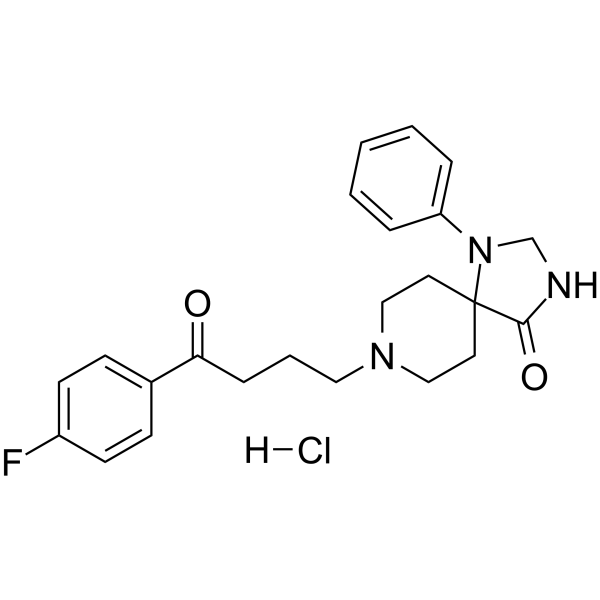
Spiperone hydrochloride (Spiroperidol hydrochloride) is a selective dopamine D2 receptor (Ki values of 0.06 nM, 0.6 nM, 0.08 nM, ~350 nM, ~3500 nM for D2, D3, D4, D1 and D5 receptors, respectively) and 5-HT2A/5-HT1A receptor (Kis of 1 nM/49 nM) antagonist. Spiperone hydrochloride is also a selective α1B-adrenoceptor antagonist. Spiperone hydrochloride activates calcium-activated chloride channel (CaCC). Antipsychotic and anti-inflammatory activities .
|
-
- HY-137055
-
|
|
Others
|
Others
|
|
PF-3774076 is a highly central nervous system (CNS) penetrant, potent, and selective human α1A-adrenoceptor partial agonist. It exhibits good potency and selectivity in multiple binding and functional assays. PF-3774076 increases peak urethral pressure in anesthetized female dogs in a dose-dependent manner via a central mechanism. PF-3774076 affects both the proximal and distal portions of the urethra in vivo. These properties suggest that PF-3774076 may have significant benefit in the treatment of stress urinary incontinence (SUI) as a CNS-penetrant α1A receptor partial agonist. However, despite its partial agonism and selectivity for α1A receptors, PF-3774076 failed to provide adequate safety differences in in vivo models of cardiovascular function. This may be due to the simultaneous activation of both peripheral and central α1A receptors. These data suggest that while central α1A partial agonists may have significant benefit in the treatment of SUI, this class of agents may have difficulty achieving the desired urethral selectivity without affecting cardiovascular function.
|
-
- HY-130418
-
|
|
Adrenergic Receptor
|
Cancer
|
|
(-)-Domesticine is an anti-α-1D-adrenoceptor compound with cytotoxic activity. (-)-Domesticine showed activity in MTS cytotoxicity assays against human colon cancer cell lines HCT-116 and Caco-2. (-)-Domesticine tolerates alkoxy substituents and benzoate functional groups at the C1 position in modifications of its chemical structure. The most potent compounds of (-)-Domesticine have IC50 values in the range of 23-38 μM, similar to the known cytotoxic compound etoposide .
|
-
- HY-181774
-
|
|
Phosphodiesterase (PDE)
|
Endocrinology
|
|
PDE4/5-IN-1 is a selective phosphodiesterase 4/5 (PDE4/5) dual inhibitor. PDE4/5-IN-1 functionally inhibits PDE5, PDE4B2, and PDE4D2 activity. PDE4/5-IN-1 relaxes isolated rat prostate tissue, enhances nitric oxide-induced relaxation in isolated rat prostate tissue, and reduces alpha-1 adrenoceptor-mediated contractile responses in isolated rat prostate tissue. PDE4/5-IN-1 inhibits proliferation of human hyperplastic prostate cells. PDE4/5-IN-1 can be used for the research of benign prostatic hyperplasia .
|
-
- HY-103100
-
|
|
5-HT Receptor
Epigenetic Reader Domain
Akt
Ribosomal S6 Kinase (RSK)
FOXO
|
Neurological Disease
Metabolic Disease
Inflammation/Immunology
Cancer
|
|
SB-699551 is a selective and brain penetrant 5-HT5A receptor antagonist with a pKi of 8.2 nM. SB-699551 shows high selectivity over most other 5-HT receptor subtypes, dopamine receptors, and α1B adrenoceptor. SB-699551 disrupts Gαi/o-coupled and PI3K/AKT/mTOR signaling pathways, alters CREB, ATF1, AKT, PRAS40, S6K, and FOXO1 phosphorylation in breast tumor cells. SB-699551 can be used for the research of anxiety, breast cancer, and Alzheimer's disease .
|
-
- HY-136700
-
|
|
5-HT Receptor
Akt
|
Neurological Disease
Cancer
|
|
SB-699551 free base is a selective and brain penetrant 5-HT5A receptor antagonist with a pKi of 8.2 nM. SB-699551 free base shows high selectivity over most other 5-HT receptor subtypes, dopamine receptors, and α1B adrenoceptor. SB-699551 free base disrupts Gαi/o-coupled and PI3K/AKT/mTOR signaling pathways, alters CREB, ATF1, AKT, PRAS40, S6K, and FOXO1 phosphorylation in breast tumor cells. SB-699551 free base can be used for the research of anxiety, breast cancer, and Alzheimer's disease .
|
-
| Cat. No. |
Product Name |
Type |
-
- HY-D1606
-
|
|
Fluorescent Dyes
|
|
BODIPY FL prazosin is a fluorescent α1-adrenergic antagonist with Ki values of 14.5, 43.3 nM for α1a-AR and α1b-AR, respectively. BODIPY FL prazosin also is a fluorescent ligand with the excitation and emission wavelengths are 485 and 535 nm, respectively. BODIPY FL prazosin can be used for study the differences in the subcellular localization of α1-adrenoceptor subtypes .
|
| Cat. No. |
Product Name |
Target |
Research Area |
-
- HY-P1442
-
|
|
Adrenergic Receptor
|
Cancer
|
|
AdTx1 is a selective α1A-adrenoceptor antagonist (Ki: 0.35 nM). AdTx1 can be used for research of benign prostatic hyperplasia .
|
-
- HY-P5846
-
|
MT3
|
mAChR
Adrenergic Receptor
|
Neurological Disease
|
|
Muscarinic toxin 3 (MT3) is a potent and non-competitive mAChR and adrenoceptors antagonist with pIC50s of 6.71, 8.79, 8.86, 7.57, 8.13, 8.49, <6.5, 7.29 against M1, M4, α1A, α1B, α1D,α2A,α2B and α2C receptors, respectively. Muscarinic toxin 3 displays prominent adrenoceptor activity .
|
| Cat. No. |
Product Name |
Category |
Target |
Chemical Structure |
| Cat. No. |
Product Name |
Chemical Structure |
-
- HY-B0371S
-
|
|
|
Terazosin-d8 is deuterium labeled Terazosin. Terazosin is a quinazoline derivative and a competitive and orally active α1-adrenoceptor antagonist. Terazosin works by relaxing blood vessels and the opening of the bladder. Terazosin has the potential for benign prostatic hyperplasia (BPH) and high blood pressure treatment .
|
-
-
- HY-B0471S
-
|
|
|
Phenylephrine-d3 (hydrochloride) is the deuterium labeled Phenylephrine hydrochloride. (R)-(-)-Phenylephrine hydrochloride is a selective α1-adrenoceptor agonist with pKis of 5.86, 4.87 and 4.70 for α1D, α1B and α1A receptors respectively.
|
-
-
- HY-B0471S1
-
|
|
|
Phenylephrine-2,4,6-d3 (hydrochloride) is the deuterium labeled Phenylephrine hydrochloride. (R)-(-)-Phenylephrine hydrochloride is a selective α1-adrenoceptor agonist with pKis of 5.86, 4.87 and 4.70 for α1D, α1B and α1A receptors respectively.
|
-
-
- HY-17034AS
-
|
|
|
Dexmedetomidine- 13C,d3 (hydrochloride) is the 13C- and deuterium labeled Dexmedetomidine (hydrochloride). Dexmedetomidine hydrochloride ((+)-Medetomidine hydrochloride) is a potent, selective and orally active agonist of α2-adrenoceptor, with a Ki of 1.08 nM. Dexmedetomidine hydrochloride shows 1620-fold selectivity against α1-adrenoceptor. Dexmedetomidine hydrochloride exhibits anxiolysis, sedation, and modest analgesia effects .
|
-
-
- HY-12987S
-
|
|
|
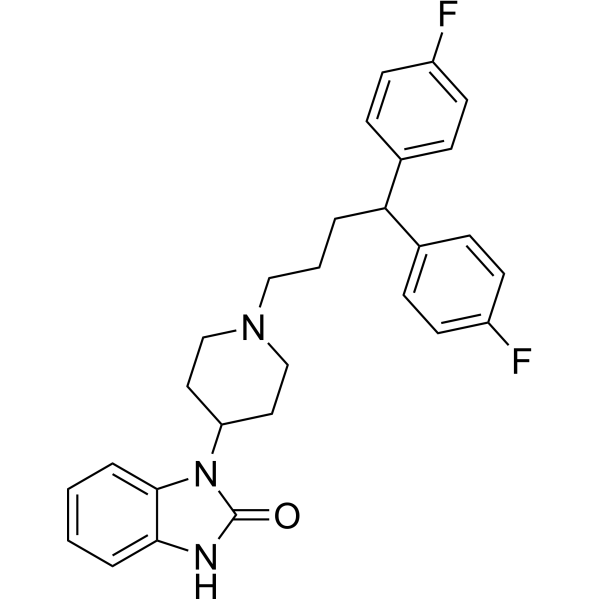
Pimozide-d4 is a deuterium labeled Pimozide. Pimozide is a dopamine receptor antagonist, with Kis of 1.4 nM, 2.5 nM and 588 nM for dopamine D2, D3 and D1 receptors, respectively, and also has affinity at α1-adrenoceptor, with a Ki of 39 nM; Pimozide also inhibits STAT3 and STAT5 .
|
-
-
- HY-12987S1
-
|
|
|
Pimozide-d5 N-Oxide is the deuterium labeled Pimozide. Pimozide is a dopamine receptor antagonist, with Kis of 1.4 nM, 2.5 nM and 588 nM for dopamine D2, D3 and D1 receptors, respectively, and also has affinity at α1-adrenoceptor, with a Ki of 39 nM; Pimozide also inhibits STAT3 and STAT5 .
|
-
-
- HY-B0471S3
-
|
|
|
Phenylephrine-d6 (hydrochloride) is deuterium labeled Phenylephrine (hydrochloride). (R)-(-)-Phenylephrine hydrochloride is a selective α1-adrenoceptor agonist with pKis of 5.86, 4.87 and 4.70 for α1D, α1B and α1A receptors respectively.
|
-
-
- HY-B0471S2
-
|
|
|
(S)-Phenylephrine-d6 (hydrochloride) is deuterium labeled Phenylephrine (hydrochloride). (R)-(-)-Phenylephrine hydrochloride is a selective α1-adrenoceptor agonist with pKis of 5.86, 4.87 and 4.70 for α1D, α1B and α1A receptors respectively.
|
-
-
- HY-15746S
-
|
|
|
(rac)-Dobutamine-d4 (hydrochloride) is a labelled racemic Dobutamine hydrochloride. Dobutamine hydrochloride is a synthetic catecholamine that acts on α1-AR, β1-AR, β2-AR (α-1, β-1 andβ-2 adrenoceptors). Dobutamine hydrochloride is a selective β1-AR agonist, relatively weak activity at α1-AR and β2-AR. Dobutamine hydrochloride can increase cardiac output and correct hypoperfusion .
|
-
-
- HY-15746S1
-
|
|
|
(rac)-Dobutamine-d6 (hydrochloride) is a labelled racemic Dobutamine hydrochloride. Dobutamine hydrochloride is a synthetic catecholamine that acts on α1-AR, β1-AR, β2-AR (α-1, β-1 andβ-2 adrenoceptors). Dobutamine hydrochloride is a selective β1-AR agonist, relatively weak activity at α1-AR and β2-AR. Dobutamine hydrochloride can increase cardiac output and correct hypoperfusion .
|
-
-
- HY-B0192S
-
|
|
|
Alfuzosin-d7 is the deuterium labeled Alfuzosin . Alfuzosin (SL 77499-10) is an orally active, selective and competitive α1-adrenoceptor antagonist. Alfuzosin relaxes the muscles of the prostate and bladder neck, aiding in urination. Alfuzosin can be used in study of benign prostatic hyperplasia (BPH) .
|
-
-
- HY-118335S
-
|
|
|
Prazobind-d8 (SZL 49-d8) is the deuterium labeled Prazobind (HY-118335). Prazobind, a prazosin analog, is an irreversible α1-adrenoceptor antagonist. Prazobind competes for alpha 1-adrenoceptor binding sites with a similar potency (IC50 of 1 nM) in tissues enriched in both the alpha 1A (hippocampus) and alpha 1B (liver) subtypes. Prazobind partially inhibits the contractions of circular muscles, longitudinal muscles and smooth muscles of the spleen. Prazobind can be used for the study of blood pressure.
|
-
-
- HY-12987S2
-
|
|
|
Pimozide-d4-1 is the deuterium labeled Pimozide. Pimozide is a dopamine receptor antagonist, with Kis of 1.4 nM, 2.5 nM and 588 nM for dopamine D2, D3 and D1 receptors, respectively, and also has affinity at α1-adrenoceptor, with a Ki of 39 nM; Pimozide also inhibits STAT3 and STAT5 .
|
-
-
- HY-B0192S3
-
|
|
|
Alfuzosin-d6 (SL 77499-d6) is deuterium labeled Alfuzosin. Alfuzosin (SL 77499-10) is an orally active, selective and competitive α1-adrenoceptor antagonist. Alfuzosin relaxes the muscles of the prostate and bladder neck, aiding in urination. Alfuzosin can be used in study of benign prostatic hyperplasia (BPH) .
|
-
-
- HY-B0192S3A
-
|
|
|
Alfuzosin (hydrochloride)-d6 (SL 77499-10-d6) is deuterium labeled Alfuzosin (hydrochloride). Alfuzosin (SL 77499-10) hydrochloride is an orally active, selective and competitive α1-adrenoceptor antagonist. Alfuzosin hydrochloride relaxes the muscles of the prostate and bladder neck, aiding in urination. Alfuzosin hydrochloride can be used in study of benign prostatic hyperplasia (BPH) .
|
-
-
- HY-W704363
-
|
|
|
Pimozide-d5 (R6238-d5) is the deuterium labeled Pimozide (HY-12987). Pimozide is a dopamine receptor antagonist, with Kis of 1.4 nM, 2.5 nM and 588 nM for dopamine D2, D3 and D1 receptors, respectively, and also has affinity at α1-adrenoceptor, with a Ki of 39 nM; Pimozide also inhibits STAT3 and STAT5.
|
-
-
- HY-B1658BS
-
|
|
|
Frovatriptan-d3 (succinate) is deuterium labeled Frovatriptan (succinate). Frovatriptan succinate ((R)-Frovatriptan succinate) is a potent, high affinity, selective and orally active 5-HT1B (pK50 of 8.2) and 5-HT1D receptor agonist. Frovatriptan succinate exhibits >10-fold selectivity for 5-HT1B and 5-HT1D over 5-HT1A, 5-HT1F, and 5-HT7 and >1000-fold selectivity over other 5-HT, dopamine, histamine H1, and α1-adrenoceptor. Frovatriptan succinate has the potential for migraine research .
|
-
-
- HY-B0391S1
-
|
|
|
Naftopidil-d5 is deuterium labeled Naftopidil. Naftopidil (KT-611) is is a selective alpha1-adrenoceptor antagonist, with Kis of 3.7 nM, 20 nM and 1.2 nM for the cloned human α1a-, α1b- and α1d-adrenoceptor subtypes, respectively. Naftopidil has antiproliferative effects. Naftopidil can be used for the research of prostate hyperplasia .
|
-
-
- HY-B0391S2
-
|
|
|
Naftopidil-d7 (KT-611-d7 ) is deuterium labeled Naftopidil. Naftopidil (KT-611) is is a selective alpha1-adrenoceptor antagonist, with Kis of 3.7 nM, 20 nM and 1.2 nM for the cloned human α1a-, α1b- and α1d-adrenoceptor subtypes, respectively. Naftopidil has antiproliferative effects. Naftopidil can be used for the research of prostate hyperplasia .
|
-
-
- HY-B0702S
-
|
|
|
Nicergoline- 13C,d3 is the 13C- and deuterium labeled Nicergoline. Nicergoline, an ergoline derivative ester of bromonicotinic acid, is a potent, selective and orally active antagonist of α1A-adrenoceptor. Nicergoline has vasodilator effects. Nicergoline also has ameliorative effects on cognitive function in mouse models of Alzheimer's disease .
|
-
-
- HY-W743952
-
|
|
|
Nicergoline-d3 is the deuterium labeled Nicergoline (HY-B0702). Nicergoline, an ergoline derivative ester of bromonicotinic acid, is a potent, selective and orally active antagonist of α1A-adrenoceptor. Nicergoline has vasodilator effects. Nicergoline also has ameliorative effects on cognitive function in mouse models of Alzheimer's disease .
|
-
Your information is safe with us. * Required Fields.
Inquiry Information
- Product Name:
- Cat. No.:
- Quantity:
- MCE Japan Authorized Agent:

